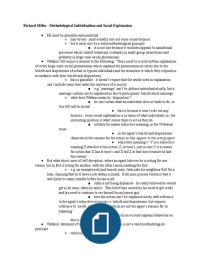
Richard Miller - Methodological Individualism and Social Explanation
● MI must be plausible and nontrivial
○ non-trivial - must actually rule out some social theories
○ but it must also be a valid methodological principle
■ it is not one because it excludes appeals to nonrational
processes which control behaviour (certainly in small group interactions and
probably in large scale social phenomena)
● Watkins’ MI seems to amount to the following: ‘There must be a rock-bottom explanation
of every large-scale social phenomenon which explains the phenomenon as solely due to the
beliefs and dispositions of actual or typical individuals and the situations to which they respond in
accordance with their beliefs and dispositions.’
○ this is plausible - it doesn’t require that the words used in explanation
can’t include terms that entail the existence of a society
■ e.g. ‘marriage’ can’t be defined individualistically, but a
marriage custom can be explained as due to participants’ beliefs about marriage
○ what does Watkins mean by ‘disposition’?
■ he can’t mean what an individual does or tends to do, or
else MI will be trivial
● this is because it won’t rule out any
theories - every social explanation is in terms of what individuals do; the
interesting question is what causes them to act as they do
■ actually he means subjective meaning, in the Weberian
sense
● so the agent’s beliefs and dispositions
characterise the reasons for the action as they appear to the acting agent
● subjective meaning = ‘Y is a subjective
meaning X attaches to his action, Z, at time t, just in case Y is a reason
for action that X has at time t, and X did Z at that time because he had
this reason’
● But what about cases of self-deception, where an agent believes he is acting for one
reason, but in fact is acting for another, with the other reason masking the first
○ e.g. an unemployed (and honest) man, John asks his neighbour Bill for a
loan, claiming that he’ll have a job within a month. Both men possess evidence that it
will likely be many months before he has a job.
■ John is not being dishonest - he really believed he would
get a job soon, when he said it. This belief was caused by his need to get credit
and his need to continue to see himself as an honest guy
■ here the action can’t be explained solely with reference
to the agent’s subjective meaning i.e. beliefs and dispositions, but requires
reference to ‘needs, goals or desires which are not the agent’s reasons for so
behaving’
● such an account explains behaviour as
due to objective interests
● Watkins’ statement of methodological individualism is not a valid methodological
principle
○ valid methodological principle:
● MI must be plausible and nontrivial
○ non-trivial - must actually rule out some social theories
○ but it must also be a valid methodological principle
■ it is not one because it excludes appeals to nonrational
processes which control behaviour (certainly in small group interactions and
probably in large scale social phenomena)
● Watkins’ MI seems to amount to the following: ‘There must be a rock-bottom explanation
of every large-scale social phenomenon which explains the phenomenon as solely due to the
beliefs and dispositions of actual or typical individuals and the situations to which they respond in
accordance with their beliefs and dispositions.’
○ this is plausible - it doesn’t require that the words used in explanation
can’t include terms that entail the existence of a society
■ e.g. ‘marriage’ can’t be defined individualistically, but a
marriage custom can be explained as due to participants’ beliefs about marriage
○ what does Watkins mean by ‘disposition’?
■ he can’t mean what an individual does or tends to do, or
else MI will be trivial
● this is because it won’t rule out any
theories - every social explanation is in terms of what individuals do; the
interesting question is what causes them to act as they do
■ actually he means subjective meaning, in the Weberian
sense
● so the agent’s beliefs and dispositions
characterise the reasons for the action as they appear to the acting agent
● subjective meaning = ‘Y is a subjective
meaning X attaches to his action, Z, at time t, just in case Y is a reason
for action that X has at time t, and X did Z at that time because he had
this reason’
● But what about cases of self-deception, where an agent believes he is acting for one
reason, but in fact is acting for another, with the other reason masking the first
○ e.g. an unemployed (and honest) man, John asks his neighbour Bill for a
loan, claiming that he’ll have a job within a month. Both men possess evidence that it
will likely be many months before he has a job.
■ John is not being dishonest - he really believed he would
get a job soon, when he said it. This belief was caused by his need to get credit
and his need to continue to see himself as an honest guy
■ here the action can’t be explained solely with reference
to the agent’s subjective meaning i.e. beliefs and dispositions, but requires
reference to ‘needs, goals or desires which are not the agent’s reasons for so
behaving’
● such an account explains behaviour as
due to objective interests
● Watkins’ statement of methodological individualism is not a valid methodological
principle
○ valid methodological principle: