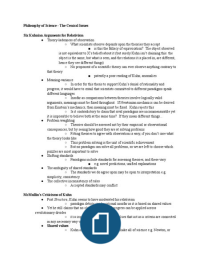
Philosophy of Science - The Central Issues
Six Kuhnian Arguments for Relativism
● Theory-ladenness of observation
○ What scientists observe depends upon the theories they accept
■ is this the fallacy of equivocation? The object observed
is not equivalent to X’s beliefs about it (but surely Kuhn isn’t claiming this: the
object is the same, but what is seen, and the relations it is placed in, are different,
hence they see different things)
○ No proponent of a scientific theory can ever observe anything contrary to
that theory
■ patently a poor reading of Kuhn; anomalies
● Meaning-variance
○ In order for this thesis to support Kuhn’s denial of rationality and
progress, it would have to entail that scientists committed to different paradigms speak
different languages
○ Insofar as comparisons between theories involve logically valid
arguments, meanings must be fixed throughout. If Newtonian mechanics can be derived
from Einstein’s mechanics, then meaning must be fixed. Kuhn rejects this
○ Is it contradictory to claim that rival paradigms are incommensurable yet
it is impossible to believe both at the same time? If they mean different things...
● Problem weighting
○ Theories should be assessed not by their empirical or observational
consequences, but by seeing how good they are at solving problems
○ Fitting theories to agree with observation is easy, if you don’t care what
the theory looks like
○ Thus problem solving is the unit of scientific achievement
○ But no paradigm can solve all problems, so we are left to choose which
puzzles are most important to solve
● Shifting standards
○ Paradigms include standards for assessing theories, and these vary
■ e.g. novel predictions, unified explanations
● The ambiguity of shared standards
○ The standards we do agree upon may be open to interpretation e.g.
simplicity, consistency
● The collective inconsistency of rules
○ Accepted standards may conflict
McMullin’s Criticisms of Kuhn
● Post Structure, Kuhn seems to have moderated his relativism
○ paradigm debate can be rational insofar as it is based on shared values
● Yet he still claims that no objective notion of progress can be applied across
revolutionary divides
○ it is impossible to show that the values that act as a criteria are connected
in any necessary way with truth or verisimilitude
● Shared values
○ Kuhn allows that revolutions can shake all of science e.g. Newton, or
Six Kuhnian Arguments for Relativism
● Theory-ladenness of observation
○ What scientists observe depends upon the theories they accept
■ is this the fallacy of equivocation? The object observed
is not equivalent to X’s beliefs about it (but surely Kuhn isn’t claiming this: the
object is the same, but what is seen, and the relations it is placed in, are different,
hence they see different things)
○ No proponent of a scientific theory can ever observe anything contrary to
that theory
■ patently a poor reading of Kuhn; anomalies
● Meaning-variance
○ In order for this thesis to support Kuhn’s denial of rationality and
progress, it would have to entail that scientists committed to different paradigms speak
different languages
○ Insofar as comparisons between theories involve logically valid
arguments, meanings must be fixed throughout. If Newtonian mechanics can be derived
from Einstein’s mechanics, then meaning must be fixed. Kuhn rejects this
○ Is it contradictory to claim that rival paradigms are incommensurable yet
it is impossible to believe both at the same time? If they mean different things...
● Problem weighting
○ Theories should be assessed not by their empirical or observational
consequences, but by seeing how good they are at solving problems
○ Fitting theories to agree with observation is easy, if you don’t care what
the theory looks like
○ Thus problem solving is the unit of scientific achievement
○ But no paradigm can solve all problems, so we are left to choose which
puzzles are most important to solve
● Shifting standards
○ Paradigms include standards for assessing theories, and these vary
■ e.g. novel predictions, unified explanations
● The ambiguity of shared standards
○ The standards we do agree upon may be open to interpretation e.g.
simplicity, consistency
● The collective inconsistency of rules
○ Accepted standards may conflict
McMullin’s Criticisms of Kuhn
● Post Structure, Kuhn seems to have moderated his relativism
○ paradigm debate can be rational insofar as it is based on shared values
● Yet he still claims that no objective notion of progress can be applied across
revolutionary divides
○ it is impossible to show that the values that act as a criteria are connected
in any necessary way with truth or verisimilitude
● Shared values
○ Kuhn allows that revolutions can shake all of science e.g. Newton, or