Rush Rhees - Discussions of Wittgenstein
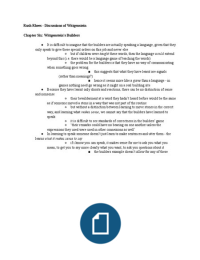
Chapter Six: Wittgenstein’s Builders
● It is difficult to imagine that the builders are actually speaking a language, given that they
only speak to give these special orders on this job and never else
○ but if children were taught these words, then the language would extend
beyond this (i.e. there would be a language game of teaching the words)
○ the problem for the builders is that they have no way of communicating
when something goes wrong
■ this suggests that what they have learnt are signals
(rather than meanings?)
■ hence it seems more like a game than a language - in
games nothing need go wrong as it might on a real building site
● Because they have learnt only shouts and reactions, there can be no distinction of sense
and nonsense
○ their bewilderment at a word they hadn’t heard before would be the same
as if someone moved a stone in a way that was not part of the routine
○ but without a distinction between learning to move stones in the correct
way, and learning what makes sense, we cannot say that the builders have learned to
speak
○ it is difficult to see standards of correctness in the builders’ game
○ ‘their remarks could have no bearing on one another unless the
expressions they used were used in other connexions as well’
● In learning to speak someone doesn’t just learn to make sentences and utter them - the
learns what it makes sense to say
○ if i know you can speak, it makes sense for me to ask you what you
mean, to get you to say more clearly what you want, to ask you questions about it
■ the builders example doesn’t allow for any of these
Chapter Six: Wittgenstein’s Builders
● It is difficult to imagine that the builders are actually speaking a language, given that they
only speak to give these special orders on this job and never else
○ but if children were taught these words, then the language would extend
beyond this (i.e. there would be a language game of teaching the words)
○ the problem for the builders is that they have no way of communicating
when something goes wrong
■ this suggests that what they have learnt are signals
(rather than meanings?)
■ hence it seems more like a game than a language - in
games nothing need go wrong as it might on a real building site
● Because they have learnt only shouts and reactions, there can be no distinction of sense
and nonsense
○ their bewilderment at a word they hadn’t heard before would be the same
as if someone moved a stone in a way that was not part of the routine
○ but without a distinction between learning to move stones in the correct
way, and learning what makes sense, we cannot say that the builders have learned to
speak
○ it is difficult to see standards of correctness in the builders’ game
○ ‘their remarks could have no bearing on one another unless the
expressions they used were used in other connexions as well’
● In learning to speak someone doesn’t just learn to make sentences and utter them - the
learns what it makes sense to say
○ if i know you can speak, it makes sense for me to ask you what you
mean, to get you to say more clearly what you want, to ask you questions about it
■ the builders example doesn’t allow for any of these