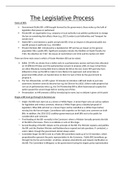
The Legislative Process
Types of Bills
Government/Public Bill- a Bill brought forward by the government; these make up the bulk of
legislation that passes in parliament
Private Bill- an organisation (e.g, company or local authority) can petition parliament to change
the law on something that affects them (e.g, 2013 London Local Authorities and Transport for
London Act)
Hybrid Bill- a mix between a public and private Bill; it has an impact on the general public but
specific groups in particular (e.g., HS2 Bills)
Private Members Bill- introduced by a backbencher MP and has an impact on the general
population (like a public Bill). Significant examples include the Abolition of Death Penalty Act
1965, the Abortion Act 1967, the House of Lords Reform Act 2014 and the Autism Act 2009
There are three main ways in which a Private Members Bill can be raised:
Ballot- 20 MPs are drawn from a ballot early in a parliamentary session and have time allocated
on 13 different Fridays over the parliamentary session to propose a Bill. An issue is that these
are often filibusted, leaving little time to debate the Bill at the end. Some MPs get help from
lobbyists to draw up the Bill to make it more likely to be approved, and some take on
government Bills which are handed down to them for lack of time by the government to
propose it.
The Ten-Minute Rule- an MP is given 10 minutes to introduce a Bill and tends to just raise
awareness, however some do become law e.g, the Divorce Act 2002. Others make progress but
run out of parliamentary time e.g, the Civil Partnership Bill to allow heterosexual couples this
option passed the second stage before running out of time.
Presentation- an MP presents a Bill by introducing its name, but no debate is given at this point
Stages a Bill must go through to become Law
Origin- the Bill must start out as a Green or White Paper. A Green Paper sets out various options
for legislation and invites comment, whereas a White Paper gives a detailed proposal of
legislation. Often Bills will start as a Green Paper and be redrafted as a White Paper before
moving into the formal stages. Committees with expertise on the topic area comment on draft
Bills. In addition, the 2010-2015 coalition government put draft Bills out to the public for
consideration and comment.
First Reading of the Bill- normally in the Commons- where a Minister formally presents the title
of the Bill to the House. There is no debate or vote at this stage.
Second Reading of the Bill- debate on the principle of the Bill. The Minister explains and justifies
the Bill, and the Shadow Minister and Backbenchers respond and ask questions. If contested, a
vote is taken, though the government almost always wins).
Committee Stage- the Bill is sent to a Public Bill committee made up of 16-50 members, which
proportionally represent the party representation in the Commons. Public Bill Committees go
through line by line and consider, scrutinise, propose amendments and request clarification on
the Bill. The Committee is Whipped, so the government having the largest party representation
Types of Bills
Government/Public Bill- a Bill brought forward by the government; these make up the bulk of
legislation that passes in parliament
Private Bill- an organisation (e.g, company or local authority) can petition parliament to change
the law on something that affects them (e.g, 2013 London Local Authorities and Transport for
London Act)
Hybrid Bill- a mix between a public and private Bill; it has an impact on the general public but
specific groups in particular (e.g., HS2 Bills)
Private Members Bill- introduced by a backbencher MP and has an impact on the general
population (like a public Bill). Significant examples include the Abolition of Death Penalty Act
1965, the Abortion Act 1967, the House of Lords Reform Act 2014 and the Autism Act 2009
There are three main ways in which a Private Members Bill can be raised:
Ballot- 20 MPs are drawn from a ballot early in a parliamentary session and have time allocated
on 13 different Fridays over the parliamentary session to propose a Bill. An issue is that these
are often filibusted, leaving little time to debate the Bill at the end. Some MPs get help from
lobbyists to draw up the Bill to make it more likely to be approved, and some take on
government Bills which are handed down to them for lack of time by the government to
propose it.
The Ten-Minute Rule- an MP is given 10 minutes to introduce a Bill and tends to just raise
awareness, however some do become law e.g, the Divorce Act 2002. Others make progress but
run out of parliamentary time e.g, the Civil Partnership Bill to allow heterosexual couples this
option passed the second stage before running out of time.
Presentation- an MP presents a Bill by introducing its name, but no debate is given at this point
Stages a Bill must go through to become Law
Origin- the Bill must start out as a Green or White Paper. A Green Paper sets out various options
for legislation and invites comment, whereas a White Paper gives a detailed proposal of
legislation. Often Bills will start as a Green Paper and be redrafted as a White Paper before
moving into the formal stages. Committees with expertise on the topic area comment on draft
Bills. In addition, the 2010-2015 coalition government put draft Bills out to the public for
consideration and comment.
First Reading of the Bill- normally in the Commons- where a Minister formally presents the title
of the Bill to the House. There is no debate or vote at this stage.
Second Reading of the Bill- debate on the principle of the Bill. The Minister explains and justifies
the Bill, and the Shadow Minister and Backbenchers respond and ask questions. If contested, a
vote is taken, though the government almost always wins).
Committee Stage- the Bill is sent to a Public Bill committee made up of 16-50 members, which
proportionally represent the party representation in the Commons. Public Bill Committees go
through line by line and consider, scrutinise, propose amendments and request clarification on
the Bill. The Committee is Whipped, so the government having the largest party representation