Additional Member System
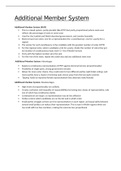
Additional Member System (AMS)
This is a mixed system- partly pluralist (like FPTP) but partly proportional (where seats won
reflects the percentage of votes in some way)
Used for the Scottish and Welsh devolved governments, and London Assembly
1. Electors have two votes: one for a representative (for a constituency), one for a party (for a
region)
2. The winner for each constituency is the candidate with the greatest number of votes (FPTP)
3. For the regional votes, where candidates vote for a party, divide the number of votes they got
by (number of constituencies/seats won+1) - the d’Hondt Formula
4. Party with the highest number wins the seat
5. For the rest of the seats, repeat this action but add any additional seats won
Additional Member System: Advantages
Balances constituency representation of FPTP against electoral fairness (proportionality)
Possibility of single-party, strong government remains
Allows for more voter choice- they could vote for two different parties (split ticket voting), and
more parties have a chance of winning seats (move away from the two-party system).
‘Zipping’ leads to improved female representation (lists alternate male/female)
Additional Member System: Disadvantages
High levels of proportionality are unlikely
Creates confusion and inequality of responsibilities by having two classes of representative, only
one of which has constituency duties
Constituencies are larger, so representation may be less effective
Parties control which candidates are on the list and in which order
Small parties struggle as there are few representatives in each region, and equal splits between
several small parties can reduce their representation. This is seen in Welsh regions which are
too small with too few members, making the outcome less proportional.
Additional Member System (AMS)
This is a mixed system- partly pluralist (like FPTP) but partly proportional (where seats won
reflects the percentage of votes in some way)
Used for the Scottish and Welsh devolved governments, and London Assembly
1. Electors have two votes: one for a representative (for a constituency), one for a party (for a
region)
2. The winner for each constituency is the candidate with the greatest number of votes (FPTP)
3. For the regional votes, where candidates vote for a party, divide the number of votes they got
by (number of constituencies/seats won+1) - the d’Hondt Formula
4. Party with the highest number wins the seat
5. For the rest of the seats, repeat this action but add any additional seats won
Additional Member System: Advantages
Balances constituency representation of FPTP against electoral fairness (proportionality)
Possibility of single-party, strong government remains
Allows for more voter choice- they could vote for two different parties (split ticket voting), and
more parties have a chance of winning seats (move away from the two-party system).
‘Zipping’ leads to improved female representation (lists alternate male/female)
Additional Member System: Disadvantages
High levels of proportionality are unlikely
Creates confusion and inequality of responsibilities by having two classes of representative, only
one of which has constituency duties
Constituencies are larger, so representation may be less effective
Parties control which candidates are on the list and in which order
Small parties struggle as there are few representatives in each region, and equal splits between
several small parties can reduce their representation. This is seen in Welsh regions which are
too small with too few members, making the outcome less proportional.