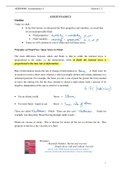
AERO40001 Aerodynamics I Section 1-2
__________________________________________________________________________
AERODYNAMICS
Outline
Today we shall :
• In the first lecture we discussed the flow properties and variables, we recall that
for an incompressible fluid:
• Fluid properties -
• Fluid variables -
density viscosity
+
pipe
velocity t
pressure u v w
,p ,
• Today we will continue by rate of strain and wall shear stress.
Principles of Fluid Flow: Shear Stress in Fluids
The main difference between solids and fluids is that in solids the internal stress is
proportional to the strain, i.e. the deformation, while in fluids the internal stress is
proportional to the time rate of deformation.
Rate of deformation means the rate of change of deformation in time . A fluid must be
in motion to resist a shear stress whereas a solid can simply deform and remain stationary in a
deformed position. For example, the faster you stir a can of paint the greater the force needed
to move the stirring rod, but the force needed to stretch a light elastic band 1 percent of its
length is independent of the rate at which it is stretched.
6- EE Hooke 's Law
-
( )
• For an (elastic) solid Stress µ strain
strain
• For most fluids - liquid or gas Stress µ time rate
"rate of strain"
of
These are called Newtonian
Newtonian Fluids. There are also non Newtonian
Non-Newtonian
-
fluids for
example non drip paint, blood flowing through small vessels.
Fluids are viscous or sticky. This is obvious for motor oil but not so obvious for air. This
property is known as the viscosity of a fluid.
Dynamics
- Reynolds Number: Inertia and viscosity
-Simple flows with and without viscosity
Homsy, G.M (2008) Simple flows with and without
viscosity. Multimedia Fluid Mechanics. 2nd ed. Cambridge
University Press.
1
__________________________________________________________________________
AERODYNAMICS
Outline
Today we shall :
• In the first lecture we discussed the flow properties and variables, we recall that
for an incompressible fluid:
• Fluid properties -
• Fluid variables -
density viscosity
+
pipe
velocity t
pressure u v w
,p ,
• Today we will continue by rate of strain and wall shear stress.
Principles of Fluid Flow: Shear Stress in Fluids
The main difference between solids and fluids is that in solids the internal stress is
proportional to the strain, i.e. the deformation, while in fluids the internal stress is
proportional to the time rate of deformation.
Rate of deformation means the rate of change of deformation in time . A fluid must be
in motion to resist a shear stress whereas a solid can simply deform and remain stationary in a
deformed position. For example, the faster you stir a can of paint the greater the force needed
to move the stirring rod, but the force needed to stretch a light elastic band 1 percent of its
length is independent of the rate at which it is stretched.
6- EE Hooke 's Law
-
( )
• For an (elastic) solid Stress µ strain
strain
• For most fluids - liquid or gas Stress µ time rate
"rate of strain"
of
These are called Newtonian
Newtonian Fluids. There are also non Newtonian
Non-Newtonian
-
fluids for
example non drip paint, blood flowing through small vessels.
Fluids are viscous or sticky. This is obvious for motor oil but not so obvious for air. This
property is known as the viscosity of a fluid.
Dynamics
- Reynolds Number: Inertia and viscosity
-Simple flows with and without viscosity
Homsy, G.M (2008) Simple flows with and without
viscosity. Multimedia Fluid Mechanics. 2nd ed. Cambridge
University Press.
1