WEEK 7: LECTURE 18: PHYLOGENIES
WHAT ARE PHYLOGENIES?
• A way of illustrating the relationship between entities
• Reconstructs the evolutionary history of
- Groups of organisms
o Species, populations, lab strains
- Molecules
o Proteins, nucleic acids
PHYLOGENETIC TREES
• Stem represents the ancestor
• Branches represent descendants
• Distance between branches, taxa or species represents degrees of relatedness
- Things closer together are more closely related than things further away
PHYLOGENETIC TREES PRE-DARWIN
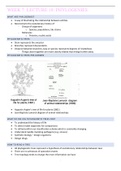
• Augustin Augier’s tree of life for plants (1801)
• Jean-Baptiste Lamarck diagram of animal relationships
WHAT DO WE USE PHYLOGENETIC TREES FOR?
• To understand the history of life
• To select model organisms for comparisons
• To refine/confirm our classification scheme which is constantly changing
• Understand rapidly mutating pathogens (e.g. viruses)
• Synthetic biology – design organisms
• Design drugs
HOW TO READ A TREE
• All phylogenetic trees represent a hypothesis of evolutionary relationships between taxa
• There are no witnesses of speciation events
• Tree topology tends to change the more information we have
1
,HOW TO READ A TREE
• A phylogeny depicts the relationship between an ancestor and its descendants
• Ancestors in the past, descendants in modern times
• Only tells times vertically
ROOTED VS UNROOTED TREE
• We can only ‘root’ a tree if we know the most recent common ancestor. If unknown, unrooted
trees are more appropriate
HOW TO READ A TREE
• Each lineage has ancestors that are unique to that lineage as well as ancestors they share with
other lineage
• Taxon/taxa: groups of organisms (species, genus, phylum)
2
,• Sister groups: two taxa that split from the same node
• In-group: taxa of interest
• Out-group: taxon outside the group of interest
• Tips of trees: descendants
• Root of tree: ancestor
3
, • These phylogenies are equivalent
• Humans are not the apex of evolution
HOW TO READ A TREE
• Clade: group consisting of an ancestor and all of its descendants
TETRAPODS AS AN EXAMPLE
• Tetrapods: vertebrates with four limbs
4
WHAT ARE PHYLOGENIES?
• A way of illustrating the relationship between entities
• Reconstructs the evolutionary history of
- Groups of organisms
o Species, populations, lab strains
- Molecules
o Proteins, nucleic acids
PHYLOGENETIC TREES
• Stem represents the ancestor
• Branches represent descendants
• Distance between branches, taxa or species represents degrees of relatedness
- Things closer together are more closely related than things further away
PHYLOGENETIC TREES PRE-DARWIN
• Augustin Augier’s tree of life for plants (1801)
• Jean-Baptiste Lamarck diagram of animal relationships
WHAT DO WE USE PHYLOGENETIC TREES FOR?
• To understand the history of life
• To select model organisms for comparisons
• To refine/confirm our classification scheme which is constantly changing
• Understand rapidly mutating pathogens (e.g. viruses)
• Synthetic biology – design organisms
• Design drugs
HOW TO READ A TREE
• All phylogenetic trees represent a hypothesis of evolutionary relationships between taxa
• There are no witnesses of speciation events
• Tree topology tends to change the more information we have
1
,HOW TO READ A TREE
• A phylogeny depicts the relationship between an ancestor and its descendants
• Ancestors in the past, descendants in modern times
• Only tells times vertically
ROOTED VS UNROOTED TREE
• We can only ‘root’ a tree if we know the most recent common ancestor. If unknown, unrooted
trees are more appropriate
HOW TO READ A TREE
• Each lineage has ancestors that are unique to that lineage as well as ancestors they share with
other lineage
• Taxon/taxa: groups of organisms (species, genus, phylum)
2
,• Sister groups: two taxa that split from the same node
• In-group: taxa of interest
• Out-group: taxon outside the group of interest
• Tips of trees: descendants
• Root of tree: ancestor
3
, • These phylogenies are equivalent
• Humans are not the apex of evolution
HOW TO READ A TREE
• Clade: group consisting of an ancestor and all of its descendants
TETRAPODS AS AN EXAMPLE
• Tetrapods: vertebrates with four limbs
4