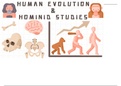
,1) evidence for a common 4) fossil evidence and
ancestor skeletal indicators
2) Sequence of human 5) Cultural evidence
evolution 6) Spread of modern humans
3) anatomical differences around the world
, evidence for a common ancestor
there is biographical evidence of a common ancestor for all primates due to a common land prior to the continental drift called
Gondwanaland (200mya)
- played an important role in the initial geographical subdivisions within primates
most present-day primates are arboreal (living in trees) this characteristics suggests that the common ancestor was arboreal. This
ancestral group then diversified in arboreal habitats
characteristics that are arboreal:
- they have a clavicle or collarbone which helps stabilises the shoulder when hanging
- they have long slender limbs that rotate freely at the shoulder and hips this helps the movement in trees
- mobile opposable thumbs
characteristics that all primates share:
- an enlarged and complex brain relative to body size
- a flattened face and reduced snout with a reduced sense of smell
- eyes that face forward
- digits with a flat nails (not claws or hooves)
- molar and premolar teeth with cusps that are low and rounded
- complex social behaviour, usually only one offspring at a time and extended care for the young
ancestor skeletal indicators
2) Sequence of human 5) Cultural evidence
evolution 6) Spread of modern humans
3) anatomical differences around the world
, evidence for a common ancestor
there is biographical evidence of a common ancestor for all primates due to a common land prior to the continental drift called
Gondwanaland (200mya)
- played an important role in the initial geographical subdivisions within primates
most present-day primates are arboreal (living in trees) this characteristics suggests that the common ancestor was arboreal. This
ancestral group then diversified in arboreal habitats
characteristics that are arboreal:
- they have a clavicle or collarbone which helps stabilises the shoulder when hanging
- they have long slender limbs that rotate freely at the shoulder and hips this helps the movement in trees
- mobile opposable thumbs
characteristics that all primates share:
- an enlarged and complex brain relative to body size
- a flattened face and reduced snout with a reduced sense of smell
- eyes that face forward
- digits with a flat nails (not claws or hooves)
- molar and premolar teeth with cusps that are low and rounded
- complex social behaviour, usually only one offspring at a time and extended care for the young