Financial History
Lecture 1: Pre-Industrial Era
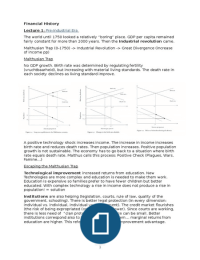
The world until 1750 looked a relatively “boring” place. GDP per capita remained
fairly constant for more than 2000 years. Then the Industrial revolution came.
Malthusian Trap (0-1750) -> Industrial Revolution -> Great Divergence (increase
of income pp)
Malthusian Trap
No GDP growth. Birth rate was determined by regulating fertility
(vruchtbaarheid), but increasing with material living standards. The death rate in
each society declines as living standard improve.
A positive technology shock increases income. The increase in income increases
birth rate and reduces death rates. Then population increases. Positive population
growth is not sustainable. The economy has to go back to a situation where birth
rate equals death rate. Malthus calls this process: Positive Check (Plagues, Wars,
Famine…)
Escaping the Malthusian Trap
Technological improvement increased returns from education. New
Technologies are more complex and education is needed to make them work.
Education is expensive so families prefer to have fewer children but better
educated. With complex technology a rise in income does not produce a rise in
population! = solution
Institutions are also helping (legislation, courts, rule of law, quality of the
government, schooling). There is better legal protection (in every dimension:
individual vs. individual, individual vs. government). The credit market flourishes
(the risk of being expropriated (onteigend) gets lower). Since courts are working,
there is less need of “clan protection’’ so family size can be small. Better
institutions correspond also to better schooling system… marginal returns from
education are higher. This refers to the technology improvement advantage.
1
, Finance in Venice
Exploiting the great geographical positions and the weaknesses of the two
empires, Venice gets rich with mercantile and long distance trade. This required a
large investment with a lot of risk. These problems were resolved with the The
Colleganza. Basically a credit contract where a young entrepreneur with ideas
but no money could be matched with wealthy lender. There
are two parties, the traveling merchant and the investor (or sedentary merchant).
In Venice, the sedentary merchant gives cash or wares to the traveling merchant,
who then boards a ship with other merchants for an overseas destination, say,
Constantinople. In Constantinople, the traveling merchant sells the wares and
uses the proceeds to buy other wares for resale in Venice. A colleganza specifies
the names of the two parties, itemizes the capital contributed by the sedentary
investor and states how profits will be split.
Decline: The wealth distribution in Venice became more and more skewed
towards few rich families who controlled the “usual” routes of international trade.
No young risky innovative entrepreneurs anymore..
Finance and the Industrial Revolution in Britain
1625 Charles I of England accedes to the English throne, and shortly after
marries a French Roman Catholic princess, Henrietta Maria. He went to war
against Spain. Needed money and Charles summons the Parliament to obtain
new funding. Charles decided to demand directly from his people and in July 1626
sent letters to the local magistrates asking his subjects "lovingly, freely, and
voluntarily" to give him money. This wasn’t working so he levied (opleggen) a
forced loan (with virtually no hope of repayment). Anyone who refused to "lend"
was to answer to the Star Chamber (court).
During the 1630s, Charles resolves a peace treaty with Spain and France (Peace
is cheaper than war), but in the meantime, tensions mounts with Scotland… 1640
Charles recalls Parliament to raise funds (there is a war against Scotland). The
parliament refused and it was dissolved (Short Parliament). November 1640
Charles again summons Parliament; this was the Long Parliament.
1642 Outbreak of the Civil War. At the end (1649), Charles I were executed.
Britain becomes a Republic led by Oliver Cromwell.
Star Chamber = The Court of Star Chamber was a court of law which evolved
from the meetings of the king's royal council. The court was a supervisory body;
its members oversaw the operations of lower courts. Members of the court were
either members of the king's advisory body or judges drawn from the courts of
common law. At the time of Charles I it had become a byword for abuse of power
by the king. It became used to try nobles too powerful to be brought to trial in the
lower courts. Court sessions were held in secret, with no right of appeal, and
punishment was swift and severe to any enemy of the crown. In other words the
Crown could blackmail the judges. Star Chamber abolished in 1641.
2
Lecture 1: Pre-Industrial Era
The world until 1750 looked a relatively “boring” place. GDP per capita remained
fairly constant for more than 2000 years. Then the Industrial revolution came.
Malthusian Trap (0-1750) -> Industrial Revolution -> Great Divergence (increase
of income pp)
Malthusian Trap
No GDP growth. Birth rate was determined by regulating fertility
(vruchtbaarheid), but increasing with material living standards. The death rate in
each society declines as living standard improve.
A positive technology shock increases income. The increase in income increases
birth rate and reduces death rates. Then population increases. Positive population
growth is not sustainable. The economy has to go back to a situation where birth
rate equals death rate. Malthus calls this process: Positive Check (Plagues, Wars,
Famine…)
Escaping the Malthusian Trap
Technological improvement increased returns from education. New
Technologies are more complex and education is needed to make them work.
Education is expensive so families prefer to have fewer children but better
educated. With complex technology a rise in income does not produce a rise in
population! = solution
Institutions are also helping (legislation, courts, rule of law, quality of the
government, schooling). There is better legal protection (in every dimension:
individual vs. individual, individual vs. government). The credit market flourishes
(the risk of being expropriated (onteigend) gets lower). Since courts are working,
there is less need of “clan protection’’ so family size can be small. Better
institutions correspond also to better schooling system… marginal returns from
education are higher. This refers to the technology improvement advantage.
1
, Finance in Venice
Exploiting the great geographical positions and the weaknesses of the two
empires, Venice gets rich with mercantile and long distance trade. This required a
large investment with a lot of risk. These problems were resolved with the The
Colleganza. Basically a credit contract where a young entrepreneur with ideas
but no money could be matched with wealthy lender. There
are two parties, the traveling merchant and the investor (or sedentary merchant).
In Venice, the sedentary merchant gives cash or wares to the traveling merchant,
who then boards a ship with other merchants for an overseas destination, say,
Constantinople. In Constantinople, the traveling merchant sells the wares and
uses the proceeds to buy other wares for resale in Venice. A colleganza specifies
the names of the two parties, itemizes the capital contributed by the sedentary
investor and states how profits will be split.
Decline: The wealth distribution in Venice became more and more skewed
towards few rich families who controlled the “usual” routes of international trade.
No young risky innovative entrepreneurs anymore..
Finance and the Industrial Revolution in Britain
1625 Charles I of England accedes to the English throne, and shortly after
marries a French Roman Catholic princess, Henrietta Maria. He went to war
against Spain. Needed money and Charles summons the Parliament to obtain
new funding. Charles decided to demand directly from his people and in July 1626
sent letters to the local magistrates asking his subjects "lovingly, freely, and
voluntarily" to give him money. This wasn’t working so he levied (opleggen) a
forced loan (with virtually no hope of repayment). Anyone who refused to "lend"
was to answer to the Star Chamber (court).
During the 1630s, Charles resolves a peace treaty with Spain and France (Peace
is cheaper than war), but in the meantime, tensions mounts with Scotland… 1640
Charles recalls Parliament to raise funds (there is a war against Scotland). The
parliament refused and it was dissolved (Short Parliament). November 1640
Charles again summons Parliament; this was the Long Parliament.
1642 Outbreak of the Civil War. At the end (1649), Charles I were executed.
Britain becomes a Republic led by Oliver Cromwell.
Star Chamber = The Court of Star Chamber was a court of law which evolved
from the meetings of the king's royal council. The court was a supervisory body;
its members oversaw the operations of lower courts. Members of the court were
either members of the king's advisory body or judges drawn from the courts of
common law. At the time of Charles I it had become a byword for abuse of power
by the king. It became used to try nobles too powerful to be brought to trial in the
lower courts. Court sessions were held in secret, with no right of appeal, and
punishment was swift and severe to any enemy of the crown. In other words the
Crown could blackmail the judges. Star Chamber abolished in 1641.
2