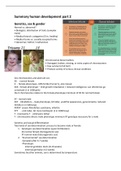
Summary human development part 2
Genetics, sex & gender
Normal vs. abnormal?
• Biologists: distribution of traits (complex
traits)
• Medical branch: categories (ill vs. healthy)
• Medical terms vs. socially accepted terms
• Abnormal / deficit / malfunction
Chromosomal Abnormalities
• Damaged, broken, missing, or extra copies of chromosomes
• Few survive to full term
• Produce variety of serious clinical conditions
Sex chromosomes and aberrant sex
XX - normal female
X - female phenotype –50% fertile (Turner’s), also mosaic
XXX - female phenotype – mild growth retardation / reduced intelligence; can oftentimes go
unnoticed (1 in 1000 girls)
the X chromosome relates to the female phenotype minimum of XX for normal female
XY - normal male
XXY - Klinefelters – male phenotype, bit taller, youthful appearance, gynecomastia; reduced
fertility (1 in 500 boys)
XXXXY- severe Klinefelters syndrome, infertile
XYY - a bit taller, bit more tomboyish (1 in 1000 boys)
Y - monosomy Y - embryonic lethal
Y - chromosome directs male phenotype minimum XY genotype necessary for a male
Genetics and sexual differentiation
Two kinds of sex determination: process to become male or female
1. Genotypic sex determination (upon fertilization)
XX normal female (homogametic sex)
XY normal male (heterogametic sex)
2. “Environmental” sex determination
-Gonadal (after 6-7 weeks)
-Phenotypic
internal genitalia: ducts (8-10 weeks)
external genitalia (>12 weeks)
Sometimes by other animals, sex is determined by temperature
,Sex
- Genetic sex – chromosomes
- Gonadal sex – gonads
- Genitals - internal and external
Gender
- The social meaning attached to being male or female
- Sexual/gender identity - one’s identity as male or female
- gender role - expectations about how a male or female should behave
- Develops in utero throughout childhood
Sex, Gender (and the brain)
• Androgyny/hermaphrodism
• sex: possessing both male and female reproductive organs
• gender: possessing both male and female qualities or feelings/identity
• Wiki: “When androgyny refers to mixed biological sex characteristics in humans, it often
refers to intersex people”
• Occurrence Netherlands: 1 in 90 (red hair 1 in 250)
Abnormal sexual phenotypes & surgery
- Physicians have traditionally recommended that intersex people be reared as girls
• Surgery was often conducted to make them look more feminine
• Assumed that children consistently raised as female would accept that identity
- Many intersex people protest against such early surgery (male or female alike)
- Many who remain female feel discontent or conflict with being female
- Such cases indicate that although hormones do not determine the genetic sex, they
are involved in determining gender identity by changing the brain
- Current dichotomy in the view of intersex people
• Medical model: asap surgery to conform with the ‘natural’ occurrence of being
male or female
• Psychological/social model: let the child decide when it is able to make a decision
(and if wants to make it)
- In most cases, parents are
confronted right after
childbirth with the question
of surgery
• “The doctors will know
what is best”
- Different from transgenders,
as that is expressed mostly
from early childhood onwards
(3–5 years); is dependent on
the development of the brain
,Sex chromosomes determine gonadal sex & internal
genitals
• System starts bisexual
• Only one (mostly) survives
No testosterone: Wolfian duct degenerates
spontaneously
Male development (fetal)
1. Genetic factors initiate the process that directs the
indifferent gonads toward testis development
2. Activation of Sertoli cells (sustentacular cells) to
produce Mullerian inhibiting hormone, causing
Mullerian duct degeneration
3. Stimulation of Leydig cells (interstitial cells) to
secrete testosterone, which then directs the
development of the Wolffian ducts towards epididymis,
vas deferens, and seminal vesicles
- Testosterone conversion to dihydrotestosterone
(DHT)
- Directs the development of the urethra, prostate
gland, and penis
Enzyme: 5a-reductase
, Sex chromosomes determine gonadal sex
Y-chromosome:
• Shortest chromosome
• Internal repeats to allow self-recombination
• Produces Testis Determination Factor (TDF)
• SRY (TDF) is a transcription factor that via a molecular cascade
activates Sertoli and Leydig cells
• SRY was found in 1990
• Acts together with an autosomal gene SOX9 (and many more)
NOTE: Default may seem the develop as a
female. Male hormones are indeed needed
to promote differentiation into a male, no
SRY = female appearance on the outside
But: other factors (Factor in Germline ) are
needed for folliculogenesis and
differentiation into ovaries
From yolk sac, primordial germ
cells (PGCs) migrate to the
gonadal ridge that then acquires
male characteristics by week 7 of
development
What happened before .....
Y-chromosome:
• Sox9 binds to the promotor of MIH (or AMH, anti-mullerian hormone) and
regulates its expression
• SRY/SOX9 induce FGF9: chemotactic factor for primordial germ cells to
penetrate gonadal ridge (without this no testis can be formed)
• Induction of steroidogenesis factor 1 (SF1): stimulates differentiation of Sertoli
& Leydig cells
• SF1 stimulates Leydig cells to make enzymes for testosterone production (from
cholesterol)
Genetics, sex & gender
Normal vs. abnormal?
• Biologists: distribution of traits (complex
traits)
• Medical branch: categories (ill vs. healthy)
• Medical terms vs. socially accepted terms
• Abnormal / deficit / malfunction
Chromosomal Abnormalities
• Damaged, broken, missing, or extra copies of chromosomes
• Few survive to full term
• Produce variety of serious clinical conditions
Sex chromosomes and aberrant sex
XX - normal female
X - female phenotype –50% fertile (Turner’s), also mosaic
XXX - female phenotype – mild growth retardation / reduced intelligence; can oftentimes go
unnoticed (1 in 1000 girls)
the X chromosome relates to the female phenotype minimum of XX for normal female
XY - normal male
XXY - Klinefelters – male phenotype, bit taller, youthful appearance, gynecomastia; reduced
fertility (1 in 500 boys)
XXXXY- severe Klinefelters syndrome, infertile
XYY - a bit taller, bit more tomboyish (1 in 1000 boys)
Y - monosomy Y - embryonic lethal
Y - chromosome directs male phenotype minimum XY genotype necessary for a male
Genetics and sexual differentiation
Two kinds of sex determination: process to become male or female
1. Genotypic sex determination (upon fertilization)
XX normal female (homogametic sex)
XY normal male (heterogametic sex)
2. “Environmental” sex determination
-Gonadal (after 6-7 weeks)
-Phenotypic
internal genitalia: ducts (8-10 weeks)
external genitalia (>12 weeks)
Sometimes by other animals, sex is determined by temperature
,Sex
- Genetic sex – chromosomes
- Gonadal sex – gonads
- Genitals - internal and external
Gender
- The social meaning attached to being male or female
- Sexual/gender identity - one’s identity as male or female
- gender role - expectations about how a male or female should behave
- Develops in utero throughout childhood
Sex, Gender (and the brain)
• Androgyny/hermaphrodism
• sex: possessing both male and female reproductive organs
• gender: possessing both male and female qualities or feelings/identity
• Wiki: “When androgyny refers to mixed biological sex characteristics in humans, it often
refers to intersex people”
• Occurrence Netherlands: 1 in 90 (red hair 1 in 250)
Abnormal sexual phenotypes & surgery
- Physicians have traditionally recommended that intersex people be reared as girls
• Surgery was often conducted to make them look more feminine
• Assumed that children consistently raised as female would accept that identity
- Many intersex people protest against such early surgery (male or female alike)
- Many who remain female feel discontent or conflict with being female
- Such cases indicate that although hormones do not determine the genetic sex, they
are involved in determining gender identity by changing the brain
- Current dichotomy in the view of intersex people
• Medical model: asap surgery to conform with the ‘natural’ occurrence of being
male or female
• Psychological/social model: let the child decide when it is able to make a decision
(and if wants to make it)
- In most cases, parents are
confronted right after
childbirth with the question
of surgery
• “The doctors will know
what is best”
- Different from transgenders,
as that is expressed mostly
from early childhood onwards
(3–5 years); is dependent on
the development of the brain
,Sex chromosomes determine gonadal sex & internal
genitals
• System starts bisexual
• Only one (mostly) survives
No testosterone: Wolfian duct degenerates
spontaneously
Male development (fetal)
1. Genetic factors initiate the process that directs the
indifferent gonads toward testis development
2. Activation of Sertoli cells (sustentacular cells) to
produce Mullerian inhibiting hormone, causing
Mullerian duct degeneration
3. Stimulation of Leydig cells (interstitial cells) to
secrete testosterone, which then directs the
development of the Wolffian ducts towards epididymis,
vas deferens, and seminal vesicles
- Testosterone conversion to dihydrotestosterone
(DHT)
- Directs the development of the urethra, prostate
gland, and penis
Enzyme: 5a-reductase
, Sex chromosomes determine gonadal sex
Y-chromosome:
• Shortest chromosome
• Internal repeats to allow self-recombination
• Produces Testis Determination Factor (TDF)
• SRY (TDF) is a transcription factor that via a molecular cascade
activates Sertoli and Leydig cells
• SRY was found in 1990
• Acts together with an autosomal gene SOX9 (and many more)
NOTE: Default may seem the develop as a
female. Male hormones are indeed needed
to promote differentiation into a male, no
SRY = female appearance on the outside
But: other factors (Factor in Germline ) are
needed for folliculogenesis and
differentiation into ovaries
From yolk sac, primordial germ
cells (PGCs) migrate to the
gonadal ridge that then acquires
male characteristics by week 7 of
development
What happened before .....
Y-chromosome:
• Sox9 binds to the promotor of MIH (or AMH, anti-mullerian hormone) and
regulates its expression
• SRY/SOX9 induce FGF9: chemotactic factor for primordial germ cells to
penetrate gonadal ridge (without this no testis can be formed)
• Induction of steroidogenesis factor 1 (SF1): stimulates differentiation of Sertoli
& Leydig cells
• SF1 stimulates Leydig cells to make enzymes for testosterone production (from
cholesterol)