Summary microbiology
The microbial world consists of microscopic organisms that have defined structures, unique
evolutionary histories, and are of enormous importance to the biosphere.
Microorganisms (microbes) are life forms too small to be seen by the unaided human eye.
• These microscopic organisms are diverse in form and function.
• They inhabit every environment on earth that supports life which can be very
extreme.
• Many microbes are undifferentiated single-celled organisms, but some form more
complex structures, and some are even multicellular.
• Microorganisms typically live in complex microbial communities, and their activities
are regulated by interactions with each other, with their environments, and with
other organisms.
Microorganisms are the oldest form of life and have a major fraction of the earth’s biomass.
They also affect human life (infectious diseases, food and water, soils, animal health, fuel),
and surround plants and animals (symbioses).
The science of microbiology is all about microorganisms, who they are, how they work, and
what they do. The cultivation of microorganisms is also foundational to microbiology. A
culture is a collection of cells that have been grown in or on a nutrient medium. A medium is
a liquid or solid nutrient mixture that contains all of the nutrients required for a
microorganism to grow. In microbiology, we use the word growth to refer to the increase in
cell number as a result of cell division. A single microbial cell placed on a solid nutrient
medium can grow and divide into millions or even billions of cells that form a visible colony.
The formation of visible colonies makes it easier to see and grow microorganisms.
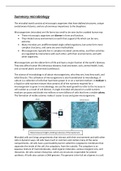
Bioluminescent (light-emitting) colonies of the bacterium.
Microbial cells are living compartments that interact with their environment and with other
cells in dynamic ways. All cells have much in common and contain many of the same
compartments. All cells have a permeability barrier called the cytoplasmic membrane that
separates the inside of the cell, the cytoplasm, from the outside. The cytoplasm is an
aqueous mixture of macromolecules, small organic molecules, various inorganic ions, and
ribosomes. All cells contain ribosomes, which are structures responsible for protein
synthesis. All cells also contain a DNA genome. The genome is the full set of genes in a cell.
,Eukaryotic DNA
• Linear chromosomes within the nucleus.
• Much larger/ more DNA (up to billions of base pairs.
Prokaryotic DNA
• Typically, a single circular chromosome that aggregates to form the nucleoid region.
• May also have plasmids (extrachromosomal DNA) that confer special properties (e.g.,
antibiotic resistance).
• Small, compact (0.5-10 million base pairs).
,Morphology→ is defined by cell size and shape.
A micrometer is one-millionth of a meter in length. The unaided human eye has difficulty
resolving objects that are less than 100 m in diameter.
The size range of prokaryotes: 0.2m to 600+ m in diameter
• Most are between 0.5 and 10 m long
• Examples of very large prokaryotes:
Diffusion in these large
prokaryotes is possible
because of many
genome copies/ a
vacuole in the center
which brings the DNA
closer to the surface.
The size range for eukaryotic cells: typically, 5 to 100 m in length.
Cell size is influenced fundamentally by cell structure. Eukaryotic cells, owing to their
complex intracellular structure and organelles, can actively transport molecules and
macromolecules within the cytoplasm. Prokaryotic cells, in contrast, rely on diffusion for
transport through the cytoplasm, and this limits their size. While diffusion is very fast at
small distances, the rate of diffusion increases as the square of the distance traveled.
Hence, the metabolic rate in a prokaryotic
cell varies inversely with the square of its
size. This relationship means that, as cell size
increases, it becomes advantageous to have
cellular structures that facilitate transport
and compartmentalize cellular activities as
seen in eukaryotic cells. In contrast, since
diffusion is rapid at small spatial scales, high
metabolic rates can be maintained in small
eukaryotic cells without a need for complex
cellular structures.
As cell size increases, its S/V ratio decreases.
The S/V ratio of a cell controls many of its
properties, including how fast it grows and
shapes. Cellular growth rate depends in part
on the rate at which cells exchange nutrients
and waste products with their environment.
Small cells can exchange nutrients and wastes
more rapidly than larger cells. As a result, free-living cells that are smaller tend to be more
efficient than those larger, and any given mass of nutrients will support the synthesis of
more small cells than large cells.
, Major morphologies of prokaryotic cells
• coccus (p l. cocci): spherical or ovoid
• rod/bacillus (p l. bacilli): cylindrical
• spirillum: flexible spiral
• spirochete: rigid spiral
• appendaged bacteria (infecting host)
• irregular/asymmetrical (e.g., budding)
• some stay grouped/clustered after cell division in distinctive shapes (e.g., diplococci,
streptococci (like in yogurt), cubes, grapelike clusters, filamentous bacteria (formed
by fungi))
Many variations on basic morphological types are known.
The microbial world consists of microscopic organisms that have defined structures, unique
evolutionary histories, and are of enormous importance to the biosphere.
Microorganisms (microbes) are life forms too small to be seen by the unaided human eye.
• These microscopic organisms are diverse in form and function.
• They inhabit every environment on earth that supports life which can be very
extreme.
• Many microbes are undifferentiated single-celled organisms, but some form more
complex structures, and some are even multicellular.
• Microorganisms typically live in complex microbial communities, and their activities
are regulated by interactions with each other, with their environments, and with
other organisms.
Microorganisms are the oldest form of life and have a major fraction of the earth’s biomass.
They also affect human life (infectious diseases, food and water, soils, animal health, fuel),
and surround plants and animals (symbioses).
The science of microbiology is all about microorganisms, who they are, how they work, and
what they do. The cultivation of microorganisms is also foundational to microbiology. A
culture is a collection of cells that have been grown in or on a nutrient medium. A medium is
a liquid or solid nutrient mixture that contains all of the nutrients required for a
microorganism to grow. In microbiology, we use the word growth to refer to the increase in
cell number as a result of cell division. A single microbial cell placed on a solid nutrient
medium can grow and divide into millions or even billions of cells that form a visible colony.
The formation of visible colonies makes it easier to see and grow microorganisms.
Bioluminescent (light-emitting) colonies of the bacterium.
Microbial cells are living compartments that interact with their environment and with other
cells in dynamic ways. All cells have much in common and contain many of the same
compartments. All cells have a permeability barrier called the cytoplasmic membrane that
separates the inside of the cell, the cytoplasm, from the outside. The cytoplasm is an
aqueous mixture of macromolecules, small organic molecules, various inorganic ions, and
ribosomes. All cells contain ribosomes, which are structures responsible for protein
synthesis. All cells also contain a DNA genome. The genome is the full set of genes in a cell.
,Eukaryotic DNA
• Linear chromosomes within the nucleus.
• Much larger/ more DNA (up to billions of base pairs.
Prokaryotic DNA
• Typically, a single circular chromosome that aggregates to form the nucleoid region.
• May also have plasmids (extrachromosomal DNA) that confer special properties (e.g.,
antibiotic resistance).
• Small, compact (0.5-10 million base pairs).
,Morphology→ is defined by cell size and shape.
A micrometer is one-millionth of a meter in length. The unaided human eye has difficulty
resolving objects that are less than 100 m in diameter.
The size range of prokaryotes: 0.2m to 600+ m in diameter
• Most are between 0.5 and 10 m long
• Examples of very large prokaryotes:
Diffusion in these large
prokaryotes is possible
because of many
genome copies/ a
vacuole in the center
which brings the DNA
closer to the surface.
The size range for eukaryotic cells: typically, 5 to 100 m in length.
Cell size is influenced fundamentally by cell structure. Eukaryotic cells, owing to their
complex intracellular structure and organelles, can actively transport molecules and
macromolecules within the cytoplasm. Prokaryotic cells, in contrast, rely on diffusion for
transport through the cytoplasm, and this limits their size. While diffusion is very fast at
small distances, the rate of diffusion increases as the square of the distance traveled.
Hence, the metabolic rate in a prokaryotic
cell varies inversely with the square of its
size. This relationship means that, as cell size
increases, it becomes advantageous to have
cellular structures that facilitate transport
and compartmentalize cellular activities as
seen in eukaryotic cells. In contrast, since
diffusion is rapid at small spatial scales, high
metabolic rates can be maintained in small
eukaryotic cells without a need for complex
cellular structures.
As cell size increases, its S/V ratio decreases.
The S/V ratio of a cell controls many of its
properties, including how fast it grows and
shapes. Cellular growth rate depends in part
on the rate at which cells exchange nutrients
and waste products with their environment.
Small cells can exchange nutrients and wastes
more rapidly than larger cells. As a result, free-living cells that are smaller tend to be more
efficient than those larger, and any given mass of nutrients will support the synthesis of
more small cells than large cells.
, Major morphologies of prokaryotic cells
• coccus (p l. cocci): spherical or ovoid
• rod/bacillus (p l. bacilli): cylindrical
• spirillum: flexible spiral
• spirochete: rigid spiral
• appendaged bacteria (infecting host)
• irregular/asymmetrical (e.g., budding)
• some stay grouped/clustered after cell division in distinctive shapes (e.g., diplococci,
streptococci (like in yogurt), cubes, grapelike clusters, filamentous bacteria (formed
by fungi))
Many variations on basic morphological types are known.