

6. 1. Carbon cycle
6. 1. a. Stores and fluxes
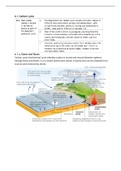
Carbon cycle: biochemical cycle whereby carbon is stored and mcoed between spheres
through flows and fluxes. It is a closed system and carbon is stored and can be released from
sources and removed by skinks.
,The carbon cycle is the cycle by which carbon moves from one Earth sphere (atmosphere,
hydrosphere, lithosphere and biosphere) to another. It is a closed system, but made up of
interlinked subsystems which are open and have inputs and outputs.
The well-being and functioning of the Earth depends on carbon and how it cycles through the
Earth's systems - used for economic development, but it is scarce, extraction destroys the
ecosystems and combustion changes the climate.
It is made up of two main component:
- Stores: function as sources (adding carbon to the atmosphere) and sinks (removing
carbon from the atmosphere)
- fluxes/flows: movements of carbon from one store to another; provide the motion in
the carbon cycle
Stores
Carbon exists in different forms, depending on the store (pools/stocks/reservoirs):
- Atmosphere: as carbon dioxide and carbon compounds, such as methane
- Hydrosphere: dissolved carbon dioxide in oceans, lakes, shells
- Lithosphere: as carbonate in limestones, chalk and fossil fuels, as pure carbon in
graphite and diamonds
- Biosphere: as carbon atoms in living and dead organisms (plants and animals)
● Terrestrial: igneous and metamorphic rocks do not contain much carbon, but
sedimentary rocks have higher concentrations (e.g. limestone). Geological processes
, have also trapped carbon in the form of coal, oil and natural gas. Calcareous oozes are
found under oceans ready to be turned into limestone. Largest store.
● Oceanic: CO2 is dissolved by oceans from the atmosphere. Most CO2 is stored in the
intermediate and deep water, and only 2.5& in surface water. Stores 38000 Gt C.
● Atmospheric: volcanic activity, respiration, wildfires input more carbon. Small changes
affect global temperatures. Stores approximately 750 GtC
These stores vary in size, capacity and locations. The biosphere contains both terrestrial and
oceanic locations
Fluxes
Movement or transfer of carbon between stores, measured in either petagrams or gigatonnes
of carbon per year. The major fluxes are between the oceans and the atmosphere, and
between the land and atmosphere via the biological processes of photosynthesis and
respiration. These fluxes vary not only in terms of flow but also on different timescales.
- Photosynthesis: removes carbon dioxide
from the atmosphere and fixes it in
producers as organic compounds
- Respiration: releases carbon dioxide into
the atmosphere when organic compounds
are digested in living organisms
, - Combustion: burning fossil fuels releases carbon gases
- Volcanism:
- Diffusion: net movement of particles from an area of high concentration to an area of
low concentration
- Gaseous dissolution: the exchange of carbon gases between the ocean and
atmosphere
- Decomposition: releases carbon products into the air or sediment when organic matter
is recycled after death of an organism
- Excretion:
- Lithification: the compaction of carbon-containing sediments into fossils and rocks
within the Earth’s crust (e.g. limestone)
Fluxes are measured in gigatons (Gt) or Pentagrams (Pg). 1 Gt or 1 Pg= 1 billion tonnes
(1,000,000,000)
Time scale:
- Short term: seconds to 10 years (photosynthesis, respiration)
- Long term: 10 - 500 years (decomposition)
- Longer term: millions of years (coal, oil, natural gas)
6. 1. b. Geological processes
Key Points:
● MOST carbon in the world is geological in ROCKS
● It comes from CARBONATE rocks
● It's mainly LIMESTONE, formed in the OCEAN
● There's also SHALE and CLAY, which is created BIOLOGICALLY
Carbon Stores
● The largest carbon store is geological
● There is over 100 million Gt of carbon in the lithosphere
● Most lithospheric carbon is concentrated in the sedimentary rocks of the crust
• 80% of carbon-containing rock is formed under the ocean. Shell-building (calcifying)
organisms precipitate on the ocean floor. Under pressure these layers are cemented
together and turned into limestone. (Lithified= turned to rock)
• The remaining 20% of carbon-containing rock is formed from organisms that have been
embedded in layers of mud and compressed to form sedimentary rock such as shale.
• Finally, fossil fuels are formed in a very similar way however this process occurs over
millennia. Organisms decay anaerobically under layers of silt and mud. When organic
matter builds up faster than it can decay, fossil fuels are created instead shale
6. 1. a. Stores and fluxes
Carbon cycle: biochemical cycle whereby carbon is stored and mcoed between spheres
through flows and fluxes. It is a closed system and carbon is stored and can be released from
sources and removed by skinks.
,The carbon cycle is the cycle by which carbon moves from one Earth sphere (atmosphere,
hydrosphere, lithosphere and biosphere) to another. It is a closed system, but made up of
interlinked subsystems which are open and have inputs and outputs.
The well-being and functioning of the Earth depends on carbon and how it cycles through the
Earth's systems - used for economic development, but it is scarce, extraction destroys the
ecosystems and combustion changes the climate.
It is made up of two main component:
- Stores: function as sources (adding carbon to the atmosphere) and sinks (removing
carbon from the atmosphere)
- fluxes/flows: movements of carbon from one store to another; provide the motion in
the carbon cycle
Stores
Carbon exists in different forms, depending on the store (pools/stocks/reservoirs):
- Atmosphere: as carbon dioxide and carbon compounds, such as methane
- Hydrosphere: dissolved carbon dioxide in oceans, lakes, shells
- Lithosphere: as carbonate in limestones, chalk and fossil fuels, as pure carbon in
graphite and diamonds
- Biosphere: as carbon atoms in living and dead organisms (plants and animals)
● Terrestrial: igneous and metamorphic rocks do not contain much carbon, but
sedimentary rocks have higher concentrations (e.g. limestone). Geological processes
, have also trapped carbon in the form of coal, oil and natural gas. Calcareous oozes are
found under oceans ready to be turned into limestone. Largest store.
● Oceanic: CO2 is dissolved by oceans from the atmosphere. Most CO2 is stored in the
intermediate and deep water, and only 2.5& in surface water. Stores 38000 Gt C.
● Atmospheric: volcanic activity, respiration, wildfires input more carbon. Small changes
affect global temperatures. Stores approximately 750 GtC
These stores vary in size, capacity and locations. The biosphere contains both terrestrial and
oceanic locations
Fluxes
Movement or transfer of carbon between stores, measured in either petagrams or gigatonnes
of carbon per year. The major fluxes are between the oceans and the atmosphere, and
between the land and atmosphere via the biological processes of photosynthesis and
respiration. These fluxes vary not only in terms of flow but also on different timescales.
- Photosynthesis: removes carbon dioxide
from the atmosphere and fixes it in
producers as organic compounds
- Respiration: releases carbon dioxide into
the atmosphere when organic compounds
are digested in living organisms
, - Combustion: burning fossil fuels releases carbon gases
- Volcanism:
- Diffusion: net movement of particles from an area of high concentration to an area of
low concentration
- Gaseous dissolution: the exchange of carbon gases between the ocean and
atmosphere
- Decomposition: releases carbon products into the air or sediment when organic matter
is recycled after death of an organism
- Excretion:
- Lithification: the compaction of carbon-containing sediments into fossils and rocks
within the Earth’s crust (e.g. limestone)
Fluxes are measured in gigatons (Gt) or Pentagrams (Pg). 1 Gt or 1 Pg= 1 billion tonnes
(1,000,000,000)
Time scale:
- Short term: seconds to 10 years (photosynthesis, respiration)
- Long term: 10 - 500 years (decomposition)
- Longer term: millions of years (coal, oil, natural gas)
6. 1. b. Geological processes
Key Points:
● MOST carbon in the world is geological in ROCKS
● It comes from CARBONATE rocks
● It's mainly LIMESTONE, formed in the OCEAN
● There's also SHALE and CLAY, which is created BIOLOGICALLY
Carbon Stores
● The largest carbon store is geological
● There is over 100 million Gt of carbon in the lithosphere
● Most lithospheric carbon is concentrated in the sedimentary rocks of the crust
• 80% of carbon-containing rock is formed under the ocean. Shell-building (calcifying)
organisms precipitate on the ocean floor. Under pressure these layers are cemented
together and turned into limestone. (Lithified= turned to rock)
• The remaining 20% of carbon-containing rock is formed from organisms that have been
embedded in layers of mud and compressed to form sedimentary rock such as shale.
• Finally, fossil fuels are formed in a very similar way however this process occurs over
millennia. Organisms decay anaerobically under layers of silt and mud. When organic
matter builds up faster than it can decay, fossil fuels are created instead shale


