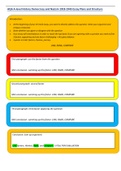
AQA A-level History Democracy and Nazism 1918-1945 Essay Plans and Structure
Introduction:
1. At the beginning of your 25 mark essay, you want to directly address the question. State your argument and
critique a historian
2. State whether you agree or disagree with the question
3. Your essay will need balance in order to reach the top band. If you are agreeing with a question you need to find
2 factors supporting and one factor challenging = this gives balance
4. 3 points in total: factors, themes, journey
LINK, RANK, COMPARE
First paragraph: use the factor from the question
Mini conclusion- summing up this factor. LINK, RANK, COMPARE
Second paragraph: second factor
Mini conclusion- summing up this factor. LINK, RANK, COMPARE
Third paragraph: third factor opposing the question
Mini conclusion- summing up this factor. LINK, RANK, COMPARE
Conclusion: Sum up argument.
Link factors, themes, Rank, and compare = VITAL FOR EVALUATION
, Propaganda was the main method through which Hitler achieved a terror state. ‘to what extent do you
agree
Introduction: this is a factors question; thus three points. Talk about propaganda and 2 other factors
ARGUMENT: Propaganda' was an indispensable method through which Hitler achieved a terror state,
however on its own arguably not the 'main method.' Both terror and propaganda were essential factors in the
creation of the Terror State, they were interdependent and indispensable.
Crtitique a historian: The cultivation of the Hitler Myth and emphasis of pre-existing, 'middle class values' as
put by Geary, meant Germans had something to be passionate about and encouraged the majority to support
the Nazis in the first instance. Once this started to falter with the introduction of new policies that were less
appealing to the ordinary person, the terror system had been effectively deployed to ensure fear assured
loyalty.
First paragraph: Propaganda was indispensable in creating a terror state as it aided in instilling initial
conformity.
• Goebbels ensured that all kinds of media were used to convey party messages
• In 1933 there were 4700 privately owned newspapers however by 1944 the Nazis owned 82% of the newspapers.
• Promoted the mass production and sale of cheap radio sets - 70% of German households had a radio by 1939, the
highest proportion in the world
• April 1934 all radio stations were brought under control of Reich Radio Company, col
• 1000 feature films were produced in Germany between 1933 and 1945 and cinema views increased 4 fold Such as
Olympia and Triumph of Will
• Very effective where messages overlapped with traditional values - nationalism, patriotism, Anti-Semitism and
national resentment towards the Treaty of Versailles ran through propaganda on these issues the Nazis ensured
they presented a front that most Germans could support.
Second paragraph: Fear & Repression was the main method in which Hitler achieved a terror state. The police
sate
Third Paragraph: resistance during this period of time suggests that a terror state was not achieved
Conclusion. Propaganda was the main method that helped to achieve a terror state- Radio was the most
significant in achieving this. Propaganda helped to control information, ensuring that only nazi information was
spread, but also important in promulgating only positive images of the regime. The police system ensured
propaganda was effective especially through the Gestapo. People were controlled by fear, they believed
informants were everywhere and this stifled criticism.
Address- resistance
RANK what method of propaganda was most effective. Compare the different forms of propaganda (radio to
newspapers. Link how Gleichstaltung lead to conformity and reduced resistance.
LINK, RANK, COMPARE!!!
,AQA A-LEVEL History Democracy and Nazism Essay Plans and Structure
‘The main reason for the survival of the Weimar government in the years 1919 to 1924 was the weaknesses of its
opponents’
Introduction
§ The Weimar Republic faced opposition between 1919 and 1924, from both right wing and left wing groups who did not
agree with the new democratic regime.
§ The opposition they faced was not strong enough to have much of an impact. It was poorly organised and poorly
supported.
§ This helped the Weimar government survive during this time.
§ However other factors played a larger role into why the Weimar Republic survived, including the support for the
constitution and the economic recovery in 1924 due to Stresemann’s leadership as Chancellor.
Agree Disagree
Right Wing Stresemann (economy)
§ Kapp Putsch (March 1920) - it was caused due to the § The decisive leadership of Stresemann brought an end
government attempting to disband the Freikorps. to the hyperinflation crisis of 1923.
§ It successfully took control over Berlin for 4 days but it § A new currency was introduced (Rentenmark).
failed to secure the support of the workers, who then § Passive Resistance was called off.
went on strike. § Tax increased and expenditure was cut.
§ Beer Hall Putsch (November 1923) - support from key § The Dawes Plan was negotiated.
figures (Gustav von Kahr and Otto von Lossow) § It is likely that without Stresemann and his actions the
evaporated over night. It led to a gun battle with the Republic would have collapsed during this period.
police in which they lost.
§ Hitler was imprisoned and the Nazis were banned.
Left Wing Support for the Constitution
• Sparticist Rising (January 1919) - led by Leibknecht • Most people accepted the Republic and the pro-
and Luxemburg who staged an armed uprising in Republic parties.
Berlin to overthrow Ebert’s government and set up • This can be shown in the Kapp Putsch where the
a revolutionary communist regime. workers went on strike in support for the Weimar
• It was poorly prepared and poorly supported. Republic and to stop the government being
• Ebert’s government relied on the army and the overthrown.
Freikorps to put the revolt down. • In 1919 elections the pro-Republic parties secured
• Red Army (1920) - seized control of the Ruhr. The 80.6% of the vote.
Freikorps and army crushed it. • In May 1924 they secured 52% of the vote.
• This shows that the majority of people wanted it
to survive.
Conclusion
• Overall, the weaknesses of the left wing and right wing opposition did help the Weimar Republic survive, however
there were other reasons that played a larger role into why it survived.
• Stresemann was able to recover German from the economic from the hyperinflation crisis, and without the changes
he made it was likely that the government would have collapsed.
• Also, the Weimar Republic maintained a lot of support throughout this time, with most people voting pro-Weimar in
the elections.
,The Weimar Constitution was not democratic nor did it provide the basis for a stable government’ 25 marks
Introduction:
• The defeat of Germany in WWI and the abdication of the Kaiser saw the emergence of a new democratic
republic.
• Germany was governed by a President and Reichstag, both of which were elected under one of the most
democratic electoral systems in Europe at the time.
• However, it cannot be said that the system was fully democratic as some key centres of power in Germany e.g.
the judiciary, and the President had the ability to undermine the system and rule by decree.
Agree Disagree
Article 48 Disagree - Reichstag
§ It gave the President the power to rule by decree in § It was elected every 4 years by all Germans over 20
exceptional circumstances. using proportional representation.
§ This was not unusual, and democratic systems often § The Chancellor and ministers were responsible to the
allowed for an executive authority to use exceptional Reichstag.
powers in a national emergency. § Voted on a budget - new laws had to originate in the
§ However, it was not anticipated by those who wrote Reichstag and required the approval of a majority of
the constitution that it would be used regularly. Reichstag deputies.
§ Ebert used these powers 136 times, some of which § The Chancellor had to have the support of at least
were deemed to be emergencies and others non- half of the Reichstag.
emergency situations when he simply wanted to § The President was elected very 7 years by men and
override opposition in the Reichstag. women over the age of 20.
§ The President could threaten to dissolve the
Reichstag and call new elections if it refused to agree
to a presidential decree.
§ This shows that the government was not stable, as
democracy was being undermined.
§ However it could also suggest that the government
was stable as the President was able to have
increased powers in an emergency.
The fact that the civil service had not been broken up: Disagree - Proportional Representation (but unstable)
judiciary
• It was designed to ensure that all shades of political
• Article 54 of the constitution guaranteed the opinion were represented in the Reichstag, since
independence of the judges. parties were allocated seats in proportion to the
• This would be a basic requirement in any democratic percentage of votes that they receive in an election.
constitution but in Weimar Germany the judges who • This shows how the Constitution was democratic and
had served the Second Empire remained in their a fair system.
posts. • However this lead to an unstable government.
• These men were staunchly monarchists and anti- • Smaller parties could gain representation in the
democratic and showed their bias in their legal Reichstag and exploit the system to gain publicity.
judgements. • It meant no larger parties could gain overall majority
• Members of left wing groups who were brought in the Reichstag, so it led to a lot of short lived
before the courts were punished with great severity. coalition governments.
• Right wing conspirators, however, were treated very • However, it can be argued that it was the deep
leniently. divisions in German society and the lack of a national
consensus which made proportional representation
an issue.
,Conclusion
§ Overall, the constitution was mostly democratic, apart from the survival of some of the undemocratic institutions
and the use of Article 48.
§ The Reichstag and Proportional Representation show how there were elements of a democracy.
§ The government was unstable due to proportional representation, the use of Article 48 and the bias towards the
right wing
Disagree with “not democratic” but Agree with “it did not provide the basis for the stable government”
LINK, RANK, COMPARE---------------------- VITAL in order to get into Band 5
The most significant factor which caused instability was the survival of undemocratic institutions as they
undermined the legitimacy of the republic.
Link proportional representation to democracy.
§ Instability: Due to coalitions; parties could very rarely agree, and even if they could agree and formed a coalition, they
would often fall out quickly.
§ Change: With coalitions constantly changing, it was hard to come up with a consistent government policy on anything
§ Inaction: Constantly changing coalitions and lack of consistent policies meant that the government rarely got much
done!
§ Public Opinion: People were suspicious of all the change and inaction. They did not trust the new government
Why was there instability under coalition governments- why did proportional representation cause problems/
- No party was ever in a position to form a government by itself because of proportional representation- governments
needed to comprise. This became even more pronounced when the German society became divided which will make
them want to overthrow the republic. We end up with lots of people seeking for decisions to be made. Fragmentation
of political parties.
Unprecedented circumstances which called for tough and unpalatable decisions which placed further strain on the
government. Scheidemann – Treaty of Versailles, Fahrenbach reparations. Many parties were dedicated to overthrow the
government and so this placed an even greater burden of responsibility on the moderate centre parties to form stable
coalition governments
Society became more polarised and support for moderate parties ebbed away. The rise of extremist parties caused a
problem for governments as they wouldn’t form a coalition and so forming a majority became harder. Political extremism
grew as people want extreme changes, which couldn’t be given by the normal parties.
The continuous changing of Government cause political instability and weakness which meant decisions couldn’t be made.
Continuity of policy was impossible to achieve and confidence became undermined. Extreme anti- democratic parties
benefited from this undermining of confidence in the democratic system. No less than 10 coalition between 1919-23. There
was continuing violence, violence on the streets became the norm as political differences became polarised.
LINK, RANK, COMPARE!!!
,QUESTION:‘The Treaty of Versailles weakened the Weimar Republic in the period 1919-1923’ 25 marks
Terms of the treaty of Versailles: LAMB (Land, Army, Money, Blame)
Introduction:
§ The armistice was signed on the 11th November 1918, ending the war
§ Germany viewed the treaty as a diktat, it was forced upon them
§ Decisions regarding the T.O.V sparked a political crisis but it was universally accepted that they hated the T.O.V
§ The London ultimatum- 7 days to accept or reject the treaty otherwise war would resume
§ The terms of the treaty of Versailles weakened Germany economically and politically.
§ The treaty of Versailles caused further problems in Germany and it was because of this that their was political
extremist, invasion of the ruhr leading to hyperinflation
Agree Disagree
Agree- The Treaty of Versailles did weaken the Weimar Disagree- The treaty of Versailles did not weaken Germany
Republic in the period 1919-1923 between the years 1919-1923
Economically: Reparations The Weimar constitution weakened Germany. Due to
proportional representation, this meant that no party could
• Under Article 231 of the treaty, Germany had to ever get a majority leading to coalition governments being
accept responsibility for the war. formed= instability. No government could deal with
• This made Germany liable to paying reparation to Germanys internal problems. This was the root cause of all
the allies which amounted to £6.6 billion. problems= t.o.v was merely a scapegoat
• Germany was struggling to pay these and it led to
inflation. • Historian Peukert believed the reparations were actually
• Instead of increasing taxes or cutting expenditure manageable as it amounted to only 2% of its gross
they chose to print and borrow more money. national product.
• In 1919 the government had a debt of 1.44 billion • He believed the effects of the reparations had been
marks. exaggerated.
• Prices doubles between 1918 and 1919. • Although there was almost universal condemnation of
• Germany falling behind on payments is what led to the treaty in Germany – a number of historians have
the invasion of the Ruhr. • pointed out that the treaty could have been a lot harsher
• Germany used passive resistance to try and get • Kolb argues the treaty as both too severe and too lenient
thefrench to leave, however this had negative • Layton- French had demanded even harsher conditions
effects on the German economy, as they were
paying workers to not work for the French. Opposition
§ The opposition against the Weimar Republic between
1919 and 1923 were not real threats.
§ All of the revolts were put down by the army (and the
Freikorps).
§ The Kapp Putsch ended as the workers went on strike
which suggests they were supportive of the current
government
Agree: Politically- Left and right wing opposition
§ When the harsh terms of the treaty were revealed
to the German gov in May 1919, ministers from all
parties shared chancellor Scheidemann’s view that
accepting it would be incompatible with German
honour.
§ Scheidemann and some ministers wanted to reject
the treaty whereas majority of the cabinet and the
SPD members of the Reichstag believed Germany
had no other choice but to sign the treaty.
Scheidemann resigned and a new coalition cabinet
led by Gustav Bauer was formed
,§ President Ebert told General Groener that he
would support rejection of the treaty if there was
any chance that military action could be
successful. Groener was a realist, he informed Ebert
that military resistance would be futile and
Germany would have no choice but to accept the
treaty. The Bauer cabinet bowed to the inevitable
and signed the treaty.
Reactions on the right:
§ Right wing resentment was intensified by the
T.O.V
§ Nationalists couldn’t accept the fact that a military
defeat nor the establishment of a new republic.
Extreme nationalists believed that the new
governed Germany lacked legitimacy as they
betrayed the Fatherland
§ These politicians became labelled as the November
criminals – contributing to the stab in the back
myth
§ Try to overthrow the Weimar Republic, ex soldiers,
Freikorps. 1920- kapp putsch Feb 1920 Gustav
Noske ordered two units comprising 12,000 men to
disband. General WaltherVon Luttwiz is unhappy
and refuses and along with Kapp Putsch plans to
overthrow the republic. Took over Berlin for 4 days,
but the workers went on strike, bringing Berlin to a
standstill and the putsch collapsed.
Left wing uprisings- Spartacists.
§ 1919 led by Karl Liebknecht and Rosa Luxemburg
They staged an uprising in Berlin to overthrow the
government.. Newspaper and some public buildings
were occupied. It was poorly prepared and poorly
supported.
§ The army and Freikorps put the revolt down.
Conclusion
• The Treaty of Versailles did weaken the Weimar Republic in the years 1919-1923.
• It led to a rise in opposition the the government found it hard to pay the reparations, which then worsened the
§ living standards for people in Germany.
• However, the Weimar Republic was not as weak as it seemed, as the opposition they faced had no success and
§ it can be argued that the reparations were not that much of a burden on Germany’s economy.
,LINK, RANK, COMPARE!!!
, Question: ‘German horror at the terms of the Treaty of Versailles was the result of unrealistic expectation”
Agree Disagree
Wilson’s 14 Points
Treaty of Brest Litovsk
§ Most Germans expected the Treaty of Versailles to
resemble Wilsons 14 Points.
§ It can be argued that Germany should have
§ They had expected to negotiate peace.
expected the harsh treatment after they treated
§ Wilsons key ideas were self-determination, free trade, a
Russia much worse in the Treaty of Brest Litovsk.
general reduction in armaments, a new international body
§ The Germans had ruthlessly punished Russia.
the League of Nations to settle disputes and ensure peace
§ They had broken up the western part of the
through a collective security.
Russian Empire and seized lots of territory.
§ Historians Hite and Hinton said “Germany hoped the
§ The German war aims of 1914 again included the
Fourteen Points ... would lead to a fair peace: they were in
annexation of the enemy territory to expand
for a major shock.
Germany’s colonial empire and a very severe
§ Germany ended up not having a voice at the meeting and
reparations bill for the defeated allies.
the treaty was not to negotiate peace but instead it was
revenge on Germany for the war.
War Guilt Clause
France
• Article 231 of the treaty meant that Germany had to
accept responsibility for the war.
§ The French actually wanted the Treaty of
• This is what made them liable to pay reparations to the
Versailles to be harsher than it ended up being.
allies to cover the cost of the damage done during the war.
§ It was too much of a compromise between what
• The reparation total was £6.6 billion.
the French wanted and Willson’s 14 Points.
• This was seen as unjust and a humiliation for Germany.
§ They still felt that Germany was a threat.
• The Germans believes they didn’t start the war but were
§ They wanted to have more land and higher
actually forced into it by the allies.
reparations.
• They felt they had been surrounded by allies in 1914 and
§ This shows that the treaty was not as bad as it
had no choice but to fight an inevitable defensive war.
could have been, so the Germans should not
• Also the reparation total was seen as unrealistic for
have reacted due to unrealistic expectation.
Germany to be able to pay.
• It led to a hyperinflation crisis.
LINK, RANK, COMPARE!!!
, The Franco- Belgian invasion of the Ruhr was the main cause of the hyperinflation crisis in Germany 1923
Introduction
§ The hyperinflation crisis of 1923 was a rapid increase in prices in Germany as the German currency became
worthless.
§ It can be argued that the invasion of the Ruhr by the French and Belgium troops in 1923 is what caused the
hyperinflation crisis.
§ However, this would not have taken place if it wasn’t for the reparations which had been forces upon Germany,
showing how the reparations were the main cause of hyperinflation.
§ It was also caused by the way in which the German government responded to the reparations and the invasion of
the Ruhr
Agree
Disagree
Invasion of Ruhr
§ By the end of 1922 Germany had fallen behind on its payments
Government
to France in the form of coal.
§ It led to French and Belgium forces occupying the Ruhr in 1923
§ Instead of increasing taxes and cutting
to extract payments by force.
expenditure the government decided to
§ The Germans responded by using passive resistance, n which
print and borrow more money.
the government continued to pay the German workers to not
§ This is how the government paid for the
work for the French.
war, and by 1919 they faced a debt of 1.44
§ The French brought in their own workers.
billion marks.
§ Shortages of goods pushed ip the prices further.
§ The government didn’t want to cut
§ The combined cost of all this was double the amount of the
expenditure of raise taxes as they were
annual reparations payments.
worried it would increase the opposition and
§ The government printed more money to deal with this.
annoyance towards the government.
§ Instead the printing of money continued.
COUNTER-ARGUMENT
§ The coalition government at the time was
dominated by the centre party who was
§ It could be argued that the invasion of the Ruhr was not the
supported by many powerful industrialists
main cause for hyperinflation but instead it was how the
who were benefiting from it, by taking
government dealt with it.
sound short term loans from Germany’s
§ It was the use of passive resistance which meant Germany was
central bank to expand their businesses.
losing more money.
§ This suggests that the government was to
§ They then chose to print more money, instead of increasing tax
blame for hyperinflation as they did not deal
or cutting expenditure.
with the situation correctly.
§ It can also be argued that the reparations are what caused the
Ruhr payments to be late, so they were the main cause of
hyperinflation.
Reparations
§ The reparations itself are what caused
hyperinflation.
§ Under Article 231 of the Treaty of Versailles,
Germany had to take responsibility for the
war and pay reparations which amounted to
£6.6 billion.
§ The English economist John Maynard Keynes
was
§ highly critical of the allies demand for £6.6
billion and calculated that £2 billion would
Introduction:
1. At the beginning of your 25 mark essay, you want to directly address the question. State your argument and
critique a historian
2. State whether you agree or disagree with the question
3. Your essay will need balance in order to reach the top band. If you are agreeing with a question you need to find
2 factors supporting and one factor challenging = this gives balance
4. 3 points in total: factors, themes, journey
LINK, RANK, COMPARE
First paragraph: use the factor from the question
Mini conclusion- summing up this factor. LINK, RANK, COMPARE
Second paragraph: second factor
Mini conclusion- summing up this factor. LINK, RANK, COMPARE
Third paragraph: third factor opposing the question
Mini conclusion- summing up this factor. LINK, RANK, COMPARE
Conclusion: Sum up argument.
Link factors, themes, Rank, and compare = VITAL FOR EVALUATION
, Propaganda was the main method through which Hitler achieved a terror state. ‘to what extent do you
agree
Introduction: this is a factors question; thus three points. Talk about propaganda and 2 other factors
ARGUMENT: Propaganda' was an indispensable method through which Hitler achieved a terror state,
however on its own arguably not the 'main method.' Both terror and propaganda were essential factors in the
creation of the Terror State, they were interdependent and indispensable.
Crtitique a historian: The cultivation of the Hitler Myth and emphasis of pre-existing, 'middle class values' as
put by Geary, meant Germans had something to be passionate about and encouraged the majority to support
the Nazis in the first instance. Once this started to falter with the introduction of new policies that were less
appealing to the ordinary person, the terror system had been effectively deployed to ensure fear assured
loyalty.
First paragraph: Propaganda was indispensable in creating a terror state as it aided in instilling initial
conformity.
• Goebbels ensured that all kinds of media were used to convey party messages
• In 1933 there were 4700 privately owned newspapers however by 1944 the Nazis owned 82% of the newspapers.
• Promoted the mass production and sale of cheap radio sets - 70% of German households had a radio by 1939, the
highest proportion in the world
• April 1934 all radio stations were brought under control of Reich Radio Company, col
• 1000 feature films were produced in Germany between 1933 and 1945 and cinema views increased 4 fold Such as
Olympia and Triumph of Will
• Very effective where messages overlapped with traditional values - nationalism, patriotism, Anti-Semitism and
national resentment towards the Treaty of Versailles ran through propaganda on these issues the Nazis ensured
they presented a front that most Germans could support.
Second paragraph: Fear & Repression was the main method in which Hitler achieved a terror state. The police
sate
Third Paragraph: resistance during this period of time suggests that a terror state was not achieved
Conclusion. Propaganda was the main method that helped to achieve a terror state- Radio was the most
significant in achieving this. Propaganda helped to control information, ensuring that only nazi information was
spread, but also important in promulgating only positive images of the regime. The police system ensured
propaganda was effective especially through the Gestapo. People were controlled by fear, they believed
informants were everywhere and this stifled criticism.
Address- resistance
RANK what method of propaganda was most effective. Compare the different forms of propaganda (radio to
newspapers. Link how Gleichstaltung lead to conformity and reduced resistance.
LINK, RANK, COMPARE!!!
,AQA A-LEVEL History Democracy and Nazism Essay Plans and Structure
‘The main reason for the survival of the Weimar government in the years 1919 to 1924 was the weaknesses of its
opponents’
Introduction
§ The Weimar Republic faced opposition between 1919 and 1924, from both right wing and left wing groups who did not
agree with the new democratic regime.
§ The opposition they faced was not strong enough to have much of an impact. It was poorly organised and poorly
supported.
§ This helped the Weimar government survive during this time.
§ However other factors played a larger role into why the Weimar Republic survived, including the support for the
constitution and the economic recovery in 1924 due to Stresemann’s leadership as Chancellor.
Agree Disagree
Right Wing Stresemann (economy)
§ Kapp Putsch (March 1920) - it was caused due to the § The decisive leadership of Stresemann brought an end
government attempting to disband the Freikorps. to the hyperinflation crisis of 1923.
§ It successfully took control over Berlin for 4 days but it § A new currency was introduced (Rentenmark).
failed to secure the support of the workers, who then § Passive Resistance was called off.
went on strike. § Tax increased and expenditure was cut.
§ Beer Hall Putsch (November 1923) - support from key § The Dawes Plan was negotiated.
figures (Gustav von Kahr and Otto von Lossow) § It is likely that without Stresemann and his actions the
evaporated over night. It led to a gun battle with the Republic would have collapsed during this period.
police in which they lost.
§ Hitler was imprisoned and the Nazis were banned.
Left Wing Support for the Constitution
• Sparticist Rising (January 1919) - led by Leibknecht • Most people accepted the Republic and the pro-
and Luxemburg who staged an armed uprising in Republic parties.
Berlin to overthrow Ebert’s government and set up • This can be shown in the Kapp Putsch where the
a revolutionary communist regime. workers went on strike in support for the Weimar
• It was poorly prepared and poorly supported. Republic and to stop the government being
• Ebert’s government relied on the army and the overthrown.
Freikorps to put the revolt down. • In 1919 elections the pro-Republic parties secured
• Red Army (1920) - seized control of the Ruhr. The 80.6% of the vote.
Freikorps and army crushed it. • In May 1924 they secured 52% of the vote.
• This shows that the majority of people wanted it
to survive.
Conclusion
• Overall, the weaknesses of the left wing and right wing opposition did help the Weimar Republic survive, however
there were other reasons that played a larger role into why it survived.
• Stresemann was able to recover German from the economic from the hyperinflation crisis, and without the changes
he made it was likely that the government would have collapsed.
• Also, the Weimar Republic maintained a lot of support throughout this time, with most people voting pro-Weimar in
the elections.
,The Weimar Constitution was not democratic nor did it provide the basis for a stable government’ 25 marks
Introduction:
• The defeat of Germany in WWI and the abdication of the Kaiser saw the emergence of a new democratic
republic.
• Germany was governed by a President and Reichstag, both of which were elected under one of the most
democratic electoral systems in Europe at the time.
• However, it cannot be said that the system was fully democratic as some key centres of power in Germany e.g.
the judiciary, and the President had the ability to undermine the system and rule by decree.
Agree Disagree
Article 48 Disagree - Reichstag
§ It gave the President the power to rule by decree in § It was elected every 4 years by all Germans over 20
exceptional circumstances. using proportional representation.
§ This was not unusual, and democratic systems often § The Chancellor and ministers were responsible to the
allowed for an executive authority to use exceptional Reichstag.
powers in a national emergency. § Voted on a budget - new laws had to originate in the
§ However, it was not anticipated by those who wrote Reichstag and required the approval of a majority of
the constitution that it would be used regularly. Reichstag deputies.
§ Ebert used these powers 136 times, some of which § The Chancellor had to have the support of at least
were deemed to be emergencies and others non- half of the Reichstag.
emergency situations when he simply wanted to § The President was elected very 7 years by men and
override opposition in the Reichstag. women over the age of 20.
§ The President could threaten to dissolve the
Reichstag and call new elections if it refused to agree
to a presidential decree.
§ This shows that the government was not stable, as
democracy was being undermined.
§ However it could also suggest that the government
was stable as the President was able to have
increased powers in an emergency.
The fact that the civil service had not been broken up: Disagree - Proportional Representation (but unstable)
judiciary
• It was designed to ensure that all shades of political
• Article 54 of the constitution guaranteed the opinion were represented in the Reichstag, since
independence of the judges. parties were allocated seats in proportion to the
• This would be a basic requirement in any democratic percentage of votes that they receive in an election.
constitution but in Weimar Germany the judges who • This shows how the Constitution was democratic and
had served the Second Empire remained in their a fair system.
posts. • However this lead to an unstable government.
• These men were staunchly monarchists and anti- • Smaller parties could gain representation in the
democratic and showed their bias in their legal Reichstag and exploit the system to gain publicity.
judgements. • It meant no larger parties could gain overall majority
• Members of left wing groups who were brought in the Reichstag, so it led to a lot of short lived
before the courts were punished with great severity. coalition governments.
• Right wing conspirators, however, were treated very • However, it can be argued that it was the deep
leniently. divisions in German society and the lack of a national
consensus which made proportional representation
an issue.
,Conclusion
§ Overall, the constitution was mostly democratic, apart from the survival of some of the undemocratic institutions
and the use of Article 48.
§ The Reichstag and Proportional Representation show how there were elements of a democracy.
§ The government was unstable due to proportional representation, the use of Article 48 and the bias towards the
right wing
Disagree with “not democratic” but Agree with “it did not provide the basis for the stable government”
LINK, RANK, COMPARE---------------------- VITAL in order to get into Band 5
The most significant factor which caused instability was the survival of undemocratic institutions as they
undermined the legitimacy of the republic.
Link proportional representation to democracy.
§ Instability: Due to coalitions; parties could very rarely agree, and even if they could agree and formed a coalition, they
would often fall out quickly.
§ Change: With coalitions constantly changing, it was hard to come up with a consistent government policy on anything
§ Inaction: Constantly changing coalitions and lack of consistent policies meant that the government rarely got much
done!
§ Public Opinion: People were suspicious of all the change and inaction. They did not trust the new government
Why was there instability under coalition governments- why did proportional representation cause problems/
- No party was ever in a position to form a government by itself because of proportional representation- governments
needed to comprise. This became even more pronounced when the German society became divided which will make
them want to overthrow the republic. We end up with lots of people seeking for decisions to be made. Fragmentation
of political parties.
Unprecedented circumstances which called for tough and unpalatable decisions which placed further strain on the
government. Scheidemann – Treaty of Versailles, Fahrenbach reparations. Many parties were dedicated to overthrow the
government and so this placed an even greater burden of responsibility on the moderate centre parties to form stable
coalition governments
Society became more polarised and support for moderate parties ebbed away. The rise of extremist parties caused a
problem for governments as they wouldn’t form a coalition and so forming a majority became harder. Political extremism
grew as people want extreme changes, which couldn’t be given by the normal parties.
The continuous changing of Government cause political instability and weakness which meant decisions couldn’t be made.
Continuity of policy was impossible to achieve and confidence became undermined. Extreme anti- democratic parties
benefited from this undermining of confidence in the democratic system. No less than 10 coalition between 1919-23. There
was continuing violence, violence on the streets became the norm as political differences became polarised.
LINK, RANK, COMPARE!!!
,QUESTION:‘The Treaty of Versailles weakened the Weimar Republic in the period 1919-1923’ 25 marks
Terms of the treaty of Versailles: LAMB (Land, Army, Money, Blame)
Introduction:
§ The armistice was signed on the 11th November 1918, ending the war
§ Germany viewed the treaty as a diktat, it was forced upon them
§ Decisions regarding the T.O.V sparked a political crisis but it was universally accepted that they hated the T.O.V
§ The London ultimatum- 7 days to accept or reject the treaty otherwise war would resume
§ The terms of the treaty of Versailles weakened Germany economically and politically.
§ The treaty of Versailles caused further problems in Germany and it was because of this that their was political
extremist, invasion of the ruhr leading to hyperinflation
Agree Disagree
Agree- The Treaty of Versailles did weaken the Weimar Disagree- The treaty of Versailles did not weaken Germany
Republic in the period 1919-1923 between the years 1919-1923
Economically: Reparations The Weimar constitution weakened Germany. Due to
proportional representation, this meant that no party could
• Under Article 231 of the treaty, Germany had to ever get a majority leading to coalition governments being
accept responsibility for the war. formed= instability. No government could deal with
• This made Germany liable to paying reparation to Germanys internal problems. This was the root cause of all
the allies which amounted to £6.6 billion. problems= t.o.v was merely a scapegoat
• Germany was struggling to pay these and it led to
inflation. • Historian Peukert believed the reparations were actually
• Instead of increasing taxes or cutting expenditure manageable as it amounted to only 2% of its gross
they chose to print and borrow more money. national product.
• In 1919 the government had a debt of 1.44 billion • He believed the effects of the reparations had been
marks. exaggerated.
• Prices doubles between 1918 and 1919. • Although there was almost universal condemnation of
• Germany falling behind on payments is what led to the treaty in Germany – a number of historians have
the invasion of the Ruhr. • pointed out that the treaty could have been a lot harsher
• Germany used passive resistance to try and get • Kolb argues the treaty as both too severe and too lenient
thefrench to leave, however this had negative • Layton- French had demanded even harsher conditions
effects on the German economy, as they were
paying workers to not work for the French. Opposition
§ The opposition against the Weimar Republic between
1919 and 1923 were not real threats.
§ All of the revolts were put down by the army (and the
Freikorps).
§ The Kapp Putsch ended as the workers went on strike
which suggests they were supportive of the current
government
Agree: Politically- Left and right wing opposition
§ When the harsh terms of the treaty were revealed
to the German gov in May 1919, ministers from all
parties shared chancellor Scheidemann’s view that
accepting it would be incompatible with German
honour.
§ Scheidemann and some ministers wanted to reject
the treaty whereas majority of the cabinet and the
SPD members of the Reichstag believed Germany
had no other choice but to sign the treaty.
Scheidemann resigned and a new coalition cabinet
led by Gustav Bauer was formed
,§ President Ebert told General Groener that he
would support rejection of the treaty if there was
any chance that military action could be
successful. Groener was a realist, he informed Ebert
that military resistance would be futile and
Germany would have no choice but to accept the
treaty. The Bauer cabinet bowed to the inevitable
and signed the treaty.
Reactions on the right:
§ Right wing resentment was intensified by the
T.O.V
§ Nationalists couldn’t accept the fact that a military
defeat nor the establishment of a new republic.
Extreme nationalists believed that the new
governed Germany lacked legitimacy as they
betrayed the Fatherland
§ These politicians became labelled as the November
criminals – contributing to the stab in the back
myth
§ Try to overthrow the Weimar Republic, ex soldiers,
Freikorps. 1920- kapp putsch Feb 1920 Gustav
Noske ordered two units comprising 12,000 men to
disband. General WaltherVon Luttwiz is unhappy
and refuses and along with Kapp Putsch plans to
overthrow the republic. Took over Berlin for 4 days,
but the workers went on strike, bringing Berlin to a
standstill and the putsch collapsed.
Left wing uprisings- Spartacists.
§ 1919 led by Karl Liebknecht and Rosa Luxemburg
They staged an uprising in Berlin to overthrow the
government.. Newspaper and some public buildings
were occupied. It was poorly prepared and poorly
supported.
§ The army and Freikorps put the revolt down.
Conclusion
• The Treaty of Versailles did weaken the Weimar Republic in the years 1919-1923.
• It led to a rise in opposition the the government found it hard to pay the reparations, which then worsened the
§ living standards for people in Germany.
• However, the Weimar Republic was not as weak as it seemed, as the opposition they faced had no success and
§ it can be argued that the reparations were not that much of a burden on Germany’s economy.
,LINK, RANK, COMPARE!!!
, Question: ‘German horror at the terms of the Treaty of Versailles was the result of unrealistic expectation”
Agree Disagree
Wilson’s 14 Points
Treaty of Brest Litovsk
§ Most Germans expected the Treaty of Versailles to
resemble Wilsons 14 Points.
§ It can be argued that Germany should have
§ They had expected to negotiate peace.
expected the harsh treatment after they treated
§ Wilsons key ideas were self-determination, free trade, a
Russia much worse in the Treaty of Brest Litovsk.
general reduction in armaments, a new international body
§ The Germans had ruthlessly punished Russia.
the League of Nations to settle disputes and ensure peace
§ They had broken up the western part of the
through a collective security.
Russian Empire and seized lots of territory.
§ Historians Hite and Hinton said “Germany hoped the
§ The German war aims of 1914 again included the
Fourteen Points ... would lead to a fair peace: they were in
annexation of the enemy territory to expand
for a major shock.
Germany’s colonial empire and a very severe
§ Germany ended up not having a voice at the meeting and
reparations bill for the defeated allies.
the treaty was not to negotiate peace but instead it was
revenge on Germany for the war.
War Guilt Clause
France
• Article 231 of the treaty meant that Germany had to
accept responsibility for the war.
§ The French actually wanted the Treaty of
• This is what made them liable to pay reparations to the
Versailles to be harsher than it ended up being.
allies to cover the cost of the damage done during the war.
§ It was too much of a compromise between what
• The reparation total was £6.6 billion.
the French wanted and Willson’s 14 Points.
• This was seen as unjust and a humiliation for Germany.
§ They still felt that Germany was a threat.
• The Germans believes they didn’t start the war but were
§ They wanted to have more land and higher
actually forced into it by the allies.
reparations.
• They felt they had been surrounded by allies in 1914 and
§ This shows that the treaty was not as bad as it
had no choice but to fight an inevitable defensive war.
could have been, so the Germans should not
• Also the reparation total was seen as unrealistic for
have reacted due to unrealistic expectation.
Germany to be able to pay.
• It led to a hyperinflation crisis.
LINK, RANK, COMPARE!!!
, The Franco- Belgian invasion of the Ruhr was the main cause of the hyperinflation crisis in Germany 1923
Introduction
§ The hyperinflation crisis of 1923 was a rapid increase in prices in Germany as the German currency became
worthless.
§ It can be argued that the invasion of the Ruhr by the French and Belgium troops in 1923 is what caused the
hyperinflation crisis.
§ However, this would not have taken place if it wasn’t for the reparations which had been forces upon Germany,
showing how the reparations were the main cause of hyperinflation.
§ It was also caused by the way in which the German government responded to the reparations and the invasion of
the Ruhr
Agree
Disagree
Invasion of Ruhr
§ By the end of 1922 Germany had fallen behind on its payments
Government
to France in the form of coal.
§ It led to French and Belgium forces occupying the Ruhr in 1923
§ Instead of increasing taxes and cutting
to extract payments by force.
expenditure the government decided to
§ The Germans responded by using passive resistance, n which
print and borrow more money.
the government continued to pay the German workers to not
§ This is how the government paid for the
work for the French.
war, and by 1919 they faced a debt of 1.44
§ The French brought in their own workers.
billion marks.
§ Shortages of goods pushed ip the prices further.
§ The government didn’t want to cut
§ The combined cost of all this was double the amount of the
expenditure of raise taxes as they were
annual reparations payments.
worried it would increase the opposition and
§ The government printed more money to deal with this.
annoyance towards the government.
§ Instead the printing of money continued.
COUNTER-ARGUMENT
§ The coalition government at the time was
dominated by the centre party who was
§ It could be argued that the invasion of the Ruhr was not the
supported by many powerful industrialists
main cause for hyperinflation but instead it was how the
who were benefiting from it, by taking
government dealt with it.
sound short term loans from Germany’s
§ It was the use of passive resistance which meant Germany was
central bank to expand their businesses.
losing more money.
§ This suggests that the government was to
§ They then chose to print more money, instead of increasing tax
blame for hyperinflation as they did not deal
or cutting expenditure.
with the situation correctly.
§ It can also be argued that the reparations are what caused the
Ruhr payments to be late, so they were the main cause of
hyperinflation.
Reparations
§ The reparations itself are what caused
hyperinflation.
§ Under Article 231 of the Treaty of Versailles,
Germany had to take responsibility for the
war and pay reparations which amounted to
£6.6 billion.
§ The English economist John Maynard Keynes
was
§ highly critical of the allies demand for £6.6
billion and calculated that £2 billion would