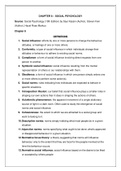
CHAPTER 8 – SOCIAL PSYCHOLOGY
Source: Social Psychology (10th Edition) by Saul Kassin (Author), Steven Fein
(Author), Hazel Rose Markus
Chapter 8
DEFINITIONS
1. Social influence: efforts by one or more persons to change the behaviour,
attitudes, or feelings of one or more others.
2. Conformity: a type of social influence in which individuals change their
attitudes or behaviour to adhere to existing social norms.
3. Compliance: a form of social influence involving direct requests from one
person to another.
4. Symbolic social influence: social influence resulting from the mental
representation of others or our relationships with them.
5. Obedience: a form of social influence in which one person simply orders one
or more others to perform some action(s).
6. Social norms: rules indicating how individuals are expected to behave in
specific situations.
7. Introspection illusion: our belief that social influence plays a smaller roles in
shaping our own actions than it does in shaping the actions of others.
8. Autokinetic phenomenon: the apparent movement of a single stationary
source of light in a dark room. Often used to study the emergence of social
norms and social influence.
9. Cohesiveness: the extent to which we are attracted to a social group and
want to belong to it.
10. Descriptive norms: norms simply indicting what most people do in a given
situation.
11. Injunctive norms: norms specifiying what ought to be done; what's approved
or disapproved behaviour in a given situation.
12. Normative focus theory: a theory suggesting that norms will influence
behaviour only to the extent that they are focal for the people involved at the
time the behaviour occurs.
13. Normative social influence: social influence based on the desire to be liked
or accepted by others people
, 14. Informational social influence: social influence based on the desire to be
correct (i.e. to possess accurate perceptions of the social world)
15. Foot-in-door technique: a procedure for gaining compliance in which
requesters begin with a small request and then, when this is granted, escalate
to a larger one (the one they actually desired all along).
16. Lowball procedure: a technique for gaining compliance in which an offer or
deal in changed to make it less attractive to the target person after this person
has accepted it.
17. Door-in-the-face technique: a procedure for gaining compliance in which
requesters begin with a large request and then, when this is refused, retreat to
a smaller one (the one they actually desired all along).
18. That's-not-all technique: a technique for gaining compliance in which
requesters offer additional benefits to target people before they have decided
whether to comply with or reject specific requests.
19. Playing hard to get: a technique that can be used for increasing compliance
by suggesting that a person or object is scarce and hard to obtain.
20. Deadline technique: a technique for increasing compliance in which target
people are told that they have only limited time to take advantage of some
offer or to obtain some item.
Social Influence: Changing Others' Behaviour
- Phishing: a fraudulent effort to obtain info that will permit the people who sent
it to gain access to your accounts
- Pharming: it redirects your web browser to what looks like your bank, utility
company/other secure locations so that you log in, just as you would on the
genuine sights - giving the "pharmers" access to your funds
• Social influence: efforts by 1/more persons to change the behaviour,
attitudes/feelings of 1/more others
Reason for social influence:
• To get what they want (e.g. money, valuables, confidential personal
information)
• To help people
Source: Social Psychology (10th Edition) by Saul Kassin (Author), Steven Fein
(Author), Hazel Rose Markus
Chapter 8
DEFINITIONS
1. Social influence: efforts by one or more persons to change the behaviour,
attitudes, or feelings of one or more others.
2. Conformity: a type of social influence in which individuals change their
attitudes or behaviour to adhere to existing social norms.
3. Compliance: a form of social influence involving direct requests from one
person to another.
4. Symbolic social influence: social influence resulting from the mental
representation of others or our relationships with them.
5. Obedience: a form of social influence in which one person simply orders one
or more others to perform some action(s).
6. Social norms: rules indicating how individuals are expected to behave in
specific situations.
7. Introspection illusion: our belief that social influence plays a smaller roles in
shaping our own actions than it does in shaping the actions of others.
8. Autokinetic phenomenon: the apparent movement of a single stationary
source of light in a dark room. Often used to study the emergence of social
norms and social influence.
9. Cohesiveness: the extent to which we are attracted to a social group and
want to belong to it.
10. Descriptive norms: norms simply indicting what most people do in a given
situation.
11. Injunctive norms: norms specifiying what ought to be done; what's approved
or disapproved behaviour in a given situation.
12. Normative focus theory: a theory suggesting that norms will influence
behaviour only to the extent that they are focal for the people involved at the
time the behaviour occurs.
13. Normative social influence: social influence based on the desire to be liked
or accepted by others people
, 14. Informational social influence: social influence based on the desire to be
correct (i.e. to possess accurate perceptions of the social world)
15. Foot-in-door technique: a procedure for gaining compliance in which
requesters begin with a small request and then, when this is granted, escalate
to a larger one (the one they actually desired all along).
16. Lowball procedure: a technique for gaining compliance in which an offer or
deal in changed to make it less attractive to the target person after this person
has accepted it.
17. Door-in-the-face technique: a procedure for gaining compliance in which
requesters begin with a large request and then, when this is refused, retreat to
a smaller one (the one they actually desired all along).
18. That's-not-all technique: a technique for gaining compliance in which
requesters offer additional benefits to target people before they have decided
whether to comply with or reject specific requests.
19. Playing hard to get: a technique that can be used for increasing compliance
by suggesting that a person or object is scarce and hard to obtain.
20. Deadline technique: a technique for increasing compliance in which target
people are told that they have only limited time to take advantage of some
offer or to obtain some item.
Social Influence: Changing Others' Behaviour
- Phishing: a fraudulent effort to obtain info that will permit the people who sent
it to gain access to your accounts
- Pharming: it redirects your web browser to what looks like your bank, utility
company/other secure locations so that you log in, just as you would on the
genuine sights - giving the "pharmers" access to your funds
• Social influence: efforts by 1/more persons to change the behaviour,
attitudes/feelings of 1/more others
Reason for social influence:
• To get what they want (e.g. money, valuables, confidential personal
information)
• To help people