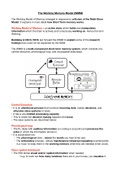
The Working Memory Model (WMM)
The Working Model of Memory emerged in response to criticism of the Multi-Store
Model. It explains in more detail how Short Term memory works.
Working Model of Memory = an active store which holds and manipulates
information which the brain is actively and consciously working on. Hence the term
Working.
Baddeley & Hitch (1974) put forward the WMM to explain some of the research
ndings that could not be explained by the MSM.
The WMM is a multi-component short-term memory system, which consists of a
central executive, phonological loop, and visuospatial sketchpad.
Central Executive:
• It is an attentional process that monitors incoming data, makes decisions, and
allocates slave systems to tasks.
• It has a very limited processing capacity.
• This is where the decision making happens (the boss)
• The slave systems are described below:
Phonological loop:
• The PL deals with auditory information (i.e coding is acoustic) and preserves the
order in which the information arrives in.
• It is subdivided into:
- The phonological store - stores the words you hear (inner ear).
- The articulatory process - allows maintenance rehearsal (repeating sounds/words
in a ‘loop’ to keep them in the working memory while they are needed) (inner voice).
Visuo-spatial sketchpad:
• The VSS stores visual and/or spatial information when needed.
→e.g. to work out how many windows there are in your house, you visualise it.
fi
The Working Model of Memory emerged in response to criticism of the Multi-Store
Model. It explains in more detail how Short Term memory works.
Working Model of Memory = an active store which holds and manipulates
information which the brain is actively and consciously working on. Hence the term
Working.
Baddeley & Hitch (1974) put forward the WMM to explain some of the research
ndings that could not be explained by the MSM.
The WMM is a multi-component short-term memory system, which consists of a
central executive, phonological loop, and visuospatial sketchpad.
Central Executive:
• It is an attentional process that monitors incoming data, makes decisions, and
allocates slave systems to tasks.
• It has a very limited processing capacity.
• This is where the decision making happens (the boss)
• The slave systems are described below:
Phonological loop:
• The PL deals with auditory information (i.e coding is acoustic) and preserves the
order in which the information arrives in.
• It is subdivided into:
- The phonological store - stores the words you hear (inner ear).
- The articulatory process - allows maintenance rehearsal (repeating sounds/words
in a ‘loop’ to keep them in the working memory while they are needed) (inner voice).
Visuo-spatial sketchpad:
• The VSS stores visual and/or spatial information when needed.
→e.g. to work out how many windows there are in your house, you visualise it.
fi