Taylor’s Notes Electrolysis Summary Page
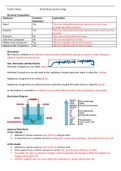
Electrical Conductivity
Substance Conducts Explanation
Electricity?
Metal Yes There are delocalised electrons which are free to move
through the lattice structure
Graphite Yes There are delocalised electrons between layers which are free
to move
Diamond No There are no delocalised electrons
Solid Ionic Compound No The ions are not free to move
Molten Ionic Compound Yes The ions separate and are free to move
Aqueous Ionic Compound Yes The ions separate and are free to move
Electrolysis
Electrolysis is defined as the chemical decomposition produced by passing an electric current through a
liquid or solution containing ions
Ions, Electrodes and Electrolytes
Positively charged ions are called cations
Positively charged ions are attracted to the negatively charged electrode which is called the cathode
Negatively charged ions are called anions
Negatively charged ions are attracted to the positively charged electrode which is called the anode
An electrolyte is a substance containing free ions that will decompose when it undergoes electrolysis
Electrolysis Diagram
Aqueous Electrolysis
At the Cathode
Whichever species wants to gain electrons will gain here
If metal ions are in solution are from a metal less reactive than hydrogen, the metal will be given off
At the Anode
Whichever species wants to lose electrons will lose here
If the species have a similar amount of control the concentration will have an effect
The halide ions give up electrons similarly well to hydroxide ions therefore either the halogens or
oxygen will be given off
All other negative ions are more stable than hydrogen so oxygen will be given off
Electrical Conductivity
Substance Conducts Explanation
Electricity?
Metal Yes There are delocalised electrons which are free to move
through the lattice structure
Graphite Yes There are delocalised electrons between layers which are free
to move
Diamond No There are no delocalised electrons
Solid Ionic Compound No The ions are not free to move
Molten Ionic Compound Yes The ions separate and are free to move
Aqueous Ionic Compound Yes The ions separate and are free to move
Electrolysis
Electrolysis is defined as the chemical decomposition produced by passing an electric current through a
liquid or solution containing ions
Ions, Electrodes and Electrolytes
Positively charged ions are called cations
Positively charged ions are attracted to the negatively charged electrode which is called the cathode
Negatively charged ions are called anions
Negatively charged ions are attracted to the positively charged electrode which is called the anode
An electrolyte is a substance containing free ions that will decompose when it undergoes electrolysis
Electrolysis Diagram
Aqueous Electrolysis
At the Cathode
Whichever species wants to gain electrons will gain here
If metal ions are in solution are from a metal less reactive than hydrogen, the metal will be given off
At the Anode
Whichever species wants to lose electrons will lose here
If the species have a similar amount of control the concentration will have an effect
The halide ions give up electrons similarly well to hydroxide ions therefore either the halogens or
oxygen will be given off
All other negative ions are more stable than hydrogen so oxygen will be given off