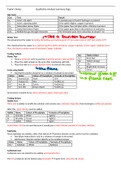
Taylor’s Notes Qualitative Analysis Summary Page
Gas Tests
Gas Test Result
H2 Insert a lit splint A squeaky pop is heard if hydrogen is present
O2 Insert a glowing splint If the splint relights, oxygen is present
Cl2 Damp Blue Litmus Paper If the paper foes red then white, chlorine is present
NH3 Damp Red Litmus Paper If the paper goes blue in the presence of ammonia
CO2 Bubble the gas through limewater The limewater goes from colourless to cloud if +ve
Water Test
The physical test for water is testing the boiling and melting point Pure water boils at 100° and melts at 0°C
The chemical test for water is to add the liquid to white anhydrous copper sulphate, of the copper sulphate turns
blue, the liquid contains water Hydrated Copper Sulphate
Testing Cations
Ion Flame Colour
Flame Test
1. Clean a nichrome wire to prevent impurities giving a false positive Ca2+ Brick Red
2. Place the solid sample on the wire after moistening with HCL Na+ Yellow Orange
3. Place the wire in a roaring Bunsen flame to observe the colour K+ Lilac
Li+ Bright Red/ Crimson
Tests using NaOH Cu2+ Green
Add NaOH solution dropwise to a solution of sample to be tested
Cation Name Colour of Precipitate Formula of Precipitate
NH4+ Ammonium None N/A
2+
Cu Copper (II) Blue Cu(OH)2(s)
Fe2+ Iron (II) Green Fe(OH)2(s)
Fe3+ Iron (III) Brown (Rust) Fe(OH)3(s)
Ammonium is tested for by damp red litmus paper which goes blue
Testing Anions
Halide Test
Nitric acid is added to acidify the solution and remove any carbonate impurities that would give a white precipitate
After this, silver nitrate must be added
Halide Name Colour of Precipitate Formula of Precipitate
Cl- Chloride White AgCl(s)
Br- Bromide Cream AgBr(s)
I- Iodide Yellow AgI(s)
Hydrochloric Acid is not used because it would give a false chloride positive Contains chloride
Sulphates
Most sulphates are soluble, other than barium Therefore barium can be used to test for sulphates
Add dilute hydrochloric acid to a solution of sample to be tested
Add barium chloride solution (BaCl2) to the acidified sample
Anion Name Colour of Precipitate Formula of Precipitate
SO4-2 Sulphate White BaSO4(s)
Carbonate ions
Carbonate ions are tested for by adding acid (usually HCL)
The CO2 produced can be tested using limewater It goes from colourless to cloudy
Gas Tests
Gas Test Result
H2 Insert a lit splint A squeaky pop is heard if hydrogen is present
O2 Insert a glowing splint If the splint relights, oxygen is present
Cl2 Damp Blue Litmus Paper If the paper foes red then white, chlorine is present
NH3 Damp Red Litmus Paper If the paper goes blue in the presence of ammonia
CO2 Bubble the gas through limewater The limewater goes from colourless to cloud if +ve
Water Test
The physical test for water is testing the boiling and melting point Pure water boils at 100° and melts at 0°C
The chemical test for water is to add the liquid to white anhydrous copper sulphate, of the copper sulphate turns
blue, the liquid contains water Hydrated Copper Sulphate
Testing Cations
Ion Flame Colour
Flame Test
1. Clean a nichrome wire to prevent impurities giving a false positive Ca2+ Brick Red
2. Place the solid sample on the wire after moistening with HCL Na+ Yellow Orange
3. Place the wire in a roaring Bunsen flame to observe the colour K+ Lilac
Li+ Bright Red/ Crimson
Tests using NaOH Cu2+ Green
Add NaOH solution dropwise to a solution of sample to be tested
Cation Name Colour of Precipitate Formula of Precipitate
NH4+ Ammonium None N/A
2+
Cu Copper (II) Blue Cu(OH)2(s)
Fe2+ Iron (II) Green Fe(OH)2(s)
Fe3+ Iron (III) Brown (Rust) Fe(OH)3(s)
Ammonium is tested for by damp red litmus paper which goes blue
Testing Anions
Halide Test
Nitric acid is added to acidify the solution and remove any carbonate impurities that would give a white precipitate
After this, silver nitrate must be added
Halide Name Colour of Precipitate Formula of Precipitate
Cl- Chloride White AgCl(s)
Br- Bromide Cream AgBr(s)
I- Iodide Yellow AgI(s)
Hydrochloric Acid is not used because it would give a false chloride positive Contains chloride
Sulphates
Most sulphates are soluble, other than barium Therefore barium can be used to test for sulphates
Add dilute hydrochloric acid to a solution of sample to be tested
Add barium chloride solution (BaCl2) to the acidified sample
Anion Name Colour of Precipitate Formula of Precipitate
SO4-2 Sulphate White BaSO4(s)
Carbonate ions
Carbonate ions are tested for by adding acid (usually HCL)
The CO2 produced can be tested using limewater It goes from colourless to cloudy