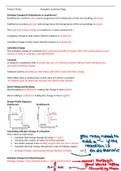
Taylor’s Notes Energetics Summary Page
Enthalpy Changes Endothermic or exothermic?
Endothermic reactions take in heat energy hence the temperature of the surroundings decreases
Exothermic reactions give out heat energy hence the temperature of the surroundings increases
The total heat energy change in a reaction is Q and is measured in J
A negative change in heat means that the reaction is exothermic
A positive change in heat means that the reaction is endothermic
Activation Energy
The activation energy of a reaction is the minimum quantity of energy which the reacting species must
possess in order to undergo a specified reaction
Catalysts
A catalyst is a substance that increases the rate of a chemical reaction without itself undergoing any
permanent chemical change
Catalysts work by providing an alternative path with a lower activation energy
What effect does a catalyst have on the value of (∆H) for a reaction?
Catalysts have no effect but increases the speed of the reaction
Bond Making and Breaking
Bond breaking is endothermic making the change in heat positive
Bond making is exothermic making the change in heat negative
Energy Profile Diagrams
Exothermic: Endothermic:
Calculating Enthalpy Change of a Reaction
This is done in a few steps:
Calculate heat energy change (q) using q = mc∆T
Calculate the number of moles (n) of the reactants
See which reactant is the limiting reagent (the one not in excess)
Calculate the heat energy released per mole of limiting reagent:
q
Enthalpy change = Heat Energy Change/Number of Moles ∆H=
n
Enthalpy Change from Bond Energies
Enthalpy Change = Sum of bonds broken – sum of bonds formed
Enthalpy Changes Endothermic or exothermic?
Endothermic reactions take in heat energy hence the temperature of the surroundings decreases
Exothermic reactions give out heat energy hence the temperature of the surroundings increases
The total heat energy change in a reaction is Q and is measured in J
A negative change in heat means that the reaction is exothermic
A positive change in heat means that the reaction is endothermic
Activation Energy
The activation energy of a reaction is the minimum quantity of energy which the reacting species must
possess in order to undergo a specified reaction
Catalysts
A catalyst is a substance that increases the rate of a chemical reaction without itself undergoing any
permanent chemical change
Catalysts work by providing an alternative path with a lower activation energy
What effect does a catalyst have on the value of (∆H) for a reaction?
Catalysts have no effect but increases the speed of the reaction
Bond Making and Breaking
Bond breaking is endothermic making the change in heat positive
Bond making is exothermic making the change in heat negative
Energy Profile Diagrams
Exothermic: Endothermic:
Calculating Enthalpy Change of a Reaction
This is done in a few steps:
Calculate heat energy change (q) using q = mc∆T
Calculate the number of moles (n) of the reactants
See which reactant is the limiting reagent (the one not in excess)
Calculate the heat energy released per mole of limiting reagent:
q
Enthalpy change = Heat Energy Change/Number of Moles ∆H=
n
Enthalpy Change from Bond Energies
Enthalpy Change = Sum of bonds broken – sum of bonds formed