Taylor’s Notes Rates of Reaction Summary Page
Reaction Requirements
To react, particles must
Collide
Have the correct spatial orientation
Have energy > activation energy (minimum energy required for a reaction)
Activation Energy
The activation energy of a reaction is the minimum energy required for a reaction to occur
Factors Affecting the Rate of Reaction
Increasing the temperature leads to particles having a higher kinetic energy
Particles will collide more frequently Only slightly increases rate
Particles collide with more energy More collisions have energy > Ea Higher proportion of collision are successful
The higher the pressure of the gas, the higher the number of particles per unit volume The frequency of collisions incr.
Increasing concentration means there are more particles per unit volume Frequency of collisions increases
For non-porous solids, reactions can only occur on the surface, as this is the only place that reagents can collide Breaking up
the solid into small pieces or a powder increases surface area Frequency of collisions increases
Measuring Rate
Why is the cotton wall in the top of the conical flask when measuring the mass lost?
To allow the gas given off to escape
Rate Graphs
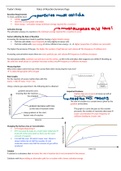
For the reaction of excess marble chips with HCL
CaCO3 + 2HCL CaCl2 + H2O + CO2
Using a volume gas experiment, the following plot is obtained
Important Features
Marble chips are in excess Some are left at
the end of the reaction
The rate of reaction at a certain time is given by the
gradient at that time
The graph is a curve because as the reaction
proceeds, the number of reactants decreases
Lower concentration Lower frequency of
collisions leading to a lower rate
Changing the Surface Area or Concentration
A Original Experiment
B Increased SA leads to a much faster initial rate
levels off at the same point as there are the same
amount of reagents
C Half the conc. Of acid Lower conc. Means a
slower initial rate Half the number of acid
molecules means only half the amount of gas will be
produced
Catalyst
A catalyst is a substance that increases the rate of reaction but is not consumed in the process
Catalysts work by providing an alternative path for a reaction with a lower activation energy
Reaction Requirements
To react, particles must
Collide
Have the correct spatial orientation
Have energy > activation energy (minimum energy required for a reaction)
Activation Energy
The activation energy of a reaction is the minimum energy required for a reaction to occur
Factors Affecting the Rate of Reaction
Increasing the temperature leads to particles having a higher kinetic energy
Particles will collide more frequently Only slightly increases rate
Particles collide with more energy More collisions have energy > Ea Higher proportion of collision are successful
The higher the pressure of the gas, the higher the number of particles per unit volume The frequency of collisions incr.
Increasing concentration means there are more particles per unit volume Frequency of collisions increases
For non-porous solids, reactions can only occur on the surface, as this is the only place that reagents can collide Breaking up
the solid into small pieces or a powder increases surface area Frequency of collisions increases
Measuring Rate
Why is the cotton wall in the top of the conical flask when measuring the mass lost?
To allow the gas given off to escape
Rate Graphs
For the reaction of excess marble chips with HCL
CaCO3 + 2HCL CaCl2 + H2O + CO2
Using a volume gas experiment, the following plot is obtained
Important Features
Marble chips are in excess Some are left at
the end of the reaction
The rate of reaction at a certain time is given by the
gradient at that time
The graph is a curve because as the reaction
proceeds, the number of reactants decreases
Lower concentration Lower frequency of
collisions leading to a lower rate
Changing the Surface Area or Concentration
A Original Experiment
B Increased SA leads to a much faster initial rate
levels off at the same point as there are the same
amount of reagents
C Half the conc. Of acid Lower conc. Means a
slower initial rate Half the number of acid
molecules means only half the amount of gas will be
produced
Catalyst
A catalyst is a substance that increases the rate of reaction but is not consumed in the process
Catalysts work by providing an alternative path for a reaction with a lower activation energy