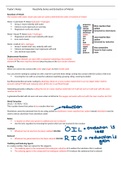
Taylor’s Notes Reactivity Series and Extraction of Metals
Reactions of Metals
The reaction with water, steam and acids are used to determine the order of reactivity of metals
Metal + Cold Water Metal Hydroxide + Hydrogen
Group 1 reacts violently with water
Calcium reacts vigorously on warming
Magnesium reacts very slowly
Metal + Steam Metal Oxide + Hydrogen
Magnesium and zinc react violently with steam
Iron reacts slowly
Metal + Acids Salt + Hydrogen
Group 1 metals react very violently with acid
Calcium and magnesium react vigorously with acid
Zinc and iron react slowly
Displacement Reactions
A more reactive element can react with a compound containing a less reactive
element The more reactive element takes the place of the less reactive element
Rusting
When iron comes into contact with water and oxygen to form iron(II) oxide
You can prevent rusting by coating iron with a barrier to prevent these things coming into contact with the surface of the iron:
Covering the iron with an unreactive substance (painting, greasing, oiling, covering in plastic)
Sacrificial protection prevents rusting by attaching a block of a more reactive metal (zinc) to an iron object (ship’s hull) to
prevent rusting Will need replacing when all the zinc is sacrificed though
Galvanising prevents rusting by coating the iron in a more reactive metal (zinc) It will not rust as it will react with the more
reactive zinc first
A galvanised bucket will not even rust even when scratched as the oxygen and water will react with the more reactive zinc first
Metal Extraction
2Fe2O3 + 3C2Fe + 3CO2
This reaction shows that carbon is less reactive than iron
Aluminium cannot be extracted from its ore using carbon as aluminium is more reactive than carbon instead electrolysis must be
used to extract aluminium from aluminium oxide
Redox
A reaction in which one species is oxidised and one is reduced
Use the ionic equation by removing the species which are not involved in the reaction
Oxidised
Whatever has lost electrons has been oxidised (OIL RIG)
Reduced
Whatever has gained electrons has been reduced (OIL RIG)
Oxidising and Reducing Agents
In a redox reaction, there are names for the reagents:
The oxidising agent is the compound that undergoes reduction It oxidises the substance that is oxidised
The reducing agents is the compound that undergoes oxidation It reduces the substance that is reduced
Reactions of Metals
The reaction with water, steam and acids are used to determine the order of reactivity of metals
Metal + Cold Water Metal Hydroxide + Hydrogen
Group 1 reacts violently with water
Calcium reacts vigorously on warming
Magnesium reacts very slowly
Metal + Steam Metal Oxide + Hydrogen
Magnesium and zinc react violently with steam
Iron reacts slowly
Metal + Acids Salt + Hydrogen
Group 1 metals react very violently with acid
Calcium and magnesium react vigorously with acid
Zinc and iron react slowly
Displacement Reactions
A more reactive element can react with a compound containing a less reactive
element The more reactive element takes the place of the less reactive element
Rusting
When iron comes into contact with water and oxygen to form iron(II) oxide
You can prevent rusting by coating iron with a barrier to prevent these things coming into contact with the surface of the iron:
Covering the iron with an unreactive substance (painting, greasing, oiling, covering in plastic)
Sacrificial protection prevents rusting by attaching a block of a more reactive metal (zinc) to an iron object (ship’s hull) to
prevent rusting Will need replacing when all the zinc is sacrificed though
Galvanising prevents rusting by coating the iron in a more reactive metal (zinc) It will not rust as it will react with the more
reactive zinc first
A galvanised bucket will not even rust even when scratched as the oxygen and water will react with the more reactive zinc first
Metal Extraction
2Fe2O3 + 3C2Fe + 3CO2
This reaction shows that carbon is less reactive than iron
Aluminium cannot be extracted from its ore using carbon as aluminium is more reactive than carbon instead electrolysis must be
used to extract aluminium from aluminium oxide
Redox
A reaction in which one species is oxidised and one is reduced
Use the ionic equation by removing the species which are not involved in the reaction
Oxidised
Whatever has lost electrons has been oxidised (OIL RIG)
Reduced
Whatever has gained electrons has been reduced (OIL RIG)
Oxidising and Reducing Agents
In a redox reaction, there are names for the reagents:
The oxidising agent is the compound that undergoes reduction It oxidises the substance that is oxidised
The reducing agents is the compound that undergoes oxidation It reduces the substance that is reduced