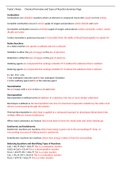
Taylor’s Notes Chemical Formulae and Types of Reaction Summary Page
Combustion
Combustions are oxidation reactions where an element or compound reacts with oxygen to form energy
Complete combustion occurs in excess supply of oxygen and produces carbon dioxide and water
Incomplete combustion occurs in a limited supply of oxygen and produces Carbon monoxide, carbon, carbon
dioxide and water
Carbon monoxide is poisonous because it irreversibly limits the ability of blood (haemoglobin) to uptake O2
Redox Reactions
In a redox reaction one species is oxidised and one is reduced
Oxidation is either the gain of oxygen or the loss of electrons
Reduction is either the loss of oxygen or the gain of electrons
Oxidising agents are compounds that undergo reduction It oxidises the substance than is oxidised
Reducing agents are compounds that undergo oxidation It reduces the substance that is reduced
K + Na+ K+ + Na
K has undergone reduction and Na has undergone Oxidation
K is the oxidising agent and Na is the reducing agent
Neutralisation
An acid reacts with a base to form a salt and water
Decomposition
Decomposition is defined as the breakdown of a substance into two or more simpler substances
Electrolysis is defined as the decomposition into ions of a chemical compound in solution by the action of an
electric current passing through the solution.
Thermal decomposition is when heat is applied to a compound causing it to decompose (break down) into
multiple different chemical substances.
When metal carbonates are heated, they break down to form the metal oxide and carbon dioxide gas
Exothermic and Endothermic
Exothermic reactions are reactions where heat energy is given out to the surroundings Temp. of
surroundings increases Making bonds is exothermic
Endothermic reactions are reactions where heat energy is taken in from the surroundings
Balancing Equations and Identifying Types of Reactions
C3H8 + 3O2 4H2O + 3CO2 This is a combustion reaction
CaCO3 CaO + CO2 This is a decomposition reaction
Fe2O3 + 2CO 2Fe + 2CO2 This is a redox reaction
C2H4 + 2O2 2CO + 2H2O This is a combustion reaction
Fe2O3 + Al Fe + Al2O3 This is a redox reaction
Combustion
Combustions are oxidation reactions where an element or compound reacts with oxygen to form energy
Complete combustion occurs in excess supply of oxygen and produces carbon dioxide and water
Incomplete combustion occurs in a limited supply of oxygen and produces Carbon monoxide, carbon, carbon
dioxide and water
Carbon monoxide is poisonous because it irreversibly limits the ability of blood (haemoglobin) to uptake O2
Redox Reactions
In a redox reaction one species is oxidised and one is reduced
Oxidation is either the gain of oxygen or the loss of electrons
Reduction is either the loss of oxygen or the gain of electrons
Oxidising agents are compounds that undergo reduction It oxidises the substance than is oxidised
Reducing agents are compounds that undergo oxidation It reduces the substance that is reduced
K + Na+ K+ + Na
K has undergone reduction and Na has undergone Oxidation
K is the oxidising agent and Na is the reducing agent
Neutralisation
An acid reacts with a base to form a salt and water
Decomposition
Decomposition is defined as the breakdown of a substance into two or more simpler substances
Electrolysis is defined as the decomposition into ions of a chemical compound in solution by the action of an
electric current passing through the solution.
Thermal decomposition is when heat is applied to a compound causing it to decompose (break down) into
multiple different chemical substances.
When metal carbonates are heated, they break down to form the metal oxide and carbon dioxide gas
Exothermic and Endothermic
Exothermic reactions are reactions where heat energy is given out to the surroundings Temp. of
surroundings increases Making bonds is exothermic
Endothermic reactions are reactions where heat energy is taken in from the surroundings
Balancing Equations and Identifying Types of Reactions
C3H8 + 3O2 4H2O + 3CO2 This is a combustion reaction
CaCO3 CaO + CO2 This is a decomposition reaction
Fe2O3 + 2CO 2Fe + 2CO2 This is a redox reaction
C2H4 + 2O2 2CO + 2H2O This is a combustion reaction
Fe2O3 + Al Fe + Al2O3 This is a redox reaction