
Taylor’s Notes Bonding Summary Page
Ionic Bonding
Ionic bonding is defined as an electrostatic between oppositely charged ions
In ionic bonding negative atoms lose electrons to form positive ions and positive atoms gain electrons to
form negative ions
Each ion has a full outer shell of electrons
Ionic compounds have an overall charge of 0
Covalent bonding
Covalent bonding is defined as an electrostatic attraction between the bonding nuclei and a shared pair of
electrons
Covalent bonding occurs between non-metal and involves a shared pair of electrons
Metallic Bonding
Metallic bonding is defined as an electrostatic attraction between positive ion and a sea of de-localised
electrons
Metals are very malleable because the ions are not bound to one another, instead they are attracted to the
sea of delocalised electrons The layers of ions can slide over each other
Alloys are much harder than metals because the different-sized atoms of the mixed metals make the
atomic layers less regular, so they cannot slide as easily
Metals and alloys conduct electricity because the delocalised electrons are free to move through the lattice
structure, as they are not associated with any ion
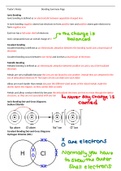
Ionic Bonding Dot-and-Cross Diagrams
Sodium Chloride
Covalent Bonding Dot-and-Cross Diagrams
Hydrogen Chloride (HCL)
Ionic Bonding
Ionic bonding is defined as an electrostatic between oppositely charged ions
In ionic bonding negative atoms lose electrons to form positive ions and positive atoms gain electrons to
form negative ions
Each ion has a full outer shell of electrons
Ionic compounds have an overall charge of 0
Covalent bonding
Covalent bonding is defined as an electrostatic attraction between the bonding nuclei and a shared pair of
electrons
Covalent bonding occurs between non-metal and involves a shared pair of electrons
Metallic Bonding
Metallic bonding is defined as an electrostatic attraction between positive ion and a sea of de-localised
electrons
Metals are very malleable because the ions are not bound to one another, instead they are attracted to the
sea of delocalised electrons The layers of ions can slide over each other
Alloys are much harder than metals because the different-sized atoms of the mixed metals make the
atomic layers less regular, so they cannot slide as easily
Metals and alloys conduct electricity because the delocalised electrons are free to move through the lattice
structure, as they are not associated with any ion
Ionic Bonding Dot-and-Cross Diagrams
Sodium Chloride
Covalent Bonding Dot-and-Cross Diagrams
Hydrogen Chloride (HCL)


