
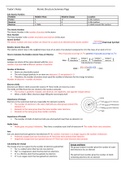
Taylor’s Notes Atomic Structure Summary Page
Sub-Atomic Particles
Particles Relative Mass Relative Charge Location
Proton 1 1+ In the nucleus
Neutron 1 0 In the nucleus
Electron 1/1836 1- In shells around the nucleus
The Atomic Number
The Atomic Number is the number of protons in the atoms
Mass Number
The Mass Number is the number of protons and neutrons in the atom
Atomic Symbol
The atomic number and mass number are shown for an atom of an element by the atomic symbol:
Relative Atomic Mass (Mr)
The relative atomic mass is the weighted mean mass of an atom of an element compared to 1/12 the mass of an atom of C-12
How to Calculate the Relative Atomic Mass of Chlorine:
Isotopes
Isotopes are atoms of the same element with the same
number of protons but a different number of neutrons
Number of Electrons
Atoms are electrically neutral
The only charged particles in an atom are electrons (-1) and protons (+1)
Therefore, the number of protons must equal the number of electrons for the charge to balance
Number of electrons = number of protons
Electron shells
Electrons are filled in shells around the nucleus These shells are show by circles:
The shells are filled from the one closest to the nucleus outwards:
The nucleus is positively charged, and electrons are negatively, and opposite charges attract
When a shell is filled, electrons begin filling the next empty shell
Importance of Groups
Electrons in the outermost shell are responsible for element reactivity
The number of electrons in the outer shell tells you what group (column) the
element is in
Elements in the same group have the same number outer electrons
Elements in the same group have similar reactivity
Importance of Periods
The number of shells of electrons tells you what period (row) than an element is in
Noble Gases
Noble gases are group 0 elements. They have a complete outer shell of electrons This makes them very unreactive
Ions
Ions are atoms that have gained or lost electrons The number of protons is no longer equal to the number of electrons
Positively charged ions have lost electrons They have more protons than electrons
Negatively charged ions have gained electrons They have more electrons than protons
Calculating Ion Charge Groups and Rows
The charge of an ion is given by the number of electrons gained/lost The group (column) number gives the number of outer
Na+ is a sodium atom that has lost one electron shell electrons for an element
Mg2+ is a magnesium atom that has lost two electrons
Cl- is a chlorine atom that has gained one electron The period (row) number gives the number of shells
O2- is an oxygen atom that has gained two electrons containing electrons for an element
Sub-Atomic Particles
Particles Relative Mass Relative Charge Location
Proton 1 1+ In the nucleus
Neutron 1 0 In the nucleus
Electron 1/1836 1- In shells around the nucleus
The Atomic Number
The Atomic Number is the number of protons in the atoms
Mass Number
The Mass Number is the number of protons and neutrons in the atom
Atomic Symbol
The atomic number and mass number are shown for an atom of an element by the atomic symbol:
Relative Atomic Mass (Mr)
The relative atomic mass is the weighted mean mass of an atom of an element compared to 1/12 the mass of an atom of C-12
How to Calculate the Relative Atomic Mass of Chlorine:
Isotopes
Isotopes are atoms of the same element with the same
number of protons but a different number of neutrons
Number of Electrons
Atoms are electrically neutral
The only charged particles in an atom are electrons (-1) and protons (+1)
Therefore, the number of protons must equal the number of electrons for the charge to balance
Number of electrons = number of protons
Electron shells
Electrons are filled in shells around the nucleus These shells are show by circles:
The shells are filled from the one closest to the nucleus outwards:
The nucleus is positively charged, and electrons are negatively, and opposite charges attract
When a shell is filled, electrons begin filling the next empty shell
Importance of Groups
Electrons in the outermost shell are responsible for element reactivity
The number of electrons in the outer shell tells you what group (column) the
element is in
Elements in the same group have the same number outer electrons
Elements in the same group have similar reactivity
Importance of Periods
The number of shells of electrons tells you what period (row) than an element is in
Noble Gases
Noble gases are group 0 elements. They have a complete outer shell of electrons This makes them very unreactive
Ions
Ions are atoms that have gained or lost electrons The number of protons is no longer equal to the number of electrons
Positively charged ions have lost electrons They have more protons than electrons
Negatively charged ions have gained electrons They have more electrons than protons
Calculating Ion Charge Groups and Rows
The charge of an ion is given by the number of electrons gained/lost The group (column) number gives the number of outer
Na+ is a sodium atom that has lost one electron shell electrons for an element
Mg2+ is a magnesium atom that has lost two electrons
Cl- is a chlorine atom that has gained one electron The period (row) number gives the number of shells
O2- is an oxygen atom that has gained two electrons containing electrons for an element


