Taylor’s Notes Amines and Amino Acids
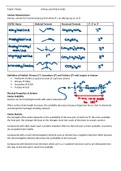
Amines Nomenclature
Amines contain the functional group R3N where R = an alkyl group or an H
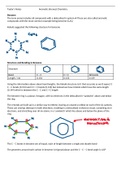
IUPAC Name Skeletal Formula Structural Formula 1°, 2° or 3°
Definition of Methyl, Primary (1°), Secondary (2°) and Tertiary (3°) with respect to Amines
Methyl CH3NH2 (a special version of a primary amine)
Primary RNH2
Secondary R2NH
Tertiary R3N
Physical Properties of Amines
Amine Solubility
Amines can form hydrogen bonds with water molecules
When carbon chain length increases, the solubility decreases because dispersion forces start to dominate
and disrupt the hydrogen bonding network
Amine Basicity
The strength of the amine depends on the availability of the lone pair of electrons The more available
the lone pair, the stronger the base as the nitrogen must lose a pair of electrons to accept a proton
Compounds with alkyl chains have a positive inductive effect so the lone pair is more available, so protons
are accepted more readily
Compounds with a more electronegative element such as chlorine has a negative inductive effect because
the electronegative element decreases the availability of the lone pair
Compounds with benzene have electrons which are in a -sandwich structure and so are delocalised into
the ring, so the lone pair is much less available
, Taylor’s Notes Amines and Amino Acids
Preparation of Amines
Reduction of Nitriles
Nitriles can be used to synthesise primary amines using LiAlH 4 in dry ether (NaBH4 doesn’t work)
R-C≡N + 4 [H] R-CH2NH2
Reduction of Nitrobenzene
Nitrobenzene is commonly used to make aromatic amines using Sn/conc. HCl
This reaction is a reduction because you are adding hydrogen
Aromatic amines are used for azo-dyes
Nucleophilic Substitution of Halogenoalkanes
Amines are produced by heating halogenoalkanes in a sealed tube with an excess of ammonia dissolved in
ethanol
A primary amine is formed: CH3CH2NH2 + 2NH3 CH3CH2NH2 + NH4Br
Mechanism for Excess Ammonia with Bromoethane
The primary amine produced has a lone pair and will react with more halogenoalkanes to form a secondary
amine and then a tertiary amine
Amines Nomenclature
Amines contain the functional group R3N where R = an alkyl group or an H
IUPAC Name Skeletal Formula Structural Formula 1°, 2° or 3°
Definition of Methyl, Primary (1°), Secondary (2°) and Tertiary (3°) with respect to Amines
Methyl CH3NH2 (a special version of a primary amine)
Primary RNH2
Secondary R2NH
Tertiary R3N
Physical Properties of Amines
Amine Solubility
Amines can form hydrogen bonds with water molecules
When carbon chain length increases, the solubility decreases because dispersion forces start to dominate
and disrupt the hydrogen bonding network
Amine Basicity
The strength of the amine depends on the availability of the lone pair of electrons The more available
the lone pair, the stronger the base as the nitrogen must lose a pair of electrons to accept a proton
Compounds with alkyl chains have a positive inductive effect so the lone pair is more available, so protons
are accepted more readily
Compounds with a more electronegative element such as chlorine has a negative inductive effect because
the electronegative element decreases the availability of the lone pair
Compounds with benzene have electrons which are in a -sandwich structure and so are delocalised into
the ring, so the lone pair is much less available
, Taylor’s Notes Amines and Amino Acids
Preparation of Amines
Reduction of Nitriles
Nitriles can be used to synthesise primary amines using LiAlH 4 in dry ether (NaBH4 doesn’t work)
R-C≡N + 4 [H] R-CH2NH2
Reduction of Nitrobenzene
Nitrobenzene is commonly used to make aromatic amines using Sn/conc. HCl
This reaction is a reduction because you are adding hydrogen
Aromatic amines are used for azo-dyes
Nucleophilic Substitution of Halogenoalkanes
Amines are produced by heating halogenoalkanes in a sealed tube with an excess of ammonia dissolved in
ethanol
A primary amine is formed: CH3CH2NH2 + 2NH3 CH3CH2NH2 + NH4Br
Mechanism for Excess Ammonia with Bromoethane
The primary amine produced has a lone pair and will react with more halogenoalkanes to form a secondary
amine and then a tertiary amine