Taylor’s Notes Carboxylic Acids and their Derivatives
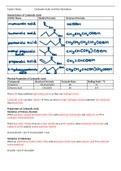
Nomenclature of Carboxylic Acids
IUPAC Name Skeletal Formula Structural Formula
Physical Properties of Carboxylic Acids
Compound Structural Formula Formula Mass Boiling Point / °C
Propanol CH3CH2CH2OH 60 97
Ethanoic Acid CH3COOH 60 119
They both have relatively high boiling points as they can hydrogen bond
Carboxylic acids can form ‘dimers’ They can form stronger hydrogen bonding between two molecules
than in alcohols
Preparation of Carboxylic Acids
Oxidation of Primary Alcohols
When a primary alcohol is heated under reflux with potassium dichromate and sulphuric acid A
carboxylic acid is produced
There is a colour change from an orange solution to a green solution when potassium dichromate and
sulphuric acid is used to oxidise a primary alcohol
CH3CH2CH2OH + [O] CH3CH2COOH + H2O
Oxidation of Aldehydes
When an aldehyde is heated under reflux with potassium dichromate and sulphuric acid A carboxylic
acid is produced
CH3CHO + [O] CH3COOH
, Taylor’s Notes Carboxylic Acids and their Derivatives
Chemical Properties
Carboxylic acids are proton donors, however they are weak acids so only partially dissociate
Neutralisation Reactions
Carboxylic acids react with alkalis, carbonates and hydrogen carbonates to form salts
Ethanoic Acid + Sodium Hydroxide = CH3COOH + NaOH CH3COO-Na+ + H2O
Ethanoic Acid + Sodium Carbonate = 2CH3COOH + Na2CO3 2CH3COO-Na+ + CO2 + H2O
Ethanoic Acid + Sodium Hydrogen Carbonate = CH3COOH + NaHCO3 CH3COO-Na+ + CO2 + H2O
Reduction of Carboxylic Acids
Carboxylic acids are formed by the oxidation of primary alcohols and can be converted back to these
compounds using a strong reducing agent
LiAlH4 in a dry ether solvent can reduce a carboxylic acid to a primary alcohol
NaBH4 is not a strong enough reducing agent so will not work
CH3CH2COOH + 4[H] CH3CH2CH2OH + H2O
HCOOH + 4[H] CH3OH + H2O
Esters
Carboxylic acids react with alcohols in the presence of concentrated sulphuric acid catalyst to form an ester
and water
Esters are named from the alkyl group of the alcohol and the -oate from the carboxylic acid
IUPAC Name Skeletal Formula Structural Formula
Nomenclature of Carboxylic Acids
IUPAC Name Skeletal Formula Structural Formula
Physical Properties of Carboxylic Acids
Compound Structural Formula Formula Mass Boiling Point / °C
Propanol CH3CH2CH2OH 60 97
Ethanoic Acid CH3COOH 60 119
They both have relatively high boiling points as they can hydrogen bond
Carboxylic acids can form ‘dimers’ They can form stronger hydrogen bonding between two molecules
than in alcohols
Preparation of Carboxylic Acids
Oxidation of Primary Alcohols
When a primary alcohol is heated under reflux with potassium dichromate and sulphuric acid A
carboxylic acid is produced
There is a colour change from an orange solution to a green solution when potassium dichromate and
sulphuric acid is used to oxidise a primary alcohol
CH3CH2CH2OH + [O] CH3CH2COOH + H2O
Oxidation of Aldehydes
When an aldehyde is heated under reflux with potassium dichromate and sulphuric acid A carboxylic
acid is produced
CH3CHO + [O] CH3COOH
, Taylor’s Notes Carboxylic Acids and their Derivatives
Chemical Properties
Carboxylic acids are proton donors, however they are weak acids so only partially dissociate
Neutralisation Reactions
Carboxylic acids react with alkalis, carbonates and hydrogen carbonates to form salts
Ethanoic Acid + Sodium Hydroxide = CH3COOH + NaOH CH3COO-Na+ + H2O
Ethanoic Acid + Sodium Carbonate = 2CH3COOH + Na2CO3 2CH3COO-Na+ + CO2 + H2O
Ethanoic Acid + Sodium Hydrogen Carbonate = CH3COOH + NaHCO3 CH3COO-Na+ + CO2 + H2O
Reduction of Carboxylic Acids
Carboxylic acids are formed by the oxidation of primary alcohols and can be converted back to these
compounds using a strong reducing agent
LiAlH4 in a dry ether solvent can reduce a carboxylic acid to a primary alcohol
NaBH4 is not a strong enough reducing agent so will not work
CH3CH2COOH + 4[H] CH3CH2CH2OH + H2O
HCOOH + 4[H] CH3OH + H2O
Esters
Carboxylic acids react with alcohols in the presence of concentrated sulphuric acid catalyst to form an ester
and water
Esters are named from the alkyl group of the alcohol and the -oate from the carboxylic acid
IUPAC Name Skeletal Formula Structural Formula