

Taylor’s Notes Alkenes
Bonding in Alkenes
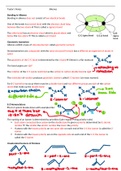
Bonding in alkenes does not consist of two identical bonds
One of the bonds is a normal bond with the electron cloud lying
between the two atoms This is called a sigma/σ bond
The other bond has an electron cloud which is placed above and
below the two atoms This is called a pi/π bond
Geometric Isomerism
Alkenes exhibit a type of stereoisomerism called geometric isomeric
Stereoisomerism are compounds with the same structural formula but a different arrangement of atoms in
space
The geometry of the C=C bond is determined by the π bond Ethene is a flat molecule
The bond angles are 120°
The rotation of the C=C axis is restricted as the carbon to carbon double bond is rigid
The restriction of rotation produces geometric isomers called E-Z isomers (cis-trans isomers)
For E-Z isomerism to occur there must be a double bond and two different groups on each of the carbon
atoms that make up the double bond
E-Z Nomenclature
The E-Z system breaks down with examples like:
The naming of an isomer is determined by priorities (Cahn-Ingold-Prelog priority rules)
Each atom connected to a carbon on the double bond is given a priority determined by its atomic
number The smaller the atomic number the lower the priority
If atoms with the lowest priority on zee zame zide on each end of the C=C the isomer is called the Z-
isomer
If atoms with the lowest priority are on the opposite side on each end of the C=C the isomer is
called the E-isomer
Unsaturated Isomers of Pentene
, Taylor’s Notes Alkenes
IUPAC Name Structure Exhibits Geometric E Isomer Z Isomer
Isomerism
Skeletal Formula E or Z Isomer? IUPAC Name
Reactions of Alkenes
Alkenes are more reactive than alkanes because of the C=C bond
It is possible for the double bond to break, allowing each carbon to form a new bond, which is often
energetically favourable Halogens, hydrogen halides, hydrogen and conc sulphuric acid will react with
alkenes in addition reactions
Bonding in Alkenes
Bonding in alkenes does not consist of two identical bonds
One of the bonds is a normal bond with the electron cloud lying
between the two atoms This is called a sigma/σ bond
The other bond has an electron cloud which is placed above and
below the two atoms This is called a pi/π bond
Geometric Isomerism
Alkenes exhibit a type of stereoisomerism called geometric isomeric
Stereoisomerism are compounds with the same structural formula but a different arrangement of atoms in
space
The geometry of the C=C bond is determined by the π bond Ethene is a flat molecule
The bond angles are 120°
The rotation of the C=C axis is restricted as the carbon to carbon double bond is rigid
The restriction of rotation produces geometric isomers called E-Z isomers (cis-trans isomers)
For E-Z isomerism to occur there must be a double bond and two different groups on each of the carbon
atoms that make up the double bond
E-Z Nomenclature
The E-Z system breaks down with examples like:
The naming of an isomer is determined by priorities (Cahn-Ingold-Prelog priority rules)
Each atom connected to a carbon on the double bond is given a priority determined by its atomic
number The smaller the atomic number the lower the priority
If atoms with the lowest priority on zee zame zide on each end of the C=C the isomer is called the Z-
isomer
If atoms with the lowest priority are on the opposite side on each end of the C=C the isomer is
called the E-isomer
Unsaturated Isomers of Pentene
, Taylor’s Notes Alkenes
IUPAC Name Structure Exhibits Geometric E Isomer Z Isomer
Isomerism
Skeletal Formula E or Z Isomer? IUPAC Name
Reactions of Alkenes
Alkenes are more reactive than alkanes because of the C=C bond
It is possible for the double bond to break, allowing each carbon to form a new bond, which is often
energetically favourable Halogens, hydrogen halides, hydrogen and conc sulphuric acid will react with
alkenes in addition reactions


