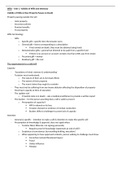
Wills – Unit 1. Validity of Wills and Intestacy
Validity of Wills & How Property Passes on Death
Property passing outside the will
- Joint property
- Insurance policies
- Pension benefits
- Trust property
Wills terminology
- Gifts:
o Specific gift = specific item the testator owns
o General gift = items corresponding to a description
If not owned on death, they must be obtained using funds
o Demonstrative gifts = general but directed to be paid from a specific fund
If there is no account or account contains less than £500, pay from estate
o Pecuniary gift = money
o Residuary gift = the rest
The requirements for a valid will
Capacity
- ‘Soundness of mind, memory & understanding’
- Testators must understand:
o The nature of their act & its broad effects
o The extent of their property
o The moral claims they ought to consider
- They must not be suffering from any insane delusion affecting the disposition of property
- Must have capacity at time of execution
- The ‘golden rule’
o If mental state is in doubt – ask a medical practitioner to provide a written report
- The burden – for the person asserting that a will is valid to prove it
o Presumption of capacity if
Will is rational on its face
Testator showed no evidence of mental conduction
Burden shifts to challenger to prove lack of capacity
Intention
- General & specific – intention to make a will & intention to make this specific will
- Presumption of knowledge & approval, does not apply when:
o Testator blind, illiterate, not signing personally
Requires proof of knowledge (statement at end of will?)
o Suspicious circumstances (surrounding drafting, execution)
o When appearing to have approved contents, person wishing to challenge must show
Force/fear (actual/threatened injury)
Fraud
Undue influence
Mistake
,Formalities of execution
- In writing & signed in the presence of 2 witnesses (who sign)
- Intention for signature to give will effect
Privileged wills
- A will made on actual military service may include an oral statement
Burden of proof
- For the person asserting a will to prove it valid
o Presumption of due execution (if attestation clause)
o If no clause, requirement for affidavit of due execution from someone present during the execution
Intestacy
- Imposes a statutory trust over all the property
Survived by spouse & issue (direct descendant)
- Spouse receives
o Personal chattels
o Statutory legacy = £270,000
o Half the balance (other half to the issue)
Survived by spouse & no issues
- Spouse receives entire estate
No surviving spouse
- Issue
- Parents
- Siblings (whole/half)
- Grandparents
- Uncles/aunts (whole/half)
- The Crown
Beneficiaries other than a spouse, parents & grandparents take on statutory trusts:
- Members of a category share equally
- The issue of a deceased relative may take that relative’s share in substitution
- Entitlement is contingent upon attaining 18/marrying
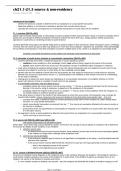
, Wills – Unit 2. Wills: Interpretation, Alteration & Revocation
Establishing Entitlement
Basic presumptions
- Non-technical words bear their ordinary meaning
- Technical words are given their technical meaning
- These may be rebutted if it is clear the testator was using the word in a different sense
Establishing the testator’s intention
- Basic rule: Not to consider other evidence to establish what the testator intended
- If the meaning remains unclear – gift fails for uncertainty
- Limited circumstances to look at external/extrinsic evidence
o Where the will is meaningless / language used is ambiguous / evidence (other than testator’s
intention) shows the language is ambiguous in the light of the surrounding circumstances
Rectification
- Only arises where the will fails to carry out the testator’s intentions
- Caused by:
o A clerical error
o Failure to understand instructions
Property passing under the will
‘speaks from date of death’
- Basic rule: Assets are determined according to those in existence at the date of death
o Unless contrary intention
- ‘My’ – could refer to the asset at the date of the will
o If asset is generic (capable of increase/decrease between date of will & death) – the asset at the
date of death
Identifying the beneficiaries
‘speaks from date of death
- General rule: People alive at the time of the will’s execution
- Spouses & civil partners are not synonymous
Validity of Wills & How Property Passes on Death
Property passing outside the will
- Joint property
- Insurance policies
- Pension benefits
- Trust property
Wills terminology
- Gifts:
o Specific gift = specific item the testator owns
o General gift = items corresponding to a description
If not owned on death, they must be obtained using funds
o Demonstrative gifts = general but directed to be paid from a specific fund
If there is no account or account contains less than £500, pay from estate
o Pecuniary gift = money
o Residuary gift = the rest
The requirements for a valid will
Capacity
- ‘Soundness of mind, memory & understanding’
- Testators must understand:
o The nature of their act & its broad effects
o The extent of their property
o The moral claims they ought to consider
- They must not be suffering from any insane delusion affecting the disposition of property
- Must have capacity at time of execution
- The ‘golden rule’
o If mental state is in doubt – ask a medical practitioner to provide a written report
- The burden – for the person asserting that a will is valid to prove it
o Presumption of capacity if
Will is rational on its face
Testator showed no evidence of mental conduction
Burden shifts to challenger to prove lack of capacity
Intention
- General & specific – intention to make a will & intention to make this specific will
- Presumption of knowledge & approval, does not apply when:
o Testator blind, illiterate, not signing personally
Requires proof of knowledge (statement at end of will?)
o Suspicious circumstances (surrounding drafting, execution)
o When appearing to have approved contents, person wishing to challenge must show
Force/fear (actual/threatened injury)
Fraud
Undue influence
Mistake
,Formalities of execution
- In writing & signed in the presence of 2 witnesses (who sign)
- Intention for signature to give will effect
Privileged wills
- A will made on actual military service may include an oral statement
Burden of proof
- For the person asserting a will to prove it valid
o Presumption of due execution (if attestation clause)
o If no clause, requirement for affidavit of due execution from someone present during the execution
Intestacy
- Imposes a statutory trust over all the property
Survived by spouse & issue (direct descendant)
- Spouse receives
o Personal chattels
o Statutory legacy = £270,000
o Half the balance (other half to the issue)
Survived by spouse & no issues
- Spouse receives entire estate
No surviving spouse
- Issue
- Parents
- Siblings (whole/half)
- Grandparents
- Uncles/aunts (whole/half)
- The Crown
Beneficiaries other than a spouse, parents & grandparents take on statutory trusts:
- Members of a category share equally
- The issue of a deceased relative may take that relative’s share in substitution
- Entitlement is contingent upon attaining 18/marrying
, Wills – Unit 2. Wills: Interpretation, Alteration & Revocation
Establishing Entitlement
Basic presumptions
- Non-technical words bear their ordinary meaning
- Technical words are given their technical meaning
- These may be rebutted if it is clear the testator was using the word in a different sense
Establishing the testator’s intention
- Basic rule: Not to consider other evidence to establish what the testator intended
- If the meaning remains unclear – gift fails for uncertainty
- Limited circumstances to look at external/extrinsic evidence
o Where the will is meaningless / language used is ambiguous / evidence (other than testator’s
intention) shows the language is ambiguous in the light of the surrounding circumstances
Rectification
- Only arises where the will fails to carry out the testator’s intentions
- Caused by:
o A clerical error
o Failure to understand instructions
Property passing under the will
‘speaks from date of death’
- Basic rule: Assets are determined according to those in existence at the date of death
o Unless contrary intention
- ‘My’ – could refer to the asset at the date of the will
o If asset is generic (capable of increase/decrease between date of will & death) – the asset at the
date of death
Identifying the beneficiaries
‘speaks from date of death
- General rule: People alive at the time of the will’s execution
- Spouses & civil partners are not synonymous