10.03.20
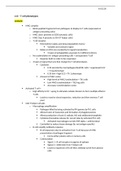
L13 – T cell phenotypes
Lecture:
MHC complex
o Binds peptide fragments from pathogens to display to T cells (expressed on
antigen presenting cells)
o MHC class I presents to CD8 (cytotoxic cells)
o MHC Class II presents to CH4 (T helper cells)
o T cell receptor
Heterodimer (alpha and beta polypeptide chains)
Variable and constant region
Relies on CD3 non-covalently for signal transduction
5 types of polypeptides associate to 3 different dimers
o No costimulation w/ antigen presenting cells = unresponsive T cell
Requires both in order to be responsive
o 3 types of signal that vary that change the T cell phenotypes
Cytokines
IL10 secreted by macrophages/dendritic cells = suppressed IL12
= T reg phenotype
IL10 low = high IL12 = Th 1 phenotype
Amount of MHC varies
High levels of MHC/costimulation = Th1 cells
Low MHC/constimulation = Th2/reg cells
Accessary constimulation varies
Activated T cell =
o High affinity to Il2 = upreg to stimulate cellular division to form multiple effector
T cells
Leads to massive clonal expansion, reduction and then memory T cell
pool
CD4 T helper cell aids
o Macrophage amplification
Pathogen killed by being activated by IFN gamma by Th1 cells
Allows fusion of lysosomes and formation of phagolysosomes
Allows production of toxic O radicals, NO and antibacterial peptides
Cytokine/chemokine release for recruit (also by activated Th1 cell)
Activated macrophages secrete TNF alpha = antimicrobial
Controlled to reduce tissue damage (bc not antigen specific)
o B cells amplify antibody response
B cell expansion due to activation from T cell because of MHC
presentation of pathogen fragment
Forms either plasma cells or memory cells
Costimulation
Signal 1 = B cell receptor recognize of epitope
Signal 2 = CD40 stim from T helper cell
Leads to expansion of B cell then antibody synth from plasma
cells
L13 – T cell phenotypes
Lecture:
MHC complex
o Binds peptide fragments from pathogens to display to T cells (expressed on
antigen presenting cells)
o MHC class I presents to CD8 (cytotoxic cells)
o MHC Class II presents to CH4 (T helper cells)
o T cell receptor
Heterodimer (alpha and beta polypeptide chains)
Variable and constant region
Relies on CD3 non-covalently for signal transduction
5 types of polypeptides associate to 3 different dimers
o No costimulation w/ antigen presenting cells = unresponsive T cell
Requires both in order to be responsive
o 3 types of signal that vary that change the T cell phenotypes
Cytokines
IL10 secreted by macrophages/dendritic cells = suppressed IL12
= T reg phenotype
IL10 low = high IL12 = Th 1 phenotype
Amount of MHC varies
High levels of MHC/costimulation = Th1 cells
Low MHC/constimulation = Th2/reg cells
Accessary constimulation varies
Activated T cell =
o High affinity to Il2 = upreg to stimulate cellular division to form multiple effector
T cells
Leads to massive clonal expansion, reduction and then memory T cell
pool
CD4 T helper cell aids
o Macrophage amplification
Pathogen killed by being activated by IFN gamma by Th1 cells
Allows fusion of lysosomes and formation of phagolysosomes
Allows production of toxic O radicals, NO and antibacterial peptides
Cytokine/chemokine release for recruit (also by activated Th1 cell)
Activated macrophages secrete TNF alpha = antimicrobial
Controlled to reduce tissue damage (bc not antigen specific)
o B cells amplify antibody response
B cell expansion due to activation from T cell because of MHC
presentation of pathogen fragment
Forms either plasma cells or memory cells
Costimulation
Signal 1 = B cell receptor recognize of epitope
Signal 2 = CD40 stim from T helper cell
Leads to expansion of B cell then antibody synth from plasma
cells