09.10.19
L2 - Intracellular trafficking: protein targeting, vesicle, trafficking and secretion (week 2/3)
Keywords:
Excretion (removal of waste products), secretion (releases product to be used), microsomes (purified
ER), nascent protein (unfolded protein state created by ribosome before active state), cytoplasm
(cytosol & cytosolic compartments), cargo protein, nuclear lamina (protein meshwork to maintain
shape of nuclear envelope), perinuclear space (space between two nuclear membranes),
nucleoporins (proteins that make up the nuclear pore), paracrine signaling (local signaling – chem
messengers rapidly uptaken and degraded), autocrine signaling (using a chemical messenger in
signaling further distances)
Lecture:
Contact-dependent signaling = cellular signaling over long distance in immunity and
development
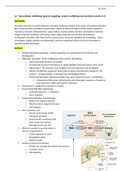
Molecular postcode = ID for trafficking protein and for distribution
o Give transmemb domains for uptake
o ER postcode found on N-terminus on signal peptides (removed when arrive at ER)
o Signal patch = 3D structure from multiple AA chain sequences for localization
o Nuclear localization sequences (have both inclusion and exclusion sequence’s for
nucleus – reusing protein - ∆ structure eg via phosphorylation)
o Protein-protein/lipid interactions (lipids vary upon memb structure = localization)
Endoplasmic Reticulum, mitochondria and chloroplast sequences cleaved as
only used once unlike peroxisome and nuclei
Peroxisomes = oxidization reactions in vesicles
Compartmentalization advantages
o Confined reactions - ↑ efficiency
o Don’t interfere
Compartmentalization disadvantages
o Delivery to regions required
o Mechs to move required (in/out)
o Cell integrity
Non-uniformed cell
o Send to correct part of PM
(transport proteins)
o Route found in polarized cells
how viruses are carried
throughout and use cell
What are needed to send proteins to
correct compartment?
o Target sequence to send
o Recognition mech
o Delivery mech
Common mechs for transport
o Protein rec and specific protein interactions
o G protein cycle
o Cell signaling
L2 - Intracellular trafficking: protein targeting, vesicle, trafficking and secretion (week 2/3)
Keywords:
Excretion (removal of waste products), secretion (releases product to be used), microsomes (purified
ER), nascent protein (unfolded protein state created by ribosome before active state), cytoplasm
(cytosol & cytosolic compartments), cargo protein, nuclear lamina (protein meshwork to maintain
shape of nuclear envelope), perinuclear space (space between two nuclear membranes),
nucleoporins (proteins that make up the nuclear pore), paracrine signaling (local signaling – chem
messengers rapidly uptaken and degraded), autocrine signaling (using a chemical messenger in
signaling further distances)
Lecture:
Contact-dependent signaling = cellular signaling over long distance in immunity and
development
Molecular postcode = ID for trafficking protein and for distribution
o Give transmemb domains for uptake
o ER postcode found on N-terminus on signal peptides (removed when arrive at ER)
o Signal patch = 3D structure from multiple AA chain sequences for localization
o Nuclear localization sequences (have both inclusion and exclusion sequence’s for
nucleus – reusing protein - ∆ structure eg via phosphorylation)
o Protein-protein/lipid interactions (lipids vary upon memb structure = localization)
Endoplasmic Reticulum, mitochondria and chloroplast sequences cleaved as
only used once unlike peroxisome and nuclei
Peroxisomes = oxidization reactions in vesicles
Compartmentalization advantages
o Confined reactions - ↑ efficiency
o Don’t interfere
Compartmentalization disadvantages
o Delivery to regions required
o Mechs to move required (in/out)
o Cell integrity
Non-uniformed cell
o Send to correct part of PM
(transport proteins)
o Route found in polarized cells
how viruses are carried
throughout and use cell
What are needed to send proteins to
correct compartment?
o Target sequence to send
o Recognition mech
o Delivery mech
Common mechs for transport
o Protein rec and specific protein interactions
o G protein cycle
o Cell signaling