Topic/Skill Definition/Tips
Topic: Further Quadratics Example
1. Quadratic A quadratic expression is of the form Examples of quadratic expressions:
2
x
2
a x +bx+ c 2
8 x −3 x+ 7
where a , b and c are numbers, a ≠ 0 Examples of non-quadratic expressions:
3 2
2 x −5 x
9 x−1
2. Factorising When a quadratic expression is in the form 2
x + 7 x +10=(x +5)( x +2)
Quadratics 2
x + bx+ c find the two numbers that add to (because 5 and 2 add to give 7 and
give b and multiply to give c. multiply to give 10)
x 2+ 2 x−8=(x+ 4)(x−2)
(because +4 and -2 add to give +2 and
multiply to give -8)
3. Difference An expression of the form a 2−b2 can be x 2−25=(x +5)( x−5)
of Two factorised to give (a+ b)(a−b) 16 x 2−81=(4 x+ 9)( 4 x−9)
Squares
4. Solving Isolate the x 2 term and square root both 2
2 x =98
Quadratics sides. 2
x =49
2
(a x =b) Remember there will be a positive and a x=± 7
negative solution.
5. Solving Factorise and then solve = 0. 2
x −3 x=0
Quadratics x ( x−3 )=0
2
(a x +bx=0) x=0∨x=3
6. Solving Factorise the quadratic in the usual way. 2
Solve x + 3 x −10=0
Quadratics by Solve = 0
Factorising Factorise: ( x +5 ) ( x−2 )=0
( a=1 ) Make sure the equation = 0 before x=−5∨x=2
factorising.
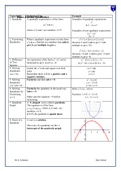
7. Quadratic A ‘U-shaped’ curve called a parabola.
Graph The equation is of the form
y=a x2 +bx +c , where a , b and c are
numbers, a ≠ 0.
If a< 0, the parabola is upside down.
8. Roots of a A root is a solution.
Quadratic
The roots of a quadratic are the x -
intercepts of the quadratic graph.
Mr A. Coleman Glyn School
Topic: Further Quadratics Example
1. Quadratic A quadratic expression is of the form Examples of quadratic expressions:
2
x
2
a x +bx+ c 2
8 x −3 x+ 7
where a , b and c are numbers, a ≠ 0 Examples of non-quadratic expressions:
3 2
2 x −5 x
9 x−1
2. Factorising When a quadratic expression is in the form 2
x + 7 x +10=(x +5)( x +2)
Quadratics 2
x + bx+ c find the two numbers that add to (because 5 and 2 add to give 7 and
give b and multiply to give c. multiply to give 10)
x 2+ 2 x−8=(x+ 4)(x−2)
(because +4 and -2 add to give +2 and
multiply to give -8)
3. Difference An expression of the form a 2−b2 can be x 2−25=(x +5)( x−5)
of Two factorised to give (a+ b)(a−b) 16 x 2−81=(4 x+ 9)( 4 x−9)
Squares
4. Solving Isolate the x 2 term and square root both 2
2 x =98
Quadratics sides. 2
x =49
2
(a x =b) Remember there will be a positive and a x=± 7
negative solution.
5. Solving Factorise and then solve = 0. 2
x −3 x=0
Quadratics x ( x−3 )=0
2
(a x +bx=0) x=0∨x=3
6. Solving Factorise the quadratic in the usual way. 2
Solve x + 3 x −10=0
Quadratics by Solve = 0
Factorising Factorise: ( x +5 ) ( x−2 )=0
( a=1 ) Make sure the equation = 0 before x=−5∨x=2
factorising.
7. Quadratic A ‘U-shaped’ curve called a parabola.
Graph The equation is of the form
y=a x2 +bx +c , where a , b and c are
numbers, a ≠ 0.
If a< 0, the parabola is upside down.
8. Roots of a A root is a solution.
Quadratic
The roots of a quadratic are the x -
intercepts of the quadratic graph.
Mr A. Coleman Glyn School