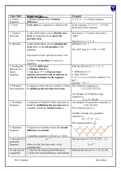
Topic/Skill Definition/Tips
Topic: Sequences Example
1. Linear A number pattern with a common 2, 5, 8, 11… is a linear sequence
Sequence difference.
2. Term Each value in a sequence is called a term. In the sequence 2, 5, 8, 11…, 8 is the
third term of the sequence.
3. Term-to- A rule which allows you to find the next First term is 2. Term-to-term rule is
term rule term in a sequence if you know the ‘add 3’
previous term.
Sequence is: 2, 5, 8, 11…
4. nth term A rule which allows you to calculate the nth term is 3 n−1
term that is in the nth position of the
sequence. The 100th term is 3 ×100−1=299
Also known as the ‘position-to-term’ rule.
n refers to the position of a term in a
sequence.
5. Finding the 1. Find the difference. Find the nth term of: 3, 7, 11, 15…
nth term of a 2. Multiply that by n .
linear 3. Substitute n=1 to find out what 1. Difference is +4
sequence number you need to add or subtract to 2. Start with 4 n
get the first number in the sequence. 3. 4 ×1=4 , so we need to subtract 1 to
get 3.
nth term = 4 n−1
6. Fibonacci A sequence where the next number is found The Fibonacci sequence is:
type sequences by adding up the previous two terms 1,1,2,3,5,8,13,21,34 …
An example of a Fibonacci-type
sequence is:
4 , 7 ,11 , 18 ,29 …
7. Geometric A sequence of numbers where each term is An example of a geometric sequence is:
Sequence found by multiplying the previous one by 2 ,10 ,50 , 250 …
a number called the common ratio, r. The common ratio is 5
Another example of a geometric
sequence is:
81 ,−27 ,9 ,−3 , 1…
−1
The common ratio is
3
8. Quadratic A sequence of numbers where the second
Sequence difference is constant.
A quadratic sequence will have a n2 term.
9. nth term of a ar
n −1
The nth term of 2 ,10 ,50 , 250 … . Is
geometric
sequence where a is the first term and r is the 2 ×5n−1
common ratio
10. nth term of 1. Find the first and second differences. Find the nth term of: 4, 7, 14, 25, 40..
a quadratic 2. Halve the second difference and multiply
Mr A. Coleman Glyn School
Topic: Sequences Example
1. Linear A number pattern with a common 2, 5, 8, 11… is a linear sequence
Sequence difference.
2. Term Each value in a sequence is called a term. In the sequence 2, 5, 8, 11…, 8 is the
third term of the sequence.
3. Term-to- A rule which allows you to find the next First term is 2. Term-to-term rule is
term rule term in a sequence if you know the ‘add 3’
previous term.
Sequence is: 2, 5, 8, 11…
4. nth term A rule which allows you to calculate the nth term is 3 n−1
term that is in the nth position of the
sequence. The 100th term is 3 ×100−1=299
Also known as the ‘position-to-term’ rule.
n refers to the position of a term in a
sequence.
5. Finding the 1. Find the difference. Find the nth term of: 3, 7, 11, 15…
nth term of a 2. Multiply that by n .
linear 3. Substitute n=1 to find out what 1. Difference is +4
sequence number you need to add or subtract to 2. Start with 4 n
get the first number in the sequence. 3. 4 ×1=4 , so we need to subtract 1 to
get 3.
nth term = 4 n−1
6. Fibonacci A sequence where the next number is found The Fibonacci sequence is:
type sequences by adding up the previous two terms 1,1,2,3,5,8,13,21,34 …
An example of a Fibonacci-type
sequence is:
4 , 7 ,11 , 18 ,29 …
7. Geometric A sequence of numbers where each term is An example of a geometric sequence is:
Sequence found by multiplying the previous one by 2 ,10 ,50 , 250 …
a number called the common ratio, r. The common ratio is 5
Another example of a geometric
sequence is:
81 ,−27 ,9 ,−3 , 1…
−1
The common ratio is
3
8. Quadratic A sequence of numbers where the second
Sequence difference is constant.
A quadratic sequence will have a n2 term.
9. nth term of a ar
n −1
The nth term of 2 ,10 ,50 , 250 … . Is
geometric
sequence where a is the first term and r is the 2 ×5n−1
common ratio
10. nth term of 1. Find the first and second differences. Find the nth term of: 4, 7, 14, 25, 40..
a quadratic 2. Halve the second difference and multiply
Mr A. Coleman Glyn School