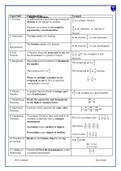
Topic/Skill Definition/Tips
Topic: Fractions Example
1. Fraction A mathematical expression representing the 2
is a ‘proper’ fraction.
division of one integer by another. 7
Fractions are written as two numbers 9
is an ‘improper’ or ‘top-heavy’
separated by a horizontal line. 4
fraction.
2. Numerator The top number of a fraction. 3
In the fraction , 3 is the numerator.
5
3. The bottom number of a fraction. 3
In the fraction , 5 is the denominator.
Denominator 5
4. Unit A fraction where the numerator is one and 1 1 1
, , etc .are examples of unit
Fraction the denominator is a positive integer. 2 3 4
fractions.
5. Reciprocal The reciprocal of a number is 1 divided by 1
The reciprocal of 5 is
the number. 5
1 2 3
The reciprocal of x is The reciprocal of is , because
x 3 2
When we multiply a number by its 2 3
× =1
reciprocal we get 1. This is called the 3 2
‘multiplicative inverse’.
6. Mixed A number formed of both an integer part 2
3 is an example of a mixed number.
Number and a fraction part. 5
7. Simplifying Divide the numerator and denominator 20 4
=
Fractions by the highest common factor. 45 9
8. Equivalent Fractions which represent the same value. 2 4 20 60
= = = etc.
Fractions 5 10 50 150
9. Comparing To compare fractions, they each need to be 3 2 5 1
Put in to ascending order : , , , .
Fractions rewritten so that they have a common 4 3 6 2
denominator.
9 8 10 6
Equivalent: , , ,
Ascending means smallest to biggest. 12 12 12 12
Descending means biggest to smallest. 1 2 3 5
Correct order: , , ,
2 3 4 6
10. Fraction of Divide by the bottom, times by the top 2
Find of £60
an Amount 5
60 ÷ 5=12
12 ×2=24
11. Adding or Find the LCM of the denominators to find 2 4
+
Subtracting a common denominator. 3 5
Mr A. Coleman Glyn School
Topic: Fractions Example
1. Fraction A mathematical expression representing the 2
is a ‘proper’ fraction.
division of one integer by another. 7
Fractions are written as two numbers 9
is an ‘improper’ or ‘top-heavy’
separated by a horizontal line. 4
fraction.
2. Numerator The top number of a fraction. 3
In the fraction , 3 is the numerator.
5
3. The bottom number of a fraction. 3
In the fraction , 5 is the denominator.
Denominator 5
4. Unit A fraction where the numerator is one and 1 1 1
, , etc .are examples of unit
Fraction the denominator is a positive integer. 2 3 4
fractions.
5. Reciprocal The reciprocal of a number is 1 divided by 1
The reciprocal of 5 is
the number. 5
1 2 3
The reciprocal of x is The reciprocal of is , because
x 3 2
When we multiply a number by its 2 3
× =1
reciprocal we get 1. This is called the 3 2
‘multiplicative inverse’.
6. Mixed A number formed of both an integer part 2
3 is an example of a mixed number.
Number and a fraction part. 5
7. Simplifying Divide the numerator and denominator 20 4
=
Fractions by the highest common factor. 45 9
8. Equivalent Fractions which represent the same value. 2 4 20 60
= = = etc.
Fractions 5 10 50 150
9. Comparing To compare fractions, they each need to be 3 2 5 1
Put in to ascending order : , , , .
Fractions rewritten so that they have a common 4 3 6 2
denominator.
9 8 10 6
Equivalent: , , ,
Ascending means smallest to biggest. 12 12 12 12
Descending means biggest to smallest. 1 2 3 5
Correct order: , , ,
2 3 4 6
10. Fraction of Divide by the bottom, times by the top 2
Find of £60
an Amount 5
60 ÷ 5=12
12 ×2=24
11. Adding or Find the LCM of the denominators to find 2 4
+
Subtracting a common denominator. 3 5
Mr A. Coleman Glyn School