
Taylor Notes Kinetics and Rate Equations Notes
Explaining Changes in Rate
Rate of Reaction
The number of successful collisions per unit time
Activation Energy
The minimum amount of energy for particles to collide successfully
Increasing Concentration of a Solution
As concentration increases, the rate increases as there are more particles per unit volume causing a higher
frequency of collisions
Increasing Pressure of a Gas
As pressure increases, the rate increase as there are more particles per unit volume causing a higher
frequency of collisions
Increasing Surface Area of a Solid
As surface area increases, the rate increases as collisions can only take place on the surface of a solid
meaning that more exposed surface allows more frequent collisions
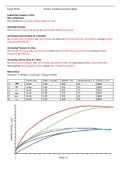
Rate Curves
CaCO3(s) + 2 HCl(aq) → CaCl2(aq) + CO2(g) + H2O(l)
CaCO3 Size [HCl] / mol dm-3 V(HCl) / cm3 Temperature / °C V(CO2) / cm3
1 Small 2.00 100 20 4800
2 Large 2.00 100 20 4800
3 Small 2.00 200 20 9600
4 Small 4.00 100 20 9600
5 Small 2.00 100 30 4800
6 Small 2.00 100 40 4800
, Taylor Notes Kinetics and Rate Equations Notes
Maxwell-Boltzmann Distributions
A Maxwell-Boltzmann distribution shows the distribution of molecular energies at given temperatures
Maxwell-Boltzmann Distribution showing changes in Temperature
As temperature increases, Maxwell-Boltzmann Distributions show a larger area beyond the activation
energy and so there is a larger proportion of particles with more or the same energy than the activation
energy for the particles to react with one another so there are more successful collisions per unit time
causing a higher rate of reaction
Explaining Changes in Rate
Rate of Reaction
The number of successful collisions per unit time
Activation Energy
The minimum amount of energy for particles to collide successfully
Increasing Concentration of a Solution
As concentration increases, the rate increases as there are more particles per unit volume causing a higher
frequency of collisions
Increasing Pressure of a Gas
As pressure increases, the rate increase as there are more particles per unit volume causing a higher
frequency of collisions
Increasing Surface Area of a Solid
As surface area increases, the rate increases as collisions can only take place on the surface of a solid
meaning that more exposed surface allows more frequent collisions
Rate Curves
CaCO3(s) + 2 HCl(aq) → CaCl2(aq) + CO2(g) + H2O(l)
CaCO3 Size [HCl] / mol dm-3 V(HCl) / cm3 Temperature / °C V(CO2) / cm3
1 Small 2.00 100 20 4800
2 Large 2.00 100 20 4800
3 Small 2.00 200 20 9600
4 Small 4.00 100 20 9600
5 Small 2.00 100 30 4800
6 Small 2.00 100 40 4800
, Taylor Notes Kinetics and Rate Equations Notes
Maxwell-Boltzmann Distributions
A Maxwell-Boltzmann distribution shows the distribution of molecular energies at given temperatures
Maxwell-Boltzmann Distribution showing changes in Temperature
As temperature increases, Maxwell-Boltzmann Distributions show a larger area beyond the activation
energy and so there is a larger proportion of particles with more or the same energy than the activation
energy for the particles to react with one another so there are more successful collisions per unit time
causing a higher rate of reaction


