Taylor Notes Amount of Substance
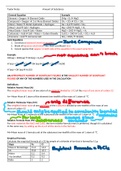
General Equation Example
Element + Oxygen Element Oxide 2Mg + O2 MgO
Compound + Oxygen 2 or More Element Oxides CH4 + 2O2 CO2 + 2H2
Metal + Water Metal Hydroxide + Hydrogen Na + H2O NaOH + ½H2
Metal + Acid Salt + Hydrogen Mg + 2HCl MgCl2 + H2
Metal Oxide + Acid Salt + Water MgO + 2HCl MgCl2 + H2
Carbonate + Acid Salt + Water + Carbon Dioxide CuCO3 + 2HCl CuCl2 + CO2 + H2O
Ammonia + Acid Ammonia Salt NH3 + HNO3 NH4NO3
Ionic Equations
1. Construct a balanced chemical equation
2. Break all aqueous electrolytes into their constituent ions
3. Cancel species that appear on both side of the equation in the exact same form
Example
HCl(aq) + KOH(aq) KCl(aq) + H2O(I)
H+(aq) + Cl-(aq)+ K+(aq) + OH-(aq) K+(aq) + Cl-(aq) + H2O(I)
H+(aq) + OH-(aq) H2O(I)
AN APPROPRIATE NUMBER OF SIGNIFICANT FIGURES IS THE SMALLEST NUMBER OF SIGNIFICANT
FIGURES OF ANY OF THE NUMBERS USED IN THE CALCULATION
Definitions
Relative Atomic Mass (Ar)
The weighted mean mass of one atom of an element divided by 1/12 of the mass of one atom of carbon-12
Ar= Mean Mass of 1 atom of the element/one-twelfth of the mass of 1 atom of 12C
Relative Molecular Mass (Mr)
The weighted mean mass of one molecule of the substance divided by one-twelfth of the mass of one
atom of carbon-12
Mr=Mean Mass of 1 molecule of the substance/one-twelfth of the mass of 1 atom of 12C
Relative Formula Mass (Mr)
For ionic materials like NaCl and CuSO4 the term relative formula mass is preferred, though it is calculated
in the same way, by adding up the Ars of all the atoms in the formula
Mr=Mean mass of 1 formula unit of the substance/one-twelfth of the mass of 1 atom of 12C
Empirical Formula
Calculate the empirical formula of a 25.4g sample of a chloride of ion that is formed by 11.g
Steps Fe Cl
Mass or Percentage 11.2 14.2
Mr 55.8 35.5
Moles 0.2 0.4
÷ by Smallest 0.2 0.2
Ratio 1 2
, Taylor Notes Amount of Substance
Water of Crystallisation
4.56g of hydrated magnesium sulphate (MgSO4.xH2O) contains 2.33g of water
Steps MgSO4 H2O
Mass or Percentage 2.23 2.33
Mr 120.4 18
Moles 0.018 0.129
÷ by Smallest 0.018 0.018
Ration 1 7
Avogadro’s Number
Avogadro’s number (L) is the number of units in one mole of a substance
Number of Particles = Moles x Avogadro’s Number
Calculate the number of particles of water molecules in 0.5 mol of H 2O
Reacting Masses
Calculate the mass of glucose that a cabbage gains by photosynthesising 242g of carbon dioxide
CO2 + H2O C6H12O6 + O2
Percentage Yield
Ammonia gas reacts with dilute sulphuric acid forming ammonium sulphate NH 3 + H2SO4 (NH4)2SO4
A student reacted 73.5g of sulphuric acid, producing 70.2g of ammonium sulphate
Percentage Atom Economy
General Equation Example
Element + Oxygen Element Oxide 2Mg + O2 MgO
Compound + Oxygen 2 or More Element Oxides CH4 + 2O2 CO2 + 2H2
Metal + Water Metal Hydroxide + Hydrogen Na + H2O NaOH + ½H2
Metal + Acid Salt + Hydrogen Mg + 2HCl MgCl2 + H2
Metal Oxide + Acid Salt + Water MgO + 2HCl MgCl2 + H2
Carbonate + Acid Salt + Water + Carbon Dioxide CuCO3 + 2HCl CuCl2 + CO2 + H2O
Ammonia + Acid Ammonia Salt NH3 + HNO3 NH4NO3
Ionic Equations
1. Construct a balanced chemical equation
2. Break all aqueous electrolytes into their constituent ions
3. Cancel species that appear on both side of the equation in the exact same form
Example
HCl(aq) + KOH(aq) KCl(aq) + H2O(I)
H+(aq) + Cl-(aq)+ K+(aq) + OH-(aq) K+(aq) + Cl-(aq) + H2O(I)
H+(aq) + OH-(aq) H2O(I)
AN APPROPRIATE NUMBER OF SIGNIFICANT FIGURES IS THE SMALLEST NUMBER OF SIGNIFICANT
FIGURES OF ANY OF THE NUMBERS USED IN THE CALCULATION
Definitions
Relative Atomic Mass (Ar)
The weighted mean mass of one atom of an element divided by 1/12 of the mass of one atom of carbon-12
Ar= Mean Mass of 1 atom of the element/one-twelfth of the mass of 1 atom of 12C
Relative Molecular Mass (Mr)
The weighted mean mass of one molecule of the substance divided by one-twelfth of the mass of one
atom of carbon-12
Mr=Mean Mass of 1 molecule of the substance/one-twelfth of the mass of 1 atom of 12C
Relative Formula Mass (Mr)
For ionic materials like NaCl and CuSO4 the term relative formula mass is preferred, though it is calculated
in the same way, by adding up the Ars of all the atoms in the formula
Mr=Mean mass of 1 formula unit of the substance/one-twelfth of the mass of 1 atom of 12C
Empirical Formula
Calculate the empirical formula of a 25.4g sample of a chloride of ion that is formed by 11.g
Steps Fe Cl
Mass or Percentage 11.2 14.2
Mr 55.8 35.5
Moles 0.2 0.4
÷ by Smallest 0.2 0.2
Ratio 1 2
, Taylor Notes Amount of Substance
Water of Crystallisation
4.56g of hydrated magnesium sulphate (MgSO4.xH2O) contains 2.33g of water
Steps MgSO4 H2O
Mass or Percentage 2.23 2.33
Mr 120.4 18
Moles 0.018 0.129
÷ by Smallest 0.018 0.018
Ration 1 7
Avogadro’s Number
Avogadro’s number (L) is the number of units in one mole of a substance
Number of Particles = Moles x Avogadro’s Number
Calculate the number of particles of water molecules in 0.5 mol of H 2O
Reacting Masses
Calculate the mass of glucose that a cabbage gains by photosynthesising 242g of carbon dioxide
CO2 + H2O C6H12O6 + O2
Percentage Yield
Ammonia gas reacts with dilute sulphuric acid forming ammonium sulphate NH 3 + H2SO4 (NH4)2SO4
A student reacted 73.5g of sulphuric acid, producing 70.2g of ammonium sulphate
Percentage Atom Economy