3.1 METHODS OF STUDYING CELLS
Monday, September 7, 2020
6:46 PM
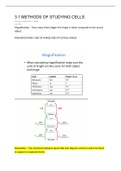
Magnification – How many times bigger the image is when compared to the actual
object.
MAGNIFICATION= SIZE OF IMAGE/SIZE OF ACTUAL IMAGE
Resolution – The minimum distance apart that two objects can be in order for them
to appear as separate items.
,The resolving power depends on the wavelength or form of radiation used.
● The longer the wavelength, the lower the resolution.
A light microscope has a resolution of about 0.2um, meaning that an objects closer
than 0.2um apart will appear as a single item.
When a microscope passes the limit of resolution, increasing the magnification will
no longer increase the resolution, making the image more blurred.
CELL FRACTIONATION
To study the structure and function of specific organelles in cells, its necessary to
obtain large numbers of isolated organelles.
Cell fractionation is the process of where cells are broken up and the different
organelles it contains are separated out.
Before cell fractionation can occur, the tissue is placed into a solution which is:
● Cold - reduces enzyme activity which may break down the organelles.
● The same water potential as the tissue - prevents organelles bursting or
shrinking from osmotic gain or loss of water.
● Buffered - pH won't fluctuate, as pH can alter the organelle structure or affect
functioning enzymes.
HOMOGENATION
-The cells are broken up by a homogeniser (blender).
-This ruptures the cells and releases the organelles.
-The resultant fluid (homogenate) is filtered, removing complete cells and debris.
ULTRACENTRIFUGATION
The fragments in the filtered homogenate are separated in a centrifuge, which spins
tubes of the homogenate at high speeds, creating a centrifugal force.
In the centrifuge:
1. The tube of filtrate is spun at a slow speed. This increases the gravitational
field, separating the organelles according to their density.
2. The heaviest organelles, the nuclei, are forced to the bottom of the tube,
forming a pellet.
3. The fluid at the top (supernatant) is removed, leaving sediment of nuclei.
, 4. The supernatant is transferred to another tube which is spun faster than
before, making the next heaviest organelles, the mitochondria, to be pushed
to the bottom, creating a pellet.
5. This process is continued, with each stage having an increased speed so that
the next heaviest organelles are sedimented and separated out.
Cell homogenisation to break open cells;
Filter to remove (large) debris / whole cells
Use isotonic solution to prevent damage to mitochondria / organelles
Keep cold to prevent / reduce damage by enzymes / use buffer to prevent protein /
enzyme denaturation
Centrifuge (at lower speed / 1000 g) to separate nuclei / cell fragments / heavy
organelles
Re-spin (supernatant / after nuclei / pellet removed) at higher speed to get
mitochondria in pellet / at bottom.
3.2 THE ELECTRON MICROSCOPE
08 September 2020
20:35
Monday, September 7, 2020
6:46 PM
Magnification – How many times bigger the image is when compared to the actual
object.
MAGNIFICATION= SIZE OF IMAGE/SIZE OF ACTUAL IMAGE
Resolution – The minimum distance apart that two objects can be in order for them
to appear as separate items.
,The resolving power depends on the wavelength or form of radiation used.
● The longer the wavelength, the lower the resolution.
A light microscope has a resolution of about 0.2um, meaning that an objects closer
than 0.2um apart will appear as a single item.
When a microscope passes the limit of resolution, increasing the magnification will
no longer increase the resolution, making the image more blurred.
CELL FRACTIONATION
To study the structure and function of specific organelles in cells, its necessary to
obtain large numbers of isolated organelles.
Cell fractionation is the process of where cells are broken up and the different
organelles it contains are separated out.
Before cell fractionation can occur, the tissue is placed into a solution which is:
● Cold - reduces enzyme activity which may break down the organelles.
● The same water potential as the tissue - prevents organelles bursting or
shrinking from osmotic gain or loss of water.
● Buffered - pH won't fluctuate, as pH can alter the organelle structure or affect
functioning enzymes.
HOMOGENATION
-The cells are broken up by a homogeniser (blender).
-This ruptures the cells and releases the organelles.
-The resultant fluid (homogenate) is filtered, removing complete cells and debris.
ULTRACENTRIFUGATION
The fragments in the filtered homogenate are separated in a centrifuge, which spins
tubes of the homogenate at high speeds, creating a centrifugal force.
In the centrifuge:
1. The tube of filtrate is spun at a slow speed. This increases the gravitational
field, separating the organelles according to their density.
2. The heaviest organelles, the nuclei, are forced to the bottom of the tube,
forming a pellet.
3. The fluid at the top (supernatant) is removed, leaving sediment of nuclei.
, 4. The supernatant is transferred to another tube which is spun faster than
before, making the next heaviest organelles, the mitochondria, to be pushed
to the bottom, creating a pellet.
5. This process is continued, with each stage having an increased speed so that
the next heaviest organelles are sedimented and separated out.
Cell homogenisation to break open cells;
Filter to remove (large) debris / whole cells
Use isotonic solution to prevent damage to mitochondria / organelles
Keep cold to prevent / reduce damage by enzymes / use buffer to prevent protein /
enzyme denaturation
Centrifuge (at lower speed / 1000 g) to separate nuclei / cell fragments / heavy
organelles
Re-spin (supernatant / after nuclei / pellet removed) at higher speed to get
mitochondria in pellet / at bottom.
3.2 THE ELECTRON MICROSCOPE
08 September 2020
20:35