Managerial Accounting 12.10.20
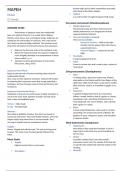
Costing systems: Activity based costing
- Different activity cost pools and cost drivers
ABC 2 stages:
Stage 1:
o The cost of an organisations significant activities is first isolated into cost pools (an area
that performs a significant activity for which costs can be accumulated)
o Cost pools (and related cost) fall into the following broad categories, which collectively
are known as a cost hierarchy:
- Unit level (each unit produced) – Direct labour, materials
- Batch level (A packet rather than individual) – Machine set up
- Product line – Product engineering, marketing, product development
- Distribution channel
- Customer level
- Facility sustaining – depreciation, rent, management
, Managerial Accounting 12.10.20
Stage 2:
o Involves identification of a cost driver for each pool (Cost driver represent activities that
affect costs)
o Use cost driver to allocate costs based on activity
o Volume based cost drivers or transaction-based cost drivers
o System then assigns overhead costs by using the cost drivers and assessing the relative
proportion of the activity consumer by a product
o This process results in the calculation of a pool rate, a cost for each ‘product line’ and an
eventual cost per unit
o Interested in cost per unit for products produced to identify appropriate mark up to add in
order to set the right price
Selection of cost driver
o Firms should consider:
- Degree of correlation (consumption of an activity and consumption of the cost driver)
- Cost of measurement (using the second-best alternative for the cost driver if the first
is not readily available or is too expensive)
- Behavioural effects (how the cost driver selected will affect the behaviour of the
individuals involved in the activity related to the cost driver)
o ABS and information sources:
- Interviews
- Top-down approach
How can ABC be used?
o ABC assigns both manufacturing and non-manufacturing costs to products
o Multiple activity cost pools and use multiple cost drivers to allocate costs
o Allocation bases used usually differ from traditional costing systems
- Uses more than one cost driver to allocate costs accurately
o Can be used in internal decision-making as well as for inventory
Costing systems: Activity based costing
- Different activity cost pools and cost drivers
ABC 2 stages:
Stage 1:
o The cost of an organisations significant activities is first isolated into cost pools (an area
that performs a significant activity for which costs can be accumulated)
o Cost pools (and related cost) fall into the following broad categories, which collectively
are known as a cost hierarchy:
- Unit level (each unit produced) – Direct labour, materials
- Batch level (A packet rather than individual) – Machine set up
- Product line – Product engineering, marketing, product development
- Distribution channel
- Customer level
- Facility sustaining – depreciation, rent, management
, Managerial Accounting 12.10.20
Stage 2:
o Involves identification of a cost driver for each pool (Cost driver represent activities that
affect costs)
o Use cost driver to allocate costs based on activity
o Volume based cost drivers or transaction-based cost drivers
o System then assigns overhead costs by using the cost drivers and assessing the relative
proportion of the activity consumer by a product
o This process results in the calculation of a pool rate, a cost for each ‘product line’ and an
eventual cost per unit
o Interested in cost per unit for products produced to identify appropriate mark up to add in
order to set the right price
Selection of cost driver
o Firms should consider:
- Degree of correlation (consumption of an activity and consumption of the cost driver)
- Cost of measurement (using the second-best alternative for the cost driver if the first
is not readily available or is too expensive)
- Behavioural effects (how the cost driver selected will affect the behaviour of the
individuals involved in the activity related to the cost driver)
o ABS and information sources:
- Interviews
- Top-down approach
How can ABC be used?
o ABC assigns both manufacturing and non-manufacturing costs to products
o Multiple activity cost pools and use multiple cost drivers to allocate costs
o Allocation bases used usually differ from traditional costing systems
- Uses more than one cost driver to allocate costs accurately
o Can be used in internal decision-making as well as for inventory