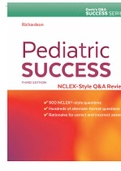
Pediatric Success NCLEX ® -Style Q&A Review THIRD EDITION
F. A. Davis Company 1915 Arch Street Philadelphia, PA 19103 Copyright © 2019 by F. A. Davis Company Copyright © 2019 by F. A. Davis Company. All rights reserved. This book is protected by copyright. No part of it may be reproduced, stored in a retrieval system, or transmitted in any form or by any means, electronic, mechanical, photocopying, recording, or otherwise, without written permission from the publisher. Printed in the United States of America Last digit indicates print number: 10 9 8 7 6 5 4 3 2 1 Acquisitions Editor: Jacalyn Sharp Senior Content Project Manager: Julia L. Curcio Electronic Project Editor: Sandra A. Glennie Illustration and Design Manager: Carolyn O’Brien As new scientific information becomes available through basic and clinical research, rec- ommended treatments and drug therapies undergo changes. The author(s) and publisher have done everything possible to make this book accurate, up to date, and in accord with accepted standards at the time of publication. The author(s), editors, and publisher are not responsible for errors or omissions or for consequences from application of the book, and make no warranty, expressed or implied, in regard to the contents of the book. Any practice described in this book should be applied by the reader in accordance with profes- sional standards of care used in regard to the unique circumstances that may apply in each situation. The reader is advised always to check product information (package inserts) for changes and new information regarding dose and contraindications before administering any drug. Caution is especially urged when using new or infrequently ordered drugs. Authorization to photocopy items for internal or personal use, or the internal or personal use of specific clients, is granted by F. A. Davis Company for users registered with the Copyright Clearance Center (CCC) Transactional Reporting Service, provided that the fee of $.25 per copy is paid directly to CCC, 222 Rosewood Drive, Danvers, MA 01923. For those organizations that have been granted a photocopy license by CCC, a separate system of payment has been arranged. The fee code for users of the Transactional Report- ing Service is: 978-0-8036-6812-6 / 19 0 + $.25. I thank my children, Jason, Sarah, and Walker; my grandchildren, Caroline, Darren, Sadie, and Sam; and my friends, especially David, for all their love and support. To students, graduates, and colleagues: thank you for all you do in caring for children and their families. Susan P. Wade, MSN, RN, CPN, CCRN Clinical Assistant Professor Indiana University Purdue University Fort Wayne, Indiana Sherrilyn Coffman, DNS, RN, CPN Professor and Assistant Dean Nevada State College Henderson, Nevada Dawn Marie Daniels, DNS, RN, PHCNS-BC Clinical Nurse Specialist Riley Hospital for Children Indianapolis, Indiana Mary Jo Eoff, RN, MSN, CPNP Clinical Instructor Indiana University Indianapolis, Indiana Joyce Foresman-Capuzzi, BSN, RN, CEN, CPN, CCRN, CTRN, CPEN, SANE-A, EMT-P Clinical Nurse Educator/Emergency Department Lankenau Hospital Wynnewood, Pennsylvania Paige Johnson, RN, MSN, MPH, CRNP Pediatric Nurse Practitioner Children’s Mercy Hospital, Department of Hematology/Oncology Kansas City, Missouri Dominique Leveque, MSN, RN, CPNP, FNP-C Workplace Health Services Clarian Health Partners Indianapolis, Indiana Christina Bittles McCarthy, MSN, RN, CPNP Pediatric Nurse Practitioner Indiana University, Department of Orthopedic Surgery Indianapolis, Indiana Patricia A. Normandin, RN, MSN, CEN, CPN, CPEN, DNP(c) Pediatric Nursing Instructor University of Massachusetts, Lowell Lowell, Massachusetts Julie A. Poore, RN, MSN Visiting Lecturer Indiana University Indianapolis, Indiana Susan P. Wade, MSN, RN, CPN, CCRN Clinical Assistant Professor Indiana University Purdue University Fort Wayne, Indiana Cele Walter, BSN, RN, CPN, NCSN High School Nurse Paul VI High School Haddonfield, New Jersey Candace F. Zickler, RN, MSN, CPNP Supervisor, Health Services Metropolitan School District of Perry Township Indianapolis, Indiana vii Jacoline Sommer Albert, ADN, RN, BScN, DI Senior Instructor The Aga Khan University Karachi, Pakistan Monique Alston-Davis, MSN, Ed, CPN Assistant Professor Montgomery College Silver Spring, Maryland Cathryn J. Baack, PhD, RN, CPNP Assistant Professor MedCentral College of Nursing Mansfield, Ohio Joyce Beard, MSN, PHCNS-BC, NCSN, RN Assistant Clinical Professor University of North Carolina, Pembroke Pembroke, North Carolina Vicky H. Becherer, MSN, RN Assistant Teaching Professor University of Missouri, St. Louis St. Louis, Missouri Stacee Bertolla, RN, MSN, CPNP Instructor University of South Alabama Mobile, Alabama María del Rosario C. Biddenback, RN, MSN, FNP-C Professor Napa Valley College Napa, California Kathleen Borge, MS, RNC Faculty Chair, Women and Children’s Health Samaritan Hospital Troy, New York Pam Bowden, RN, MS, PNP Faculty North Hennepin Community College Brooklyn Park, Minnesota Twila J. Brown, PhD, RN Assistant Professor Southeast Missouri State University Cape Girardeau, Missouri Katherine Bydalek, MSN, FNP-BC, PhD Assistant Professor University of South Alabama Mobile, Alabama Dena Christianson, MSN, PNP Adjunct Faculty Nova Southeastern University Fort Lauderdale, Florida Karen Clancy, MS, RN, CNP Clinical Instructor Ohio State University Neonatal Nurse Practitioner Columbus Children’s Hospital Columbus, Ohio Myra L. Clark, MS, FNP-C Assistant Professor North Georgia College and State University Dahlonega, Georgia Lori Clay, MSN, RN Assistant Professor Arkansas State University Jonesboro, Arkansas Sallie Coke, PhD, APRN, CPNP, CFNP Associate Professor Georgia College and State University Milledgeville, Georgia ix x PEDIATRIC SUCCESS Georgina Colalillo, MS, RN, CNE Associate Professor, Nursing Department Queensborough Community College Bayside, New York Judith Drumm, DNS, RN, CPN Professor/Nursing Palm Beach Atlantic University West Palm Beach, Florida Elizabeth Fiske, PhD, RN, NNP-BC, PCNS, BC Associate Professor Carson-Newman University Jefferson City, Tennessee Jennifer Bell Frank, MSN, APRN, BC Instructor Jacksonville State University Jacksonville, Alabama Marianne Fraser, MSN, RN, BC Assistant Professor University of Utah Salt Lake City, Utah Susan Golden, MSN, RN Nursing Faculty Eastern New Mexico University, Roswell Roswell, New Mexico Heather Janiszewski Goodin, PhD, RN, AHN-BC Professor Capital University Columbus, Ohio Kathy L. Ham, RN, EdD Assistant Professor Southeast Missouri State University Cape Girardeau, Missouri Brenda J. Walters Holloway, APRN, FNP, DNSc Clinical Assistant Professor University of South Alabama Spanish Fort, Alabama Teresa L. Howell, DNP, RN, CNE Associate Professor of Nursing Morehead State University Morehead, Kentucky Mary C. Kishman, PhD, RN Associate Professor College of Mount St. Joseph Cincinnati, Ohio Katherine R. Kniest, RN, MSN, CNE Professor William Rainey Harper College Palatine, Illinois Robyn Leo, MSN Associate Professor Worcester State College Worcester, Massachusetts Barbara J. MacDougall, MSN, ARNP Nova Southeastern University Ft. Lauderdale, Florida Sheila Matye, MSN, RN, CNE Associate Clinical Professor Montana State University, College of Nursing Great Falls, Montana Kathleen T. Mohn, RN, MSEd, CLNC Instructor College of Southern Nevada Las Vegas, Nevada Jennifer Morton, MS, MPH, RN Assistant Professor University of New England Portland, Maine Irene Owens, MSN, APRN Instructor Lake Sumter Community College Leesburg, Florida Brenda Pavill, RN, FNP, PhD, IBCLC Professor Misericordia University Dallas, Pennsylvania Delia Pittman, PhD Nursing Professor MidAmerica Nazarene University Olathe, Kansas Janine T. Reale, MS, RN, CNE Instructor, Nursing Faculty Rivier University Nashua, New Hampshire Deborah A. Roberts, RN, BSN, MSN, EdD Instructor Sonoma State University, Department of Nursing Sonoma, California Rebecca L. Shabo, RN, PNP-BC, PhD Associate Professor Kennesaw State University Kennesaw, Georgia Cynthia A. Shartle, RN, MSN, APRN, BC-FNP ADN Faculty South Texas College McAllen, Texas Patsy M. Spratling, RN, MSN Nursing Instructor Holmes Community College Ridgeland, Mississippi Linda Strong, MSN, RN, CPNP, CNE Assistant Professor, Pediatric Nursing Cuyahoga Community College Cleveland, Ohio REVIEWERS FOR PREVIOUS EDITIONS xi Bev Valkenier, BScN, RN, MSN Lecturer University of British Columbia Vancouver, British Columbia, Canada Linda Walters, RN, MSN, PhD (a.b.d.) Nursing Instructor Indiana State University Terre Haute, Indiana Elizabeth M. Wertz, RN, BSN, MPM, EMT-P, PHRN, FACMPE Chief Executive Officer Pediatric Alliance, PC Carnegie, Pennylvania Sarah Whitaker, DNS, RN Nursing Program Director Dona Ana Community College Las Cruces, New Mexico Barbara White, RN, MSN, CCRN Nursing Instructor Southwestern Michigan College Dowagiac, Michigan 1 Fundamentals of Critical Thinking Related to Test Taking: The RACE Model 1 HOW TO USE THIS REVIEW BOOK 1 Test Preparation 1 RACE Model 2 2 Pharmacology 3 KEYWORDS 3 ABBREVIATIONS 3 CONVERSIONS 4 QUESTIONS 4 ANSWERS AND RATIONALES 12 3 Growth and Development 21 KEYWORDS 21 ABBREVIATIONS 21 QUESTIONS 21 ANSWERS AND RATIONALES 31 4 Pediatric Health Issues 43 KEYWORDS 43 ABBREVIATIONS 43 QUESTIONS 44 ANSWERS AND RATIONALES 53 5 Respiratory Disorders 67 KEYWORDS 67 ABBREVIATIONS 67 QUESTIONS 68 ANSWERS AND RATIONALES 77 6 Cardiovascular Disorders 91 KEYWORDS 91 ABBREVIATIONS 91 QUESTIONS 91 ANSWERS AND RATIONALES 100 7 Gastrointestinal Disorders 109 KEYWORDS 109 ABBREVIATIONS 110 QUESTIONS 110 ANSWERS AND RATIONALES 121 8 Genitourinary Disorders 133 KEYWORDS 133 ABBREVIATIONS 133 QUESTIONS 133 ANSWERS AND RATIONALES 144 9 Endocrine Disorders 155 KEYWORDS 155 ABBREVIATIONS 155 xiii xiv PEDIATRIC SUCCESS QUESTIONS 155 ANSWERS AND RATIONALES 165 10 Hematological/Oncology Disorders 177 KEYWORDS 177 ABBREVIATIONS 177 QUESTIONS 177 ANSWERS AND RATIONALES 186 11 Neuromuscular Disorders 197 KEYWORDS 197 ABBREVIATIONS 197 QUESTIONS 197 ANSWERS AND RATIONALES 207 12 Orthopedic Disorders 219 KEYWORDS 219 ABBREVIATIONS 219 QUESTIONS 219 ANSWERS AND RATIONALES 229 13 Neurological Disorders 239 KEYWORDS 239 ABBREVIATIONS 239 QUESTIONS 240 ANSWERS AND RATIONALES 250 14 Leadership and Management 261 KEYWORDS 261 ABBREVIATIONS 261 QUESTIONS 261 ANSWERS AND RATIONALES 271 15 Comprehensive Exam 285 QUESTIONS 285 ANSWERS AND RATIONALES 301 Glossary of English Words Commonly Encountered on Nursing Examinations 319 Index 323 Pediatric Success: NCLEX ®-Style Q&A Review is designed to help you, the student, complete your nursing program as well as succeed on the NCLEX-RN® examination. This book applies critical-thinking skills primarily to multiple choice questions and to some alternate test items. It provides practice test questions and test-taking hints to help you analyze each item and choose the correct response. Another book in the Success series, Fundamentals Success by Nugent and Vitale, explains critical thinking and the RACE Model, which are used in each book in the series. This information will help you answer questions on tests in your nursing courses and on the NCLEX-RN® examination. The key to successful studying is knowing the material that will be covered on the examinations. Course notes should be studied every night and cor- responding readings done before class. This will help you learn the material and retain it longer. Once you know the material, it is important for you to be able to answer primarily multiple choice questions correctly. The RACE Model will help you succeed with answer- ing questions. HOW TO USE THIS REVIEW BOOK The book contains 14 chapters, a final comprehensive examination, and practice questions online. Test-taking hints are included with each question. This chapter, Chapter 1, provides guidelines for course test preparation and includes an example of how to use the RACE Model. Chapter 2 focuses on pharmacology and has been included because of the expressed need of students for extra testing in this area. In the NCLEX-RN® test plan (www. ), pharmacology and management of care have a large number of test items. This chapter includes questions centered on what the student nurse caring for children of all ages needs to know about administering medications, drug actions, dosages, expected effects, adverse effects, and teaching families. Chapter 3 covers growth and development of children from infancy through adolescence. Chapter 4 covers material on issues related to pediatric health. Chapters 5 through 13 follow pediatric health problems through each of the body systems. Each chapter contains practice questions, answers, and rationales for the correct answer, including test-taking hints, keywords, and abbreviations. Chapter 14, “Leadership and Management,” relates to pediatric nursing. Graduates need to have a working knowledge of issues in these areas. Chapter 15 is a final 100-ques- tion comprehensive examination. There are also questions available online that you can access free for 30 days. Questions in this book are written primarily at the application and analysis level and are either multiple choice, with four response choices, or alternate item format. Nursing faculty members write tests in these formats to familiarize students with the NCLEX-RN® examination style. Test Preparation One of the most important strategies for you is to study your course materials thoroughly and know the assigned concepts for each examination in your class. It is best to study daily 1 2 PEDIATRIC SUCCESS so that you really learn the material. Don’t wait and try to learn it all at once. The more time you spend studying the topic, the better you will retain the material. After you feel confident that you know the material, choose the chapter(s) in this book that correspond(s) with the assigned test material in your nursing course. Answer the prac- tice questions to determine your level of knowledge about the topic. Carefully review the questions you miss, making sure you read and understand the rationale for choosing the wrong distracter and why the correct response is indeed correct. The rationales provide a great deal of information about the correct and incorrect options, which helps you under- stand the content more completely. The test-taking hints are strategies to help you logi- cally determine the correct response. If you still feel uncomfortable with the content area, review that chapter in your textbook for better understanding. This method of preparing for an examination will help you identify your strengths and areas to focus on as you con- tinue to study. You may want to start with Chapter 2, “Pharmacology,” because you will be admin- istering medications to children throughout your pediatric nursing course. This chapter will help you focus on teaching strategies for families of children receiving medications, differences in delivering drugs to children, and calculating dosages. RACE Model The RACE Model is a critical-thinking strategy to be used when answering multiple choice questions. The RACE Model helps you analyze the question stem and determine the correct response. For more detailed information about the RACE Model, see Test Success: Test-Taking Techniques for Beginning Nursing Students by Nugent and Vitale. The RACE Model comprises: R - Recognize the keywords in the stem. A - Ask what the question is asking the nurse to do. C - Critically analyze each option in relation to the information in the stem. E - Eliminate as many options as possible to narrow your choice to the correct response. Some students believe they know the material but have difficulty choosing the correct response when answering multiple choice questions. Using the RACE Model will greatly increase your chances of choosing the correct response. To use it effectively during timed tests, you need to practice. Using the RACE Model as you prepare yourself with the chapter tests will help you. Following is a sample question: 1. A 6-month-old is being seen in the clinic for a well-child checkup. The parents want to know about starting solid foods. How should the nurse counsel them? 1. “Since you started rice cereal from a spoon 2 months ago, you can add a new strained vegetable each week.” 2. “Introduce some mashed fruits first. After the infant is eating that well, start vegetables and rice cereal.” 3. “Infants do best eating solids if you spoon-feed a new strained vegetable every other day to see what their preferences are.” 4. “Add rice cereal to each bottle. Next you can add fruits and vegetables fed by spoon.” Using the RACE Model: R - The client in the stem is the parent. A - The parents want to know how to add solid foods to their infant’s diet. C - Infants start rice cereal between 4 and 6 months. This is fed to the infant by spoon unless there is an indication to place it in the bottle. That is not stated in the stem of this question. Either strained fruits or vegetables are added to the infant’s diet at about 6 months of age. The infant stays on that choice for several days to determine whether the infant is allergic. E - Now you can eliminate choices 2, 3, and 4 because they do not contain choices that you know are correct. The remaining choice is 1, the correct response. KEYWORDS The following words include English vocabulary, nursing/medical terminology, concepts, princi- ples, or information relevant to content specifically addressed in the chapter or associated with topics presented in it. English dictionaries, your nursing textbooks, and medical dictionaries such as Taber’s Cyclopedic Medical Dictionary are resources that can be used to expand your knowl- edge and understanding of these words and related information. Acetaminophen (Tylenol) Albuterol (Proventil) Amoxicillin (Amoxil) Amoxicillin/clavulanate potassium (Augmentin) Amphotericin B Anticholinergic Baclofen Diphenhydramine (Benadryl) Benzoyl peroxide Carbamazepine (Tegretol) Chlorhexidine (Hibiclens) Ciprofloxacin (Cipro) Collagenase (Santyl) Cyclophosphamide (Cytoxan) Dexamethasone (Decadron) Diclofenac (Voltaren) Digoxin (Lanoxin) Diltiazem (Cardizem) Erythromycin Filgrastim (Neupogen) Gamma globulin Gentamicin (Garamycin) Growth hormone Ibuprofen (Advil, Motrin) Ifosfamide (Ifex) Indomethacin (Indocin) Intradermal Isotretinoin (Accutane) Levothyroxine (Synthroid) Lindane (Kwell, G-Well) Mesna (Mesnex) Metoclopramide (Reglan) Morphine sulfate (Duramorph) Nasal decongestant NPH insulin Oxybutynin (Ditropan) Pancreatic enzymes Penicillin Phenytoin (Dilantin) Prednisone Prostaglandin E Pyrantel pamoate (Antiminth) Ribavirin (Virazole) Rifampin (Rifadin) Salicylic acid Sympathomimetic Terbinafine (Lamisil) Trimethoprim/sulfamethoxazole (Septra, Bactrim) Vancomycin Vastus lateralis ABBREVIATIONS Cerebral palsy (CP) grain (gr) gram (g) milligram (mg) pound (lb) 3 4 PEDIATRIC SUCCESS CONVERSIONS 1 fl ounce = 30 mL (fluid volume) 1 g = 15 gr 1 g = 1000 mg 1 gr = 60 mg (or 65 mg for Tylenol or aspirin) 1 in = 2.54 cm 1 kg = 2.2 lb 1 L = 1000 mL 1 lb = 454 g 1 lb = 16 ounces 1 mg = 1000 mcg 1 ounce = 28 g (weight) QUESTIONS 1. A child is to receive phenytoin
Written for
- Institution
-
Walden University
- Course
-
Pediatric Success
Document information
- Uploaded on
- July 27, 2022
- Number of pages
- 356
- Written in
- 2021/2022
- Type
- Exam (elaborations)
- Contains
- Questions & answers
Subjects
-
pediatric success nclex ® style qampa review third edition
-
pediatric success nclex ® style qampa review third edition a grade
-
pediatric success nclex ® style qampa review third edition

Also available in package deal