Energy transfers in & between organisms
Photosynthesis
Carbon dioxide + water —> glucose + oxygen
6CO2 + 6H20 —> C₆H₁₂O₆ + 6CO2
1. Light dependent reac9on 2. The Clavin Cycle (light independent reac9on)
Occurs in thylakoid of chloroplast Occurs in stroma of chloroplast
• Chlorophyll (photosystem II) absorbs light • CO2 diffuses into stroma
• Energy excites electrons • CO2 combines with RuBP (5C) - catalysed by rubisco
• Electrons leave & accepted by electron carrier • 6C molecule splits into x2 glycerate-3-phosphate (GP)
• Lose energy as they pass along electron transfer chain (3C)
in series of redox reacDons • NADPH from LDR reduces GP to triose phosphate (TP)
• Whilst protons (H+) pumped from stroma into using ATP
thylakoid lumen • NADP reformed & transported back to thylakoid to be
• Electrons enter stroma & picked up by NADP used again in LDR
• Photolysis of water - replaces electrons lost from PSII • TP converted to hexose/glucose/RuBP
• H+ build up in thylakoid space
• H+diffuse into stroma through ATP synthase
(facilitated)
• Energy released in process, causing phosphorylaDon
of ADP into ATP
• H+ now in stroma, accepted by NADP, forming NADPH
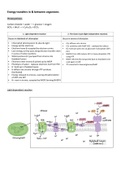
Light-dependent reacDon
,Light-independent reacDon (The Calvin cycle)
Cell adaptaDons for photosynthesis
• Many chloroplasts/chlorophyll, to absorb light
• Elongated cells - max light absorpDon
• Range of pigments to absorb range of wavelengths/max light absorpDon
• Thin cell wall for rapid CO2 absorpDon
,RespiraDon
Aerobic respiraDon
Glucose + Oxygen —> Water + Carbon Dioxide + ATP
C6H12O6 + 6O2 → 6CO2 + 6H2O + 2ATP
Glycolysis Link reac9on Krebs cycle Oxida9ve phosphoryla9on
Cytoplasm Mitochondrial matrix Mitochondrial matrix Cristae
Glucose phosphorylated to Pyruvate decarboxylated & Acetyl coA combines with 4C NADH & FADH donate
glucose phosphate oxidised to acetate molecule to produce citrate electrons to first molecule in
• Using 2ATP • CO2 removed (6C) electron transfer chain
• H accepted by NAD Pass along chain in series of
(becoming reduced redox reacDons
NAD)
Glucose phosphate split into Acetate combines with Citrate decarboxylated & Energy released from electron
x2 TP coenzyme A oxidised to 4C molecule movement used to acDvely
Producing acetylcoenzyme A • Loses 2CO2 transport protons (H+) into
• H accepted by NAD (x3) inter-membrane space
• H accepted by FAD
• ATP produced (substrate-
level phosphorylaDon)
TP oxidised into pyruvate H+ diffuse into matrix through
• H accepted by NAD ATP synthase
(NADH) PhosphorylaDon of ADP into
• 2ATP regenerated from ATP (oxidaDve
ADP phosphorylaDon)
H+ combine with O2 (final
electron receptor) &
electrons to form water
, OxidaDve phosphorylaDon (electron transport chain)
Anaerobic respiraDon
Produc9on of ethanol (plant/fungi) Produc9on of lactate (animal)
Cytoplasm Cytoplasm
1. Glycolysis 1. Glycolysis
2. Pyruvate 2. Pyruvate
• Loses CO2 molecule • Accepts 2H from 2NADH
• Accepts H from NADH (produced in glycolysis) • Form lactate
• Form ethanol
Photosynthesis
Carbon dioxide + water —> glucose + oxygen
6CO2 + 6H20 —> C₆H₁₂O₆ + 6CO2
1. Light dependent reac9on 2. The Clavin Cycle (light independent reac9on)
Occurs in thylakoid of chloroplast Occurs in stroma of chloroplast
• Chlorophyll (photosystem II) absorbs light • CO2 diffuses into stroma
• Energy excites electrons • CO2 combines with RuBP (5C) - catalysed by rubisco
• Electrons leave & accepted by electron carrier • 6C molecule splits into x2 glycerate-3-phosphate (GP)
• Lose energy as they pass along electron transfer chain (3C)
in series of redox reacDons • NADPH from LDR reduces GP to triose phosphate (TP)
• Whilst protons (H+) pumped from stroma into using ATP
thylakoid lumen • NADP reformed & transported back to thylakoid to be
• Electrons enter stroma & picked up by NADP used again in LDR
• Photolysis of water - replaces electrons lost from PSII • TP converted to hexose/glucose/RuBP
• H+ build up in thylakoid space
• H+diffuse into stroma through ATP synthase
(facilitated)
• Energy released in process, causing phosphorylaDon
of ADP into ATP
• H+ now in stroma, accepted by NADP, forming NADPH
Light-dependent reacDon
,Light-independent reacDon (The Calvin cycle)
Cell adaptaDons for photosynthesis
• Many chloroplasts/chlorophyll, to absorb light
• Elongated cells - max light absorpDon
• Range of pigments to absorb range of wavelengths/max light absorpDon
• Thin cell wall for rapid CO2 absorpDon
,RespiraDon
Aerobic respiraDon
Glucose + Oxygen —> Water + Carbon Dioxide + ATP
C6H12O6 + 6O2 → 6CO2 + 6H2O + 2ATP
Glycolysis Link reac9on Krebs cycle Oxida9ve phosphoryla9on
Cytoplasm Mitochondrial matrix Mitochondrial matrix Cristae
Glucose phosphorylated to Pyruvate decarboxylated & Acetyl coA combines with 4C NADH & FADH donate
glucose phosphate oxidised to acetate molecule to produce citrate electrons to first molecule in
• Using 2ATP • CO2 removed (6C) electron transfer chain
• H accepted by NAD Pass along chain in series of
(becoming reduced redox reacDons
NAD)
Glucose phosphate split into Acetate combines with Citrate decarboxylated & Energy released from electron
x2 TP coenzyme A oxidised to 4C molecule movement used to acDvely
Producing acetylcoenzyme A • Loses 2CO2 transport protons (H+) into
• H accepted by NAD (x3) inter-membrane space
• H accepted by FAD
• ATP produced (substrate-
level phosphorylaDon)
TP oxidised into pyruvate H+ diffuse into matrix through
• H accepted by NAD ATP synthase
(NADH) PhosphorylaDon of ADP into
• 2ATP regenerated from ATP (oxidaDve
ADP phosphorylaDon)
H+ combine with O2 (final
electron receptor) &
electrons to form water
, OxidaDve phosphorylaDon (electron transport chain)
Anaerobic respiraDon
Produc9on of ethanol (plant/fungi) Produc9on of lactate (animal)
Cytoplasm Cytoplasm
1. Glycolysis 1. Glycolysis
2. Pyruvate 2. Pyruvate
• Loses CO2 molecule • Accepts 2H from 2NADH
• Accepts H from NADH (produced in glycolysis) • Form lactate
• Form ethanol