CHAPTER 13
Maxima and Minima
13.1 State the second-derivative test for relative extrema.
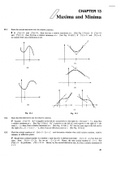
I If f ' ( c ) = 0 and /"(e) <0, then f(x) has a relative maximum at c. [See Fig. 13-l(a).] If /'(c) = 0
and /"(c)>0, then f(x) has a relative minimum at c. [See Fig. 13-l(b).] If f ' ( c ) = Q and /"(c) = 0,
we cannot draw any conclusions at all.
(«)
(«)
(*)
(*)
(c)
Fig. 13-1 Fig. 13-2
13.2 State the first-derivative test for relative extrema.
I Assume f ' ( c ) = 0. If/' is negative to the left of c and positive to the right of c—thecase{-,+}—then/has
a relative minimum at c. [See Fig. 13-2(o).] If/' is positive to the left of c and negative to the right of c—the
case{ + , -}—then/has a relative maximum at c. [See Fig. 13-2(6).] If/' has the same sign to the left and to
the right of c—{ + , +} or { —, —}—then/has an inflection point at c. [See Fig. 13-2(c).]
13.3 Find the critical numbers of f(x) = 5 — 2x + x2, and determine whether they yield relative maxima, relative
minima, or inflection points.
I Recall that a critical number is a number c such that /(c) is defined and either /'(c) = 0 or /'(c) does not
exist. Now, f ' ( x ) = -2 + 2x. So, we set -2 + 2x = Q. Hence, the only critical number is x = \. But
/"(AT) = 2. In particular, /"(I) = 2>0. Hence, by the second-derivative test, f(x) has a relative minimum at
*=1.
81
, 82 CHAPTER 13
13.4 Find the critical numbers of /(*) = x l(x - 1) and determine whether they yield relative maxima, relative
minima, or inflection points.
Hence, the critical numbers are x = 0 and x — 2. [x = 1 is not a critical number because /(I) is not
defined.] Now let us compute f"(x).
Hence, /"(0) = — 2 < 0 , and, therefore, by the second-derivative test, f(x) has a relative maximum at
0. Similarly, f"(2) = 2 > 0, and, therefore, /(*) has a relative minimum at 2.
13.5 Find the critical numbers of f(x) = x 3 - 5x 2 - 8x + 3, and determine whether they yield relative maxima,
relative minima, or inflection points.
f /'(*) = 3*2 - 10* - 8 = (3x + 2)(x -4). Hence, the critical numbers are x=4 and x=—\. Now,
f"(x) - 6.v - 10. So, /"(4) = 14 > 0, and, by the second-derivative test, there is a relative minimum at x =
4. Similarly, /"(— f ) = -14, and, therefore, there is a relative maximum at x = - §.
13.6 Find the critical numbers of /(*) = *(* - I)3, and determine whether they yield relative maxima, relative
minima, or inflection points.
f ' ( x ) = x-3(x-l)2 + (x-lY = (x- l) 2 (3x + x-l) = (x- 1) (4x - 1). So, the critical numbers are x = I
and x=\. Now, f"(x) = (x - I)2 • 4 + 2(x - l)(4x - 1) = 2(x - l)[2(jt - 1) + 4* - 1] = 2(jt - 1)(6* - 3)
= 6(jf - l)(2;c - 1). Thus, /"(J) = 6(-i)(-j) = ! >0, and, therefore, by the second-derivative test, there is a
relative minimum at * = j . On the other hand /"(I) = 6 - 0 - 1 =0, and, therefore, the second-derivative
test is inapplicable. Let us use thefirst-derivativetest. f ' ( x ) - (x - 1)2(4* - 1). For j r ^ l , (A:-I) 2 is
positive. Since 4x — 1 has the value 3 when x = l, 4x — 1 > 0 just to the left and to the right of 1.
Hence,/'(*) is positive both on the left and on the right of x = 1, and this means that we have the case { + , +}.
By the first-derivative test, there is an inflection point at x = 1.
13.7 Find the critical numbers of f(x) = sinx — x, and determine whether they yield relative maxima, relative
minima, or inflection points.
I f ' ( x ) = cos x — 1. The critical numbers are the solutions of cos* = 1, and these are the numbers x =
2irn for any integer n. Now, f"(x) = —sinx. So, f"(2irn) = -sin (Iirn) = -0 = 0, and, therefore, the
second-derivative test is inapplicable. Let us use the first-derivative test. Immediately to the left and right
of x = 2irn, c o s j c < l , and, therefore, /'(*) = cos x - 1 < 0. Hence, the case { - , — } holds, and there is
an inflection point at x — 7.-nn.
13.8 Find the critical numbers of f(x) = (x - I) 2 ' 3 and determine whether they yield relative maxima, relative
minima, or inflection points.
I /'(*)= ! ( x - l ) ~ " 3 = §{l/(x-l)" 3 ]. There are no values of x for which /'(*) = 0, but jt = 1 is a
critical number, since/'(l) is not defined. Try the first-derivative test [which is also applicable when/'(c) is not
defined]. To the left of x = \, (x - 1) is negative, and, therefore,/'(.*) is negative. To the right of x = l,
(jt-1) is positive, and, therefore, f(x) is positive. Thus, the case {-,+} holds, and there is a relative
minimum at x = 1.
13.9 Describe a procedure for finding the absolute maximum and absolute minimum values of a continuous function
f(x) on a closed interval [a, b\.
I Find all the critical numbers of f(x) in [a, b]. List all these critical numbers, c,, c 2 , . . ., and add the
endpoints a and b to the list. Calculate /(AC) for each x in the list. The largest value thus obtained is the
maximum value of f(x) on [a, b], and the minimal value thus obtained is the minimal value of f(x) on [a, b].
Maxima and Minima
13.1 State the second-derivative test for relative extrema.
I If f ' ( c ) = 0 and /"(e) <0, then f(x) has a relative maximum at c. [See Fig. 13-l(a).] If /'(c) = 0
and /"(c)>0, then f(x) has a relative minimum at c. [See Fig. 13-l(b).] If f ' ( c ) = Q and /"(c) = 0,
we cannot draw any conclusions at all.
(«)
(«)
(*)
(*)
(c)
Fig. 13-1 Fig. 13-2
13.2 State the first-derivative test for relative extrema.
I Assume f ' ( c ) = 0. If/' is negative to the left of c and positive to the right of c—thecase{-,+}—then/has
a relative minimum at c. [See Fig. 13-2(o).] If/' is positive to the left of c and negative to the right of c—the
case{ + , -}—then/has a relative maximum at c. [See Fig. 13-2(6).] If/' has the same sign to the left and to
the right of c—{ + , +} or { —, —}—then/has an inflection point at c. [See Fig. 13-2(c).]
13.3 Find the critical numbers of f(x) = 5 — 2x + x2, and determine whether they yield relative maxima, relative
minima, or inflection points.
I Recall that a critical number is a number c such that /(c) is defined and either /'(c) = 0 or /'(c) does not
exist. Now, f ' ( x ) = -2 + 2x. So, we set -2 + 2x = Q. Hence, the only critical number is x = \. But
/"(AT) = 2. In particular, /"(I) = 2>0. Hence, by the second-derivative test, f(x) has a relative minimum at
*=1.
81
, 82 CHAPTER 13
13.4 Find the critical numbers of /(*) = x l(x - 1) and determine whether they yield relative maxima, relative
minima, or inflection points.
Hence, the critical numbers are x = 0 and x — 2. [x = 1 is not a critical number because /(I) is not
defined.] Now let us compute f"(x).
Hence, /"(0) = — 2 < 0 , and, therefore, by the second-derivative test, f(x) has a relative maximum at
0. Similarly, f"(2) = 2 > 0, and, therefore, /(*) has a relative minimum at 2.
13.5 Find the critical numbers of f(x) = x 3 - 5x 2 - 8x + 3, and determine whether they yield relative maxima,
relative minima, or inflection points.
f /'(*) = 3*2 - 10* - 8 = (3x + 2)(x -4). Hence, the critical numbers are x=4 and x=—\. Now,
f"(x) - 6.v - 10. So, /"(4) = 14 > 0, and, by the second-derivative test, there is a relative minimum at x =
4. Similarly, /"(— f ) = -14, and, therefore, there is a relative maximum at x = - §.
13.6 Find the critical numbers of /(*) = *(* - I)3, and determine whether they yield relative maxima, relative
minima, or inflection points.
f ' ( x ) = x-3(x-l)2 + (x-lY = (x- l) 2 (3x + x-l) = (x- 1) (4x - 1). So, the critical numbers are x = I
and x=\. Now, f"(x) = (x - I)2 • 4 + 2(x - l)(4x - 1) = 2(x - l)[2(jt - 1) + 4* - 1] = 2(jt - 1)(6* - 3)
= 6(jf - l)(2;c - 1). Thus, /"(J) = 6(-i)(-j) = ! >0, and, therefore, by the second-derivative test, there is a
relative minimum at * = j . On the other hand /"(I) = 6 - 0 - 1 =0, and, therefore, the second-derivative
test is inapplicable. Let us use thefirst-derivativetest. f ' ( x ) - (x - 1)2(4* - 1). For j r ^ l , (A:-I) 2 is
positive. Since 4x — 1 has the value 3 when x = l, 4x — 1 > 0 just to the left and to the right of 1.
Hence,/'(*) is positive both on the left and on the right of x = 1, and this means that we have the case { + , +}.
By the first-derivative test, there is an inflection point at x = 1.
13.7 Find the critical numbers of f(x) = sinx — x, and determine whether they yield relative maxima, relative
minima, or inflection points.
I f ' ( x ) = cos x — 1. The critical numbers are the solutions of cos* = 1, and these are the numbers x =
2irn for any integer n. Now, f"(x) = —sinx. So, f"(2irn) = -sin (Iirn) = -0 = 0, and, therefore, the
second-derivative test is inapplicable. Let us use the first-derivative test. Immediately to the left and right
of x = 2irn, c o s j c < l , and, therefore, /'(*) = cos x - 1 < 0. Hence, the case { - , — } holds, and there is
an inflection point at x — 7.-nn.
13.8 Find the critical numbers of f(x) = (x - I) 2 ' 3 and determine whether they yield relative maxima, relative
minima, or inflection points.
I /'(*)= ! ( x - l ) ~ " 3 = §{l/(x-l)" 3 ]. There are no values of x for which /'(*) = 0, but jt = 1 is a
critical number, since/'(l) is not defined. Try the first-derivative test [which is also applicable when/'(c) is not
defined]. To the left of x = \, (x - 1) is negative, and, therefore,/'(.*) is negative. To the right of x = l,
(jt-1) is positive, and, therefore, f(x) is positive. Thus, the case {-,+} holds, and there is a relative
minimum at x = 1.
13.9 Describe a procedure for finding the absolute maximum and absolute minimum values of a continuous function
f(x) on a closed interval [a, b\.
I Find all the critical numbers of f(x) in [a, b]. List all these critical numbers, c,, c 2 , . . ., and add the
endpoints a and b to the list. Calculate /(AC) for each x in the list. The largest value thus obtained is the
maximum value of f(x) on [a, b], and the minimal value thus obtained is the minimal value of f(x) on [a, b].