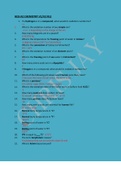
HESI A2 CHEMISTRY
HESI A2 CHEMISTRY V1/V2 FILE 1. If a Hydrogen is in a compound, what would its oxidation number be? +1 2. What is the oxidation number of any simple ion? +1 or -1 depending on the charge of the ion 3. How many kilograms are in a pound? 0. kg 4. What is the temperature for freezing point of water in Celsius? 0 degrees Celsius (32°F for Fahrenheit) 5. What is the conversion of Celsius to Fahrenheit? 0°C = 32°F 6. What is the oxidation number of an element atom? 0 7. What is the freezing point of sea water in Fahrenheit? 0°F 8. How many amino acids are in a dipeptide? 2 9. If Oxygen is in a compound, what would its oxidation number be? -2 10. Which of the following pH values would lemon juice likely have? 2 because the lower the pH value, the more acidic 11. What is a pentose? A 5 carbon sugar (Pent = 5) (ose = sugar) 12. What is the oxidation state of the Sulfur atom in Sulfuric Acid H2SO4? 6 13. How many neutrons does carbon 14 have? 8 ( mass# - atomics # = neutrons) 14 - 6 = 8 14. How many protons does Potassium have? 19 15. How many amino acids are essential for human life? 20 amino acids 16. Normal body temperature in °C? 37°C 17. Normal body temperature in °F? 98.6°F 18. Boiling point of water in °C? 100°C 19. Boiling point of water in °F? 212°F 20. 0°K is equal to °C? -273°C 21. The term Amphoteric means? A substance that can act as both a base & acid 22. What is Kelvin based around? Absolute zero 23. A compound that is a Hydrogen or proton donor, corrosive to metals, causes blue litmus paper to become red and becomes less acidic when mixed with a base is? Acid 24. Mixture of 2 or more metals are? Alloys 25. Acids: • pH less than 7.0 • sour/tart • Formulas begin with H (Hydrogen) • Proton Donor 26. 3 types of radiation in nuclear chemistry? Alpha, Beta & Gamma 27. Alpha radiation: * Emission of Helium (He) ions in the nuclei * Contains 2 protons & 2 neutrons. * +2 Charge * Largest radiation particle. * Can be stopped by piece of paper 00. Type of Alloy in which another metal is dissolved in Mercury (Hg)? Amalgam 28. Proteins are made up of? Amino Acids 29. Glycogen is what kind of starch? Animal Starch 30. When a electron gains one or more electrons? Anions 31. Basic building block of a molecule? Atom (NOT CELL!!) 32. Atomic mass? Average mass of a elements isotope 33. Atomic #: # of protons in nucleus of an atom 34. Base? • A Hydrogen or proton ACCEPTOR & has hydroxide group in the makeup of the molecule • Produce -OH • Bitter, slippery, conduct electricity, formulas contain -OH • pH value greater than 7.0 • Proton acceptor 35. Key note: Acids are Proton donors as Bases are proton acceptors 36. Beta radiation: • Decomposition product of a proton or neutron • High speed/energy Electrons • EITHER - charged electrons or + charged positrons • Can be stopped by aluminum foil 37. What is Biochemistry? Study of substances & processes occurring in living things 38. Fahrenheit is based off of? Body temperature 39. How does ↑ Surface area speed up chemical reactions? By ↑ areas of contact where chemical reactions can occur 40. How do catalyst accelerate a chemical reaction? By reducing the amount of energy needed for a reaction to occur 41. What does COOH symbolize? A Carboxyl group 42. Which of the following is not a solution type? Catalyst 43. Define Catalyst. Substance that speeds up a chemical reaction. 44. What is an atom called when it LOSES 1 or more electrons? Cations 45. What is chemical bonding? The joining of atoms to form new substances. 2 types: ionic & covalent bonding 46. What is a Ionic bond? • Electrical attraction between 2 oppositely charged atoms groups of atoms called ions • (between metals & nonmetals) 47. Ionic bonding? Chemical bond that’s formed when an atom transfers a electron to another atom. (steals) 48. Single Covalent bond? • Chemical bond that shares 1 electron pair • Formed by non-metals 49. What are chemical reactions? Making & breaking of chemical bonds, leading to changes in composition of matter 50. Double Covalent bond? When 2 electron pairs are shared 51. Triple Covalent bond? When 3 electron pairs are shared 52. The following is an example of? Combustion reaction 2C2H6 (g) + 7O2 (g) 4CO2(g) + 6H2O 53. What is a combustion reaction? A chemical reaction that occurs when a substance reacts with Oxygen, releasing energy in the form of heat & light 54. What is a compound? • Combination of 2 or more elements or atoms. • Made up of atoms of 2 or more different elements joined by chemical bonds 55. Different types of solutions? Compounds, Alloys, Amalgams, Emulsions 56. Strongest type of chemical bond? Covalent 57. What is a decomposition reaction? A SINGLE compound breaks down to form 2 or more simpler substances 58. What is Deoxyribose? A sugar used in the formation of DNA 59. Attractions between opposite charges of polar moles? Dipole-dipole forces 60. What is a Disaccharide? A double sugar molecule made of 2 monosaccharides bonded together through dehydration synthesis. 61. When 2 monosaccharides are joined together this makes? Disaccharide 62. Type of chemical bond that share 2 electron pairs? Double covalent bond 63. Example of double replacement? AB + CD = AD + CB 64. Example of Single replacement? A + BC B + AC 65. Group of electrons revolving around the nucleus of an atom, or known as a cloudlike group of electrons? Electron clouds 66. Mixtures of matter that readily separate such as water and oil? Emulsion 67. 3 common temperature systems? Fahrenheit, Celsius, Kelvin 68. Celsius is based around? Freezing & boiling point of water 69. What is reduction? GAIN of electrons 70. Gamma radiation: • Similar to xrays • Can be stopped by several feet of concrete or several inches of Lead • High energy electromagnetic radiation lacking charge and mass 71. Unit measure of weight? Gram 72. Basic units of METRIC system? Gram, Liter Meter 73. What are Hydrogen bonds? Weak attraction between a hydrogen atom & another atom 74. Examples of intermolecular forces? Hydrogen bonds, dipole-dipole, dispersion forces 75. 4 basic ways to speed up a reaction? ↑ temperature, ↑ Surface area, ↑ catalyst & concentration 76. What are intermolecular forces? Forces of attractions between molecules 77. Where are nucleic acids, DNA & RNA found? Cell nucleus 78. Atoms of the same element but have different numbers of neutrons? Isotope 79. Gluconeogenesis is a process that produces? Glucose from proteins and fats 80. What is oxidation? Loss of electrons (OIL) 81. A way to express concentration of atoms? Mole 82. What is reduction? Gain in electrons (RIG) 83. Part of the nucleus of an atom that has no charge? Neutron 84. What is the Molarity Formula? Moles of SoluteLiters of Solution=Molarity 85. Single sugar molecules? Monosaccharides 86. How does ↑ concentration cause reaction acceleration? More potential for contact (chemical reaction) 87. Which is a example of a ionic bond? NaCl (Sodium Chloride) because it does not have a charge 88. In a covalent bond compound, if the electrons are shared equally, then the bond is? Non-polar (water loving, equal) 89. The study of changes that occur in atomic nuclei? Nuclear Chemistry 90. Polar Covalent bond? Unequal sharing of electrons 91. When 3-6 monosaccharides join together this is called? Polysaccharide 92. Emission of particles or energy from a unstable nucleus? Radioactivity 93. Particles that are emitted during radioactivity? Radiation 94. Ractant is? A chemical substance that is present at the start of a chemical reaction. Reactant Product 95. A substance that is dissolved in a solution? Solute 96. A homogenous mixture of 2 or more substances? Solution 97. Liquid substance capable of dissolving other substances? Solvent 98. Define stoichiometry. Calculation of quantities in chemical reactions 99. Combining parts into a whole is? Or synthesis is? • Synthesis • Chemical reaction in which 2 elements combine to form a product 100. How many electrons does an Oxygen ion have? 10 (Atomic # of 8 & is in group VIA which has a -2 charge, which means it has 2 more electrons than the 8 protons) 101. What is the charge of Potassium (K) in KCl? +1 because K is found in group IA 1. What is the mass of 1 mole of CO2? 44g/mol (C =12.011 + (15.999 x 2) = answer 2. How many moles are present in 2 moles of O2? 3. 1.204 x 1024 ( 1 mole – 6.02 x 10²³) 2 mole would be double that 4. What characterizes a chemical reaction as combustion? The chemical reaction that is the reaction of a compound with Oxygen? • Adding O2 • Combustion 5. Sum of oxidation # =? Charge on polyatomic ion 6. Increasing the causes the particles to have greater kinetic energy, allowing them to move faster and have a greater chance? Temperature 7. To balance an equation, what are placed in front of each component? Coefficient 8. Dispersions forces are found in which covalent bond? Non-polar 9. The weakest of all intermolecular forces? Dispersion forces 10. A Dipole attraction is a intermolecular force? Weak 11. What is created when an electron pair in a covalent bond is shared unequally? Dipole 12. The attractions of one dipole to another is? Dipole interactions 13. Strongest bond of intermolecular forces? Hydrogen bond. (This is not relating to covalent) 14. Elements Flourine (F), Chlorine (Cl ), Oxygen (O) and Nitrogen (N) are involved in which bond? Hydrogen bond 15. Polarity is? Based on the difference in electronegativity values for the elements involved 16. What reactions take p[lace in the nucleus to obtain stable nuclear configurations? Nuclear reactions 17. Mass # - Atomic # = # Neutrons in a element 18. Protons + Neutrons = Mass # 19. # of Protons in a element = Atomic # 20. Neutral ions = Neutrons 21. – charge ions = electrons 22. + charge ions = Protons 23. Charge of noble gases? 0 24. Group IA = +1 Charge 25. Group IIA = +2 Charge 26. Group IIIA = +3 Charge 27. Group VA = -3 Charge 28. Group VIA = -2 Charge 29. Group VIIA = -1 Charge 30. Rows on periodic table: Period (Horizontal Left/right) 31. Columns of periodic table: Group (Vertical up/down) 32. Mass # - Atomic # = # Neutrons in a element 33. # protons an element has: Atomic # 34. How elements are arranged on the periodic table? By their chemical properties 35. Matter that has definite shape & volume? Solid 36. Matter that changes in volume with changes in temperature & pressure? Gas 37. Which change of matter is when no change is made to the chemical composition of a substance? Physical 38. Simplest substance and is represented by a letter or letters? Element 39. Law that states matter can neither be created nor destroyed during a chemical reaction? Law of conservation of mass Chemistry 1. What are all metric measurements composed of? A. Metric prefix and a basic unit of measure B. A significand and a metric prefix C. A metric prefix and a coefficient D. A coefficient and a significand 2. What is the most commonly used temperature scale in the scientific community? A. Fahrenheit B. Celsius or Centigrade C. Kelvin D. English temperature method 3. The nucleus of an atom contains or is made up of which of the following? A. Protons and electrons B. Protons only C. Protons and neutrons D. Neutrons and electrons 4. What is an atom that has a positive charge called? A. A cathode B. A cation C. An anode D. An anion 5. In the periodic table, what are the rows called? A. Groups B. Moles C. Columns D. Periods 6. What is the atomic number? A. Number of neutrons B. Number of protons C. Number of electrons D. Number of isotopes 7. Which of the following describes the atomic mass? A. Mass of protons and electrons B. Mass of neutrons and electrons C. Average mass of that element’s isotopes D. Number of moles in a solution 8. Chemical equations are written in which manner? A. Product → Reactants B. Reactants → Products C. Reactants + Reactants D. Products + Reactants 9. What is the charge on potassium in the compound KCl? A. −1 B. +1 C. −2 D. +2 10. A catalyst is a substance that accelerates a reaction by which of the following? A. Adding energy to the overall reaction B. Increasing the amount of energy needed for the reaction to occur C. Finding an alternate pathway for a reaction that requires less energy D. Speeding up the overall reaction process 11. Percent concentration of a solution is expressed as which of the following? A. 100 parts per 100 dL B. Parts per 100 parts C. Parts of moles D. Moles per 100 parts 12. What will one liter of a one molar solution of any element contain? A. The atomic mass in grams of that element B. The atomic number in grams of that element C. The atomic mass in liters of that element D. The atomic number in liters of that element 13. Chemical bonding is the bonding of which of the following? A. One atom to another atom B. One mole to another mole C. A proton to an electron D. One cation to another cation 14. Which of the following describes an ionic bond? A. It shares electrons. B. It does not share electrons. C. It is sometimes called a covalent bond. D. It is the strongest of all chemical bonds. 15. The reaction 2C2H6 + 7O2 → 4CO2 + 6H2O has a ratio of 2 parts ethane (C2H6) and 7 parts oxygen (O2). How many parts of ethane (C2H6) will be needed to react with 21 parts of oxygen (O2)? A. 3 parts of ethane C2H6 B. 6 parts of ethane C2H6 C. 9 parts of ethane C2H6 D. 14 parts of ethane C2H6 16. What is the concentration of 58.5 g of NaCl in 2 L of solution (atomic weights of each element are as follows: Na = 23 g/mol, Cl = 35.5 g/mol)? A. 0.5 mol NaCl B. 0.75 mol NaCl C. 1 mol NaCl D. 2 mol NaCl 17. In a redox reaction, which of the following describes reduction? A. It is the loss of electrons. B. It is the gain of protons. C. It is the loss of a neutron. D. It is the gain of electrons. 18. What are acids? A. Hydrogen acceptors B. Solutions of high pH C. Hydrogen donors D. Amphoteric 19. What is a benefit of water’s ability to make hydrogen bonds? A. Lack of cohesiveness B. Low surface tension C. Use as a nonpolar solvent D. High specific heat 20. What are bases or alkaline solutions? A. Hydrogen acceptors B. Solutions of low pH C. Hydrogen donors D. Amphoteric 21. Chemical reactions in living systems proceed along catabolic pathways, and there tends to be an increase in which of the following? A. Entropy B. Enthalpy C. Glucose D. Glycogen 22. What is a pH of 7? A. Acidic B. Basic C. Neutral D. Positive 23. Which is the correct way to write Iodine (I) with an atomic mass of 131? A. I131 B. I131 C. 131I D. 131I 24. What is the correct formula for magnesium chloride? A. MgCl2 B. MgCl C. Mg2Cl D. Mg2Cl2 25. What is the weakest of all the intermolecular forces? A. Dispersion B. Dipole interactions C. Hydrogen bonding D. Covalent bonding 26. Beta radiation is the emission of which of the following? A. Large numbers of helium ions B. An electron C. High energy electromagnetic radiation D. A product of the decomposition of a proton 27. Which of the following describes carbohydrates? A. They serve as fuel for the body. B. They are present in DNA but not in RNA. C. They are the least abundant biomolecule. D. They cannot be stored in the body. 28. What are monosaccharides? A. The simplest form of carbohydrates B. The most complex form of carbohydrates C. One form of a very complex fat D. Artificial sweeteners such as saccharin 29. Disaccharides are the joining together of which of the following? A. Three to six monosaccharides B. Two monosaccharides C. A number of monosaccharides D. A fat and a monosaccharide 30. Glycolysis is one of the body’s chemical pathways for which of the following? A. Manufacturing glycogen B. Building proteins C. Producing fats D. Metabolizing glucose 31. Amino acids are the building blocks for which of the following? A. Nucleic acids B. Carbohydrates C. Proteins D. Lipids 32. What is the union of two amino acids using a peptide bond called? A. A dipeptide B. A peptide C. A monopeptide D. A polypeptide 33. Which of the following describes lipids? A. They are a major source of fuel
Written for
- Institution
- HESI A2 CHEMISTRY
- Course
- HESI A2 CHEMISTRY
Document information
- Uploaded on
- July 18, 2022
- Number of pages
- 52
- Written in
- 2021/2022
- Type
- Exam (elaborations)
- Contains
- Questions & answers
Subjects
- hesi a2 chemistry
-
hesi a2 chemistry v1v2 file 1 if a hydrogen is in a compound
-
what would its oxidation number be 1 2 what is the oxidation number of any simple ion 1 or 1 depending on the ch

Also available in package deal