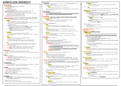
NAZI LAWMAKERS FOUND IT DIFFICULT TO DEFINE THE JEWISH RACE
The Nazi lawmakers failed to define the Jews as a biological group. Nazi Antisemitism was based on
notions of race rather than anti-religious sentiments of prejudice. The Nazis believed that the Jews
collected qualities as a biological group and did not think about the Jews in terms of religion. In the
Nuremberg laws, the Nazis failed to find a scientific way of identifying the Jew. Instead of using
biology or science, the laws resorted to ancestry to define the Jew. A minimum of three Jewish
grandparents defined a person as Jewish, and two Jewish grandparents defined a person as ‘Mixed
blood’ or ‘Mietchling’. In this way, the Nazis officially created a new group; a new problem that later
haunted them. This way of defining the Jew was unsatisfactory to the Nazis because the definition s
was based on religion. This did not prove the Jews as a biological race. Practically, this sufficed to
protect the Volksmeinshaft. The biological substance of a person mattered; Jewish blood was undes
Article: Sebastian Conrad, ‘Rethinking German Colonialism in a Global Age’, Journal of Imperial and
Commonwealth History, 41, no. 4 (2013), pp. 543- 566
796 words
1. This article is located firmly in the debate about the uses of a colonial focus when examining
German history, with a secondary outlook that the wider global context allows insight into
the nuances of German peculiarities. Conrad addresses a vast array of recent scholarship,
which has begun to put German history into the context of global connections and
interaction (Conrad suggests that we should ponder upon ‘what we can gain if we insert
Germany’s colonial past more thoroughly into a global context’) and makes three core
arguments.1 Firstly, that studies of the 30-year German empire must be examined through a
global lens to understand the dynamics of the relationship between the empire and nations.
Conrad gives the example of mass German migration to America fuelling nationalist thought,
which contributed to the German public’s great attention to African settlement projects as
an attempt to preserve the German nation abroad. Secondly, that the transmission of
knowledge and information about the colonies and other areas worldwide gives
understanding to Germany’s relationships with her colonies and other empires. Conrad, by
means of illustrations, mentions the German Bernhard von Dernburg’s reliance upon the
British when requesting information about the politics of a colony. This provides evidence
for cooperation between empires, and a German desire to know more, and potentially have
a greater role in, her colonies’ interior politics. Thirdly, Conrad argues that the history of
population politics, including that of Germany, would benefit from a taking a
historiographical global perspective.
2. Source and stance. The article engages with a variety of evidence to support its conclusions.
This ranges from books and articles, to metropolitan reports, although the article’s evidence
is primarily focussed on books. Thus, the article takes an approach that is more grounded in
secondary sources to the debate. This is in stark contrast to the approach of historians such
as Minu Haschemi Yekani, who uses more primary sources to take a more cultural and
1
Sebastian Conrad, ‘Rethinking German Colonialism in a Global Age’, Journal of Imperial and Commonwealth
History, 41, no. 4 (2013), pp. 543- 566.
The Nazi lawmakers failed to define the Jews as a biological group. Nazi Antisemitism was based on
notions of race rather than anti-religious sentiments of prejudice. The Nazis believed that the Jews
collected qualities as a biological group and did not think about the Jews in terms of religion. In the
Nuremberg laws, the Nazis failed to find a scientific way of identifying the Jew. Instead of using
biology or science, the laws resorted to ancestry to define the Jew. A minimum of three Jewish
grandparents defined a person as Jewish, and two Jewish grandparents defined a person as ‘Mixed
blood’ or ‘Mietchling’. In this way, the Nazis officially created a new group; a new problem that later
haunted them. This way of defining the Jew was unsatisfactory to the Nazis because the definition s
was based on religion. This did not prove the Jews as a biological race. Practically, this sufficed to
protect the Volksmeinshaft. The biological substance of a person mattered; Jewish blood was undes
Article: Sebastian Conrad, ‘Rethinking German Colonialism in a Global Age’, Journal of Imperial and
Commonwealth History, 41, no. 4 (2013), pp. 543- 566
796 words
1. This article is located firmly in the debate about the uses of a colonial focus when examining
German history, with a secondary outlook that the wider global context allows insight into
the nuances of German peculiarities. Conrad addresses a vast array of recent scholarship,
which has begun to put German history into the context of global connections and
interaction (Conrad suggests that we should ponder upon ‘what we can gain if we insert
Germany’s colonial past more thoroughly into a global context’) and makes three core
arguments.1 Firstly, that studies of the 30-year German empire must be examined through a
global lens to understand the dynamics of the relationship between the empire and nations.
Conrad gives the example of mass German migration to America fuelling nationalist thought,
which contributed to the German public’s great attention to African settlement projects as
an attempt to preserve the German nation abroad. Secondly, that the transmission of
knowledge and information about the colonies and other areas worldwide gives
understanding to Germany’s relationships with her colonies and other empires. Conrad, by
means of illustrations, mentions the German Bernhard von Dernburg’s reliance upon the
British when requesting information about the politics of a colony. This provides evidence
for cooperation between empires, and a German desire to know more, and potentially have
a greater role in, her colonies’ interior politics. Thirdly, Conrad argues that the history of
population politics, including that of Germany, would benefit from a taking a
historiographical global perspective.
2. Source and stance. The article engages with a variety of evidence to support its conclusions.
This ranges from books and articles, to metropolitan reports, although the article’s evidence
is primarily focussed on books. Thus, the article takes an approach that is more grounded in
secondary sources to the debate. This is in stark contrast to the approach of historians such
as Minu Haschemi Yekani, who uses more primary sources to take a more cultural and
1
Sebastian Conrad, ‘Rethinking German Colonialism in a Global Age’, Journal of Imperial and Commonwealth
History, 41, no. 4 (2013), pp. 543- 566.