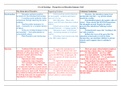
A Level Sociology – Perspectives on Education Summary Grid
Key Ideas about Education Supporting Evidence Criticisms/ Limitations
Functionalism • Education performs positive • School performs positive functions • Marxists - the education system is not
functions for the individual and society. for most pupils – exclusion and truancy meritocratic (not fair) – e.g. private schools
• It creating social solidarity (value rates are very low. benefit the wealthy.
consensus) through teaching the same • Role Allocation – Those with • Functionalism ignores the negative sides of
subjects. degrees earn 85% more than those without school – Many schools fail OFSTED inspections;
• Teaching skills necessary for degrees. Not all pupils succeed; Negative In school
work – necessary for a complex division • Schools do try to foster ‘solidarity’ – processes like subcultures/ bullying/ teacher
of labour. Extended Tutorials – (‘cringing together’?) labelling
• Acting as a bridge between home • Education is more ‘work focused’ • Postmodernists argue that ‘teaching to the
and soceiety – from paricularistic to today – increasing amounts of vocational test’ kills creativity.
universalistic values. courses. • Reflects the views of the powerful. The
• Role Allocation and meritocracy • Schooling is more meritocratic than education system tends to work for them.
in the 19th century (fairer). (because they can send their children to private
schools) and it suggests there is nothing to
criticise.
Marxism • Traditional Marxists see the • To support the reproduction of • There are many critical subjects taught at
education system as working in the inequality – Who gets the best Jobs. And university that criticise elites (e.g. Sociology).
interests of ruling class elites. The there is no statistically significant evidence • It is deterministic – not every child
education system performs three against the FACT that, on aggregate, the passively accepts authority (see Paul Willis).
functions for these elites: richer your parents, the better you do in • Some students rebel – 5% are persistent
• Reproduces class inequality. education. truants (they are active, not passive!).
• Legitimates class inequality. • To support the Legitimation of class • Some students from poor backgrounds do
• The Correspondence Principle – inequality – pupils are generally not taught ‘beat the odds’ and go on to achieve highly.
• Neo- Marxism – Paul Willis – PO about how unfair the education system is – • The growth of the creative industries in the
of 12 lads who formed a counter school they are taught that if they do badly, it is UK suggest school doesn’t pacify all students.
cultur: rejected authority and school and down to them and their lack of effort. • The nature of work and the class structure
just turned up to ‘have a laff’. However, • To support the Ideological State has also changed, possibly making Marxism less
they ended up failing and still ended up Apparatus - Surveillance has increased relevant today.
in working class jobs (so supports the schools’ ability to control students.
reproduction of class inequality).
Key Ideas about Education Supporting Evidence Criticisms/ Limitations
Functionalism • Education performs positive • School performs positive functions • Marxists - the education system is not
functions for the individual and society. for most pupils – exclusion and truancy meritocratic (not fair) – e.g. private schools
• It creating social solidarity (value rates are very low. benefit the wealthy.
consensus) through teaching the same • Role Allocation – Those with • Functionalism ignores the negative sides of
subjects. degrees earn 85% more than those without school – Many schools fail OFSTED inspections;
• Teaching skills necessary for degrees. Not all pupils succeed; Negative In school
work – necessary for a complex division • Schools do try to foster ‘solidarity’ – processes like subcultures/ bullying/ teacher
of labour. Extended Tutorials – (‘cringing together’?) labelling
• Acting as a bridge between home • Education is more ‘work focused’ • Postmodernists argue that ‘teaching to the
and soceiety – from paricularistic to today – increasing amounts of vocational test’ kills creativity.
universalistic values. courses. • Reflects the views of the powerful. The
• Role Allocation and meritocracy • Schooling is more meritocratic than education system tends to work for them.
in the 19th century (fairer). (because they can send their children to private
schools) and it suggests there is nothing to
criticise.
Marxism • Traditional Marxists see the • To support the reproduction of • There are many critical subjects taught at
education system as working in the inequality – Who gets the best Jobs. And university that criticise elites (e.g. Sociology).
interests of ruling class elites. The there is no statistically significant evidence • It is deterministic – not every child
education system performs three against the FACT that, on aggregate, the passively accepts authority (see Paul Willis).
functions for these elites: richer your parents, the better you do in • Some students rebel – 5% are persistent
• Reproduces class inequality. education. truants (they are active, not passive!).
• Legitimates class inequality. • To support the Legitimation of class • Some students from poor backgrounds do
• The Correspondence Principle – inequality – pupils are generally not taught ‘beat the odds’ and go on to achieve highly.
• Neo- Marxism – Paul Willis – PO about how unfair the education system is – • The growth of the creative industries in the
of 12 lads who formed a counter school they are taught that if they do badly, it is UK suggest school doesn’t pacify all students.
cultur: rejected authority and school and down to them and their lack of effort. • The nature of work and the class structure
just turned up to ‘have a laff’. However, • To support the Ideological State has also changed, possibly making Marxism less
they ended up failing and still ended up Apparatus - Surveillance has increased relevant today.
in working class jobs (so supports the schools’ ability to control students.
reproduction of class inequality).