Chapter 2: Molecular Biology
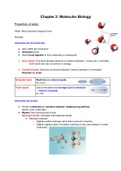
Properties of water:
Water: Most important inorganic bond
Bonding:
Intramolecular forces/bonds:
● Intra: within the compound
● Strongest bonds
● Atoms bond together to form molecules or compounds
1. Ionic bonds: One atom donates electrons to another (between 1 metal and 1 nonmetal)
Ionic bonds are very uncommon in biology
2. Covalent bonds: Electrons are shared between 2 atoms (between 2 nonmetals)
Nonpolar vs. polar:
Nonpolar bond Electrons are shared equally
Ex. H2Cl2:
Polar bonds One of the atoms has stronger pull on electrons
→ Shared unequally
Ex. HCl
Intermolecular bonds:
● Forces of attraction or repulsion between neighbouring particles
(atoms, ions, molecules)
● Weaker than intramolecular forces
Hydrogen bonds: Strongest intermolecular bonds
● Attraction between:
○ Slightly positive hydrogen atom that is part of a molecule
○ Slightly negative atom of another molecule (in this case between 2 water
molecules)
,Properties of water that are advantageous to life:
Hydrogen bonds between water molecules causes these unique characteristics to water:
1. High specific Heat (high boiling point):
a. Specific heat = amount of energy required to raise 1g by 1oC
b. Each water molecule must break their hydrogen bonds → takes a lot of time to
boil water
c. Water naturally regulates temperature, helping organisms resist changes in
environmental temperature
d. Evaporation of sweat cools organisms
2. Expansion when freezing (less dense when solid):
a. Solid water is less dense than liquid water
b. Frozen water floats (ice cubes for instance)
3. Universal solvent:
a. Dissolve polar covalent molecules and most ionic
compounds.
b. Water molecules are attracted to the sugar
molecules, causing them to dissolve in the water.
4. Surface tension:
a. Adhesion
b. They are attracted to one another forming Hydrogen bonds &
create a surface
5. Capillary action:
a. Due to cohesion and adhesion
i. Cohesion: Attraction between molecules of the same substance
ii. Adhesion: Water hydrogen bonds with other substances
b. Water molecules attract one another → they are cohesive.
i. This attraction is due to the formation of H-bonds
6. Water is transparent:
a. Light can pass through it
b. Photosynthesis is possible inside water bodies
, Properties of carbon:
Compounds
Organic compounds:
● Contain carbon
● Produced by the life processes of living things (photosynthesis, etc.), they live
● Major organic substances:
○ Proteins
○ Lipids
○ Nucleic acids
○ Carbohydrates
● Can also be man-made these days (Plastics, styrofoam, nylon, etc)
Inorganic compounds:
● All compounds without carbon
● However, compounds with carbon can also be inorganic (not living)
○ Examples: carbon oxides (CO2, CO) hydrogen carbonates (HCO3)
Carbon atoms
Carbon atoms:
● Can form 4 covalent bonds (because it needs 4 electrons to fill its valence shell)
Properties:
1. Carbon bonds happen easily (with hydrogen and other nonmetals
such as oxygen, nitrogen, sulphur and phosphorus) and create
straight chains, branched chains, or cyclic or ring structures.
2. Can form multiple covalent bonds between themselves
3. Formation of unsaturated hydrocarbon chains
4. Can share 1, 2 or 3 pairs of electrons between 2 carbon atoms
forming single, double, or triple bonds
5. In 99.9% → Covalent bonds (if I don’t know the answer → covalent bonds)
Properties of water:
Water: Most important inorganic bond
Bonding:
Intramolecular forces/bonds:
● Intra: within the compound
● Strongest bonds
● Atoms bond together to form molecules or compounds
1. Ionic bonds: One atom donates electrons to another (between 1 metal and 1 nonmetal)
Ionic bonds are very uncommon in biology
2. Covalent bonds: Electrons are shared between 2 atoms (between 2 nonmetals)
Nonpolar vs. polar:
Nonpolar bond Electrons are shared equally
Ex. H2Cl2:
Polar bonds One of the atoms has stronger pull on electrons
→ Shared unequally
Ex. HCl
Intermolecular bonds:
● Forces of attraction or repulsion between neighbouring particles
(atoms, ions, molecules)
● Weaker than intramolecular forces
Hydrogen bonds: Strongest intermolecular bonds
● Attraction between:
○ Slightly positive hydrogen atom that is part of a molecule
○ Slightly negative atom of another molecule (in this case between 2 water
molecules)
,Properties of water that are advantageous to life:
Hydrogen bonds between water molecules causes these unique characteristics to water:
1. High specific Heat (high boiling point):
a. Specific heat = amount of energy required to raise 1g by 1oC
b. Each water molecule must break their hydrogen bonds → takes a lot of time to
boil water
c. Water naturally regulates temperature, helping organisms resist changes in
environmental temperature
d. Evaporation of sweat cools organisms
2. Expansion when freezing (less dense when solid):
a. Solid water is less dense than liquid water
b. Frozen water floats (ice cubes for instance)
3. Universal solvent:
a. Dissolve polar covalent molecules and most ionic
compounds.
b. Water molecules are attracted to the sugar
molecules, causing them to dissolve in the water.
4. Surface tension:
a. Adhesion
b. They are attracted to one another forming Hydrogen bonds &
create a surface
5. Capillary action:
a. Due to cohesion and adhesion
i. Cohesion: Attraction between molecules of the same substance
ii. Adhesion: Water hydrogen bonds with other substances
b. Water molecules attract one another → they are cohesive.
i. This attraction is due to the formation of H-bonds
6. Water is transparent:
a. Light can pass through it
b. Photosynthesis is possible inside water bodies
, Properties of carbon:
Compounds
Organic compounds:
● Contain carbon
● Produced by the life processes of living things (photosynthesis, etc.), they live
● Major organic substances:
○ Proteins
○ Lipids
○ Nucleic acids
○ Carbohydrates
● Can also be man-made these days (Plastics, styrofoam, nylon, etc)
Inorganic compounds:
● All compounds without carbon
● However, compounds with carbon can also be inorganic (not living)
○ Examples: carbon oxides (CO2, CO) hydrogen carbonates (HCO3)
Carbon atoms
Carbon atoms:
● Can form 4 covalent bonds (because it needs 4 electrons to fill its valence shell)
Properties:
1. Carbon bonds happen easily (with hydrogen and other nonmetals
such as oxygen, nitrogen, sulphur and phosphorus) and create
straight chains, branched chains, or cyclic or ring structures.
2. Can form multiple covalent bonds between themselves
3. Formation of unsaturated hydrocarbon chains
4. Can share 1, 2 or 3 pairs of electrons between 2 carbon atoms
forming single, double, or triple bonds
5. In 99.9% → Covalent bonds (if I don’t know the answer → covalent bonds)