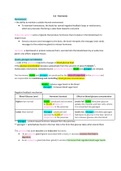
6.6 - Hormones
Homeostasis:
= the ability to maintain a stable internal environment
● To maintain homeostasis, the body has several negative feedback loops or mechanisms,
which are processes that bring a value back towards a set point.
Endocrine system = series of glands that produce hormones that circulates in the bloodstream to
target tissue
● Sensory neurons send messages to the brain, the brain interprets the message, brain sends
messages to the endocrine glands to release hormones
Hormone: a lipid-based or protein molecule that is secreted into the bloodstream by an endocrine
gland; only affects targeted tissues
Insulin, glucagon and diabetes:
→ cells in the pancreas respond to changes in blood glucose level
If the glucose concentration deviates substantially from the set point of about 5 mmol L-1,
homeostatic mechanisms mediated by the pancreatic hormones insulin and glucagon are initiated.
Two hormones, insulin and glucagon, are produced by the Islets of Langerhans in the pancreas and
are responsible for maintaining and controlling blood glucose concentrations
Insulin - reduces sugar levels in the blood
Glucagon: Increases blood sugar level
Negative feedback mechanism:
Blood Glucose Level Hormone Secreted Effect on blood glucose concentration
Higher than normal Insulin - produced and secreted Levels Fall: insulin stimulates glucose
by β-cells of Islets of uptake into muscles and liver cells, where
Langerhans in the pancreas it is converted into glycogen
Lower than normal Glucagon - produced and Levels rise: Glucagon stimulates glycogen
secreted by ɑ-cells of Islets of hydrolysis to glucose in the liver, which in
Langerhans in the pancreas turn releases glucose into the blood
***glucagon = protein-based hormone released from the pancreas.
** glycogen = carbohydrate found in the liver that is the form that glucose takes when stored there
The pancreas has both exocrine and endocrine functions.
● As an exocrine gland (gland associated with a duct), it secretes enzymes that help in
digestion;
● As an endocrine gland (ductless gland) it secretes hormones that regulate blood sugar levels.
Homeostasis:
= the ability to maintain a stable internal environment
● To maintain homeostasis, the body has several negative feedback loops or mechanisms,
which are processes that bring a value back towards a set point.
Endocrine system = series of glands that produce hormones that circulates in the bloodstream to
target tissue
● Sensory neurons send messages to the brain, the brain interprets the message, brain sends
messages to the endocrine glands to release hormones
Hormone: a lipid-based or protein molecule that is secreted into the bloodstream by an endocrine
gland; only affects targeted tissues
Insulin, glucagon and diabetes:
→ cells in the pancreas respond to changes in blood glucose level
If the glucose concentration deviates substantially from the set point of about 5 mmol L-1,
homeostatic mechanisms mediated by the pancreatic hormones insulin and glucagon are initiated.
Two hormones, insulin and glucagon, are produced by the Islets of Langerhans in the pancreas and
are responsible for maintaining and controlling blood glucose concentrations
Insulin - reduces sugar levels in the blood
Glucagon: Increases blood sugar level
Negative feedback mechanism:
Blood Glucose Level Hormone Secreted Effect on blood glucose concentration
Higher than normal Insulin - produced and secreted Levels Fall: insulin stimulates glucose
by β-cells of Islets of uptake into muscles and liver cells, where
Langerhans in the pancreas it is converted into glycogen
Lower than normal Glucagon - produced and Levels rise: Glucagon stimulates glycogen
secreted by ɑ-cells of Islets of hydrolysis to glucose in the liver, which in
Langerhans in the pancreas turn releases glucose into the blood
***glucagon = protein-based hormone released from the pancreas.
** glycogen = carbohydrate found in the liver that is the form that glucose takes when stored there
The pancreas has both exocrine and endocrine functions.
● As an exocrine gland (gland associated with a duct), it secretes enzymes that help in
digestion;
● As an endocrine gland (ductless gland) it secretes hormones that regulate blood sugar levels.