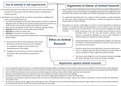
• The scientific procedures act in 1986 covers all animal research and relates to any • Brats are often used in psychological research because they can produce offspring after at
procedure that causes pain comment suffering, distress or lasting harm to 22 day gestation period meaning when investigating characteristics like aggression across
‘protected animals’. generations the researcher can quickly see the effect of breeding over several generations
• Psychologists must comply with this act and the animal welfare act (2006) which • It is argued that lab experiments have a degree of internal validity as animal participants
covers a more general duty of care are naive about what is happening, since behaviour is unlikely to change due to demand
• The British psychological society states that permission to perform procedures characteristics as a likely in humans.
regulated under the 1986 act will not be permitted unless the researcher can
justify the cost to the animals in relation to benefits from research • Researchers can exercise a high degree of control in animal experiments compared to
• there must be consideration of the three R’s: replacing, reducing, refining humans. For example the sleep and eating patterns can be monitored so you can isolate
• Replacing animals with non-sentient alternatives if possible variables in a way that you can't with humans. This may increase the reliability and validity
• Reducing the number of animals used of results • While unnecessary pain must be avoided, pain and distress may be
• Refining the procedure to minimise suffering permitted which is not the case with humans. However animal
• each project requires a government licence which is only granted after a cost research is controlled by legislation to ensure correct Treatment of
benefit analysis Animals and labs are inspected for welfare standards
• Animal experiments have provided significant insights into vital areas
• Researchers like Skinner used experiments with animals
of research including drug treatments and what we know about the
because they could exercise great control manipulate brain and the nervous system.
the independent variable an see the effect on the
resulting behaviour of the subject • Therefore results from animal experiments can directly help humans
• language and consciousness are issues to consider when • There is a utilitarian argument that the suffering of a small number of
animals is justified if it helps a significant number of people.
assessing the ethics and validity of using animals in
research • If we have a moral obligation to our own species to advance knowledge
and reduce suffering for this end animal research is justified
• It can be argued that animal research is not credible and lacks ecological validity as lab based research producers behaviour that is different from the animal’s natural behaviour
• There are too many differences between human and animals to be able to generalise the results. to generalise between animals and humans is to be guilty of anthropomorphism
• there are differences between human and animal evolution and genetic makeup. We are different both cognitively and emotionally
• behaviour and thought processes are subject to many more variables, for instance cultural norms and language
• psychologically we have a proportionately much larger cortex which suggests generalising from animals has limited value
• causing pain and discomfort should be avoided unless the results are of significant benefit to humans. however this benefit is not known or certain until after the study which
raises ethical issues
• the utilitarian argument would suggest that research gives human suffering priority over animal suffering which researcher Singer viewed as a form of discrimination which he
turned speciesism and that animals and humans should have the same rights
, Definition:- Observing the behaviour of participants within their own environment, where they would
normally show their behaviours being investigated. Nothing is manipulated/controlled by the researcher Definition: - Observation is staged in some way so the researcher has some control over the situation
Strengths:- A realistic picture of natural, spontaneous behaviour Strengths:- Controlled environment allows focus on particular aspects of behaviour, for example, children playing with ‘feminine’ toys to observe how boys
- The observation takes place in a person’s (or animal’s) natural environment and so they are likely to and girls react
behave as they normally do
- This means that specific conclusions can be drawn about gender responses- if everything was natural the children might not encounter different types of toys
- This means the results are likely t be high in ecological validity
- It may be possible to draw some tentative causal conclusions.
- Useful method to use when investigating a new area of research
- If variables are deliberately changed by the researcher and different effects are observed then it suggests that one caused the
- Gives researcher ideas of what further investigations may be planned, for example using certain
behavioural categories or experimental methods Weaknesses: - Environment may feel unnatural and then participants may not behave as they would in everyday life
Weaknesses: - The observation is more likely to be covert, which raises ethical issues - This means that the ecological validity may lack
- It is difficult to draw conclusions if the focus is too wide - Participants may know they are being observed, for example if the observation takes place in a lab so that the researcher can control aspects of the situation.
- If behavioural categories and event/time sampling have been used that may restrict the amount of - This awareness means that participants may try to guess what the study is about which alters their behaviour
data collected which makes it easier to see patterns of behaviour
Observations Definition: - Where the participants do know that they are being observed
Strengths:- Avoids lack of informed consent because participants can decide whether to participate
Definition: - Where the participants don’t know that they are being observed
Strengths: - Participants behave more naturally because they are not aware of being observed
(learning research - It is easier to see everything that is going on because the observer doesn’t have to hide
Weaknesses:- If the participants know they are being observed they are likely to alter their
Weaknesses:- Raises ethical issues about observing people without their knowledge method) behaviour (demand characteristics)
- Participants may be able to give informed consent if asked afterwards (and can withhold their
data) but in practice this is difficult
- There is an invasion of privacy issue
- Even for observations in a public place, such as a bus queue, people might regard it as unethical
to record what they are doing
Definition:
- Where the observer remains detached from the people they are observing
Strengths:
Definition: - Where the observer becomes part of the group that they are observing
- Participants behave more naturally because they are not aware of being observed
Strengths:- Likely to provide special insights into behaviour, from the ‘inside’
Weaknesses:
- The participant has greater familiarity with what is likely to happen and therefore may ‘see’ greater detail that would be missed by someone new to
the situation - Raises ethical issues about observing people without their knowledge
- Being on the inside means the observer may see more.
- Participants may be able to give informed consent if asked afterwards (and can withhold
Weaknesses:- Objectivity is reduced (observer bias) because the observer is familiar with what is going on they are looking at the situati on more their data) but in practice this is difficult
subjectively
- There is an invasion of privacy issue
- More difficult to record and monitor behaviour unobtrusively if the observer is part of the group being observed.
- Even for observations in a public place, such as a bus queue, people might regard it as
- Therefore, the observation is likely to be overt and participants are aware they are being studied, which may alter their behaviour
unethical to record what they are doing
procedure that causes pain comment suffering, distress or lasting harm to 22 day gestation period meaning when investigating characteristics like aggression across
‘protected animals’. generations the researcher can quickly see the effect of breeding over several generations
• Psychologists must comply with this act and the animal welfare act (2006) which • It is argued that lab experiments have a degree of internal validity as animal participants
covers a more general duty of care are naive about what is happening, since behaviour is unlikely to change due to demand
• The British psychological society states that permission to perform procedures characteristics as a likely in humans.
regulated under the 1986 act will not be permitted unless the researcher can
justify the cost to the animals in relation to benefits from research • Researchers can exercise a high degree of control in animal experiments compared to
• there must be consideration of the three R’s: replacing, reducing, refining humans. For example the sleep and eating patterns can be monitored so you can isolate
• Replacing animals with non-sentient alternatives if possible variables in a way that you can't with humans. This may increase the reliability and validity
• Reducing the number of animals used of results • While unnecessary pain must be avoided, pain and distress may be
• Refining the procedure to minimise suffering permitted which is not the case with humans. However animal
• each project requires a government licence which is only granted after a cost research is controlled by legislation to ensure correct Treatment of
benefit analysis Animals and labs are inspected for welfare standards
• Animal experiments have provided significant insights into vital areas
• Researchers like Skinner used experiments with animals
of research including drug treatments and what we know about the
because they could exercise great control manipulate brain and the nervous system.
the independent variable an see the effect on the
resulting behaviour of the subject • Therefore results from animal experiments can directly help humans
• language and consciousness are issues to consider when • There is a utilitarian argument that the suffering of a small number of
animals is justified if it helps a significant number of people.
assessing the ethics and validity of using animals in
research • If we have a moral obligation to our own species to advance knowledge
and reduce suffering for this end animal research is justified
• It can be argued that animal research is not credible and lacks ecological validity as lab based research producers behaviour that is different from the animal’s natural behaviour
• There are too many differences between human and animals to be able to generalise the results. to generalise between animals and humans is to be guilty of anthropomorphism
• there are differences between human and animal evolution and genetic makeup. We are different both cognitively and emotionally
• behaviour and thought processes are subject to many more variables, for instance cultural norms and language
• psychologically we have a proportionately much larger cortex which suggests generalising from animals has limited value
• causing pain and discomfort should be avoided unless the results are of significant benefit to humans. however this benefit is not known or certain until after the study which
raises ethical issues
• the utilitarian argument would suggest that research gives human suffering priority over animal suffering which researcher Singer viewed as a form of discrimination which he
turned speciesism and that animals and humans should have the same rights
, Definition:- Observing the behaviour of participants within their own environment, where they would
normally show their behaviours being investigated. Nothing is manipulated/controlled by the researcher Definition: - Observation is staged in some way so the researcher has some control over the situation
Strengths:- A realistic picture of natural, spontaneous behaviour Strengths:- Controlled environment allows focus on particular aspects of behaviour, for example, children playing with ‘feminine’ toys to observe how boys
- The observation takes place in a person’s (or animal’s) natural environment and so they are likely to and girls react
behave as they normally do
- This means that specific conclusions can be drawn about gender responses- if everything was natural the children might not encounter different types of toys
- This means the results are likely t be high in ecological validity
- It may be possible to draw some tentative causal conclusions.
- Useful method to use when investigating a new area of research
- If variables are deliberately changed by the researcher and different effects are observed then it suggests that one caused the
- Gives researcher ideas of what further investigations may be planned, for example using certain
behavioural categories or experimental methods Weaknesses: - Environment may feel unnatural and then participants may not behave as they would in everyday life
Weaknesses: - The observation is more likely to be covert, which raises ethical issues - This means that the ecological validity may lack
- It is difficult to draw conclusions if the focus is too wide - Participants may know they are being observed, for example if the observation takes place in a lab so that the researcher can control aspects of the situation.
- If behavioural categories and event/time sampling have been used that may restrict the amount of - This awareness means that participants may try to guess what the study is about which alters their behaviour
data collected which makes it easier to see patterns of behaviour
Observations Definition: - Where the participants do know that they are being observed
Strengths:- Avoids lack of informed consent because participants can decide whether to participate
Definition: - Where the participants don’t know that they are being observed
Strengths: - Participants behave more naturally because they are not aware of being observed
(learning research - It is easier to see everything that is going on because the observer doesn’t have to hide
Weaknesses:- If the participants know they are being observed they are likely to alter their
Weaknesses:- Raises ethical issues about observing people without their knowledge method) behaviour (demand characteristics)
- Participants may be able to give informed consent if asked afterwards (and can withhold their
data) but in practice this is difficult
- There is an invasion of privacy issue
- Even for observations in a public place, such as a bus queue, people might regard it as unethical
to record what they are doing
Definition:
- Where the observer remains detached from the people they are observing
Strengths:
Definition: - Where the observer becomes part of the group that they are observing
- Participants behave more naturally because they are not aware of being observed
Strengths:- Likely to provide special insights into behaviour, from the ‘inside’
Weaknesses:
- The participant has greater familiarity with what is likely to happen and therefore may ‘see’ greater detail that would be missed by someone new to
the situation - Raises ethical issues about observing people without their knowledge
- Being on the inside means the observer may see more.
- Participants may be able to give informed consent if asked afterwards (and can withhold
Weaknesses:- Objectivity is reduced (observer bias) because the observer is familiar with what is going on they are looking at the situati on more their data) but in practice this is difficult
subjectively
- There is an invasion of privacy issue
- More difficult to record and monitor behaviour unobtrusively if the observer is part of the group being observed.
- Even for observations in a public place, such as a bus queue, people might regard it as
- Therefore, the observation is likely to be overt and participants are aware they are being studied, which may alter their behaviour
unethical to record what they are doing