To the Night - Percy Bysshe Shelley
Background
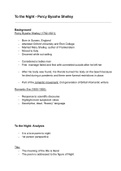
Percy Bysshe Shelley (1792-1821):
- Born in Sussex, England
- Attended Oxford University and Eton College
- Married Mary Shelley, author of Frankenstein
- Moved to Italy
- Drowned while out sailing
- Considered a ladies man
- First marriage failed and first wife committed suicide after he left her
- After his body was found, his friends burned his body on the beach because
he died during a pandemic and there were funeral restrictions in place.
- Part of the romantic movement: 2nd generation of British Romantic writers
Romantic Era (1850-1920):
- Response to scientific discourse
- Highlight more subjective views
- Descriptive, ideal, “flowery” language
To the Night: Analysis
- It is a love poem to night
- 1st person perspective
Title:
- The meaning of the title is literal
- The poem is addressed to the figure of Night
, A Swiftly walk o'er the western wave,
B Spirit of Night!
A Out of the misty eastern cave,
B Where, all the long and lone daylight,
C Thou wovest dreams of joy and fear,
C Which make thee terrible and dear,—
B Swift be thy flight!
D Wrap thy form in a mantle grey,
E Star-inwrought!
D Blind with thine hair the eyes of Day;
E Kiss her until she be wearied out,
F Then wander o'er city, and sea, and land,
F Touching all with thine opiate wand—
E Come, long-sought!
G When I arose and saw the dawn,
H I sighed for thee;
G When light rode high, and the dew was gone,
H And noon lay heavy on flower and tree,
I And the weary Day turned to his rest,
I Lingering like an unloved guest.
H I sighed for thee.
J Thy brother Death came, and cried,
K Wouldst thou me?
J Thy sweet child Sleep, the filmy-eyed,
K Murmured like a noontide bee,
L Shall I nestle near thy side?
L Wouldst thou me?—And I replied,
K No, not thee!
M Death will come when thou art dead,
N Soon, too soon—
M Sleep will come when thou art fled;
N Of neither would I ask the boon
O I ask of thee, belovèd Night—
O Swift be thine approaching flight,
N Come soon, soon!
Structure:
- The format is that of an ode
- It has a musical quality which is created by the rhyme scheme and rhythm
- Rhyme Scheme: ababccb in each stanza
Background
Percy Bysshe Shelley (1792-1821):
- Born in Sussex, England
- Attended Oxford University and Eton College
- Married Mary Shelley, author of Frankenstein
- Moved to Italy
- Drowned while out sailing
- Considered a ladies man
- First marriage failed and first wife committed suicide after he left her
- After his body was found, his friends burned his body on the beach because
he died during a pandemic and there were funeral restrictions in place.
- Part of the romantic movement: 2nd generation of British Romantic writers
Romantic Era (1850-1920):
- Response to scientific discourse
- Highlight more subjective views
- Descriptive, ideal, “flowery” language
To the Night: Analysis
- It is a love poem to night
- 1st person perspective
Title:
- The meaning of the title is literal
- The poem is addressed to the figure of Night
, A Swiftly walk o'er the western wave,
B Spirit of Night!
A Out of the misty eastern cave,
B Where, all the long and lone daylight,
C Thou wovest dreams of joy and fear,
C Which make thee terrible and dear,—
B Swift be thy flight!
D Wrap thy form in a mantle grey,
E Star-inwrought!
D Blind with thine hair the eyes of Day;
E Kiss her until she be wearied out,
F Then wander o'er city, and sea, and land,
F Touching all with thine opiate wand—
E Come, long-sought!
G When I arose and saw the dawn,
H I sighed for thee;
G When light rode high, and the dew was gone,
H And noon lay heavy on flower and tree,
I And the weary Day turned to his rest,
I Lingering like an unloved guest.
H I sighed for thee.
J Thy brother Death came, and cried,
K Wouldst thou me?
J Thy sweet child Sleep, the filmy-eyed,
K Murmured like a noontide bee,
L Shall I nestle near thy side?
L Wouldst thou me?—And I replied,
K No, not thee!
M Death will come when thou art dead,
N Soon, too soon—
M Sleep will come when thou art fled;
N Of neither would I ask the boon
O I ask of thee, belovèd Night—
O Swift be thine approaching flight,
N Come soon, soon!
Structure:
- The format is that of an ode
- It has a musical quality which is created by the rhyme scheme and rhythm
- Rhyme Scheme: ababccb in each stanza