Inheritance
01 February 2022 12:18
Homologous Chromosomes
• Homologous chromosomes are the same size, same shape, and have the same genes in
the same order
• Humans have 22 pairs of homologous chromosomes (autosomal chromosomes) and a pair
of sex chromosomes
• One of each pair came from the mother via the egg while the other came from the father's
sperm
• The chromosomes pairs are numbered according to size
• At the stage in the cell cycle when the chromosomes are fully condensed, a photograph
can be taken of the chromosomes
• The chromosomes can then be cut out and stuck on a piece of paper in their matching
pairs in order of decreasing size, with the sex chromosomes put at the end for quick
identification of gender
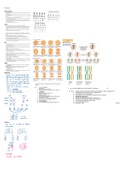
• The resulting picture is called a karyogram
Karyogram
• A karyogram is used to show up any gross chromosomal abnormalities
• During pregnancy, the mother and foetus may undertake amniocentesis or CVS in order to
look for major genetic problems such as Downs Syndrome of Kleinfelter's syndrome
• A karyogram will not show up point mutations such as cystic fibrosis or Huntington's
disease
• As well as being the same size and shape, homologous chromosomes have the same
banding pattern when stained to show the genes
• A gene for a particular protein is always found at a specific locus on a chromosome
• A human chromosome will have somewhere between a few hundred and a few thousand
genes
• The total number of genes in humans is about 20,000 - 25,000
• A gene for a particular protein may exist in different forms called alleles
• Cells of most organisms contain two sets of chromosomes (one from each parent)
• These cells are described as being diploid
• These cells may be written as 2n, where n = the number of chromosomes in a set
• Some cells of the body (relatively few) are haploid (represented as n), containing only one
set of chromosomes, these are the gametes
Meiosis
• For a species to continue there must be a point before fertilisation where the number of
chromosomes is halved
• If this didn't happen, the chromosome number would double with each generation and
the species would be unviable
• Halving of the chromosome number occurs in meiosis, sometimes known as reduction
division
• Meiosis introduces variation into chromosomes
• As does mutation, which can arise at any stage of the life cycle
• This gives natural selection a chance to act in order to produce the huge range of species
present on the earth today
• Meiosis consists of two division stages (meiosis I and meiosis II), not one
• Meiosis I consists of a reduction division, resulting in two daughter cells with half the
chromosome number of the parent
• Meiosis II is just like mitosis, in that the haploid cells divide again by separating the two
sister chromatids of each chromosome
• The final result of meiosis is four daughter cells
• Each cell is haploid
• Genetic variation has been introduced by independent assortment and crossing over of
the homologous chromosomes
• When these genetically varied gametes fuse randomly at fertilisation, there is another
chance of variation being introduced
Definitions
• Recessive allele, only expressed in the phenotype in the absence of a dominant allele
(when homozygous)
• Dominant allele, expressed in the phenotype even when only one copy is present
• Genotype, representation of alleles of an organism using letters eg,
- AA, homozygous dominant
- Aa, heterozygous
- aa, homozygous recessive
• Phenotype, description (in words) about the appearance or characteristic, eg, brown hair,
white petals, blood group A, can roll tongue, etc
Monohybrid Crosses
Describe how crossing over and independent assortment can lead to genetic
variation:
Dihybrid Crosses
01 February 2022 12:18
Homologous Chromosomes
• Homologous chromosomes are the same size, same shape, and have the same genes in
the same order
• Humans have 22 pairs of homologous chromosomes (autosomal chromosomes) and a pair
of sex chromosomes
• One of each pair came from the mother via the egg while the other came from the father's
sperm
• The chromosomes pairs are numbered according to size
• At the stage in the cell cycle when the chromosomes are fully condensed, a photograph
can be taken of the chromosomes
• The chromosomes can then be cut out and stuck on a piece of paper in their matching
pairs in order of decreasing size, with the sex chromosomes put at the end for quick
identification of gender
• The resulting picture is called a karyogram
Karyogram
• A karyogram is used to show up any gross chromosomal abnormalities
• During pregnancy, the mother and foetus may undertake amniocentesis or CVS in order to
look for major genetic problems such as Downs Syndrome of Kleinfelter's syndrome
• A karyogram will not show up point mutations such as cystic fibrosis or Huntington's
disease
• As well as being the same size and shape, homologous chromosomes have the same
banding pattern when stained to show the genes
• A gene for a particular protein is always found at a specific locus on a chromosome
• A human chromosome will have somewhere between a few hundred and a few thousand
genes
• The total number of genes in humans is about 20,000 - 25,000
• A gene for a particular protein may exist in different forms called alleles
• Cells of most organisms contain two sets of chromosomes (one from each parent)
• These cells are described as being diploid
• These cells may be written as 2n, where n = the number of chromosomes in a set
• Some cells of the body (relatively few) are haploid (represented as n), containing only one
set of chromosomes, these are the gametes
Meiosis
• For a species to continue there must be a point before fertilisation where the number of
chromosomes is halved
• If this didn't happen, the chromosome number would double with each generation and
the species would be unviable
• Halving of the chromosome number occurs in meiosis, sometimes known as reduction
division
• Meiosis introduces variation into chromosomes
• As does mutation, which can arise at any stage of the life cycle
• This gives natural selection a chance to act in order to produce the huge range of species
present on the earth today
• Meiosis consists of two division stages (meiosis I and meiosis II), not one
• Meiosis I consists of a reduction division, resulting in two daughter cells with half the
chromosome number of the parent
• Meiosis II is just like mitosis, in that the haploid cells divide again by separating the two
sister chromatids of each chromosome
• The final result of meiosis is four daughter cells
• Each cell is haploid
• Genetic variation has been introduced by independent assortment and crossing over of
the homologous chromosomes
• When these genetically varied gametes fuse randomly at fertilisation, there is another
chance of variation being introduced
Definitions
• Recessive allele, only expressed in the phenotype in the absence of a dominant allele
(when homozygous)
• Dominant allele, expressed in the phenotype even when only one copy is present
• Genotype, representation of alleles of an organism using letters eg,
- AA, homozygous dominant
- Aa, heterozygous
- aa, homozygous recessive
• Phenotype, description (in words) about the appearance or characteristic, eg, brown hair,
white petals, blood group A, can roll tongue, etc
Monohybrid Crosses
Describe how crossing over and independent assortment can lead to genetic
variation:
Dihybrid Crosses