The Trochlear Nerve (CN IV)
It is the smallest cranial nerve, but has the longest intracranial path
It only contains somatic motor neurones, so has no sensory function
Anatomical course:
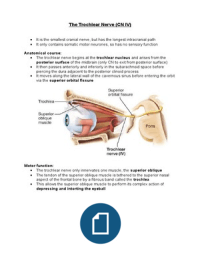
The trochlear nerve begins at the trochlear nucleus and arises from the
posterior surface of the midbrain (only CN to exit from posterior surface)
It then passes anteriorly and inferiorly in the subarachnoid space before
piercing the dura adjacent to the posterior clinoid process
It moves along the lateral wall of the cavernous sinus before entering the orbit
via the superior orbital fissure
Motor function:
The trochlear nerve only innervates one muscle, the superior oblique
The tendon of the superior oblique muscle is tethered to the superior nasal
aspect of the frontal bone by a fibrous band called the trochlea
This allows the superior oblique muscle to perform its complex action of
depressing and intorting the eyeball
It is the smallest cranial nerve, but has the longest intracranial path
It only contains somatic motor neurones, so has no sensory function
Anatomical course:
The trochlear nerve begins at the trochlear nucleus and arises from the
posterior surface of the midbrain (only CN to exit from posterior surface)
It then passes anteriorly and inferiorly in the subarachnoid space before
piercing the dura adjacent to the posterior clinoid process
It moves along the lateral wall of the cavernous sinus before entering the orbit
via the superior orbital fissure
Motor function:
The trochlear nerve only innervates one muscle, the superior oblique
The tendon of the superior oblique muscle is tethered to the superior nasal
aspect of the frontal bone by a fibrous band called the trochlea
This allows the superior oblique muscle to perform its complex action of
depressing and intorting the eyeball