The Hypoglossal Nerve (CN XII)
The hypoglossal nerve only has a somatic motor function, innervating most of
the muscles of the tongue
Anatomical course:
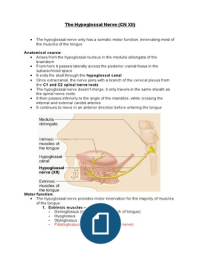
Arises from the hypoglossal nucleus in the medulla oblongata of the
brainstem
From here it passes laterally across the posterior cranial fossa in the
subarachnoid space
It exits the skull through the hypoglossal canal
Once extracranial, the nerve joins with a branch of the cervical plexus from
the C1 and C2 spinal nerve roots
The hypoglossal nerve doesn’t merge; it only travels in the same sheath as
the spinal nerve roots
It then passes inferiorly to the angle of the mandible, while crossing the
internal and external carotid arteries
It continues to move in an anterior direction before entering the tongue
Motor function:
The hypoglossal nerve provides motor innervation for the majority of muscles
of the tongue:
1. Extrinsic muscles –
- Genioglossus (makes up muscle bulk of tongue)
- Hyoglossus
- Styloglossus
- Palatoglossus (supplied by the vagus nerve)
The hypoglossal nerve only has a somatic motor function, innervating most of
the muscles of the tongue
Anatomical course:
Arises from the hypoglossal nucleus in the medulla oblongata of the
brainstem
From here it passes laterally across the posterior cranial fossa in the
subarachnoid space
It exits the skull through the hypoglossal canal
Once extracranial, the nerve joins with a branch of the cervical plexus from
the C1 and C2 spinal nerve roots
The hypoglossal nerve doesn’t merge; it only travels in the same sheath as
the spinal nerve roots
It then passes inferiorly to the angle of the mandible, while crossing the
internal and external carotid arteries
It continues to move in an anterior direction before entering the tongue
Motor function:
The hypoglossal nerve provides motor innervation for the majority of muscles
of the tongue:
1. Extrinsic muscles –
- Genioglossus (makes up muscle bulk of tongue)
- Hyoglossus
- Styloglossus
- Palatoglossus (supplied by the vagus nerve)