Organisational Behaviour 2021 | Joyce Rommens
Objectives course:
- Students can explain and discuss how HRM contributes to the performance of health care professionals and to
patient care.
- Students can analyse individual and collective behaviour of health care professionals within a case, based on
concepts discussed in the course such as HRM, leadership and teamwork.
- Students can analyse the consequences of developments in health care for the individual and collective behaviour
of health care professionals and for patients.
- Students can explain how concepts such as leadership, teamwork, and HRM can affect working in healthcare and
analyse how trends in health care affect this relationship.
- Students can present dilemmas and tensions on concepts such as leadership, performance, professionalism, and
teamwork within health care organisations and to reflect on it.
- Students can identify, analyse, and reach solutions to problems on individual and collective behaviour, presented
in a case.
- Students can discuss paper(s) in a workgroup by presenting the strengths and weaknesses and by relating papers
to each other.
Lecture 1: Introduction to organisational behaviour and human resource
management (M. Buljac)
Good work environments have an advantage compared to the competitors, because people are less
likely to switch their jobs. All those challenges leading to behaviour in the organisation and leading to
effectiveness of organisations, is organisational behaviour. We try to understand how it is that some
organisations are more effective than others and what leads employees to behave a certain way that
will lead to more or less success.
Organisational behaviour: “A field of study that investigates the impact that individuals, groups, and
structure have on behaviour within organisations, for the purpose of applying such knowledge
toward improving an organisation’s effectiveness.” ® We are looking at individual behaviour that is
influenced by different levels (individual level, group team level, organisational level). We are trying
to understand these relationships, to gain knowledge on how to improve the effectiveness of
organisations.
Human resource management (Boselie, 2002):
- Human: employment relationship employer and employee
- Resource: human capital; employees as resources to achieve organisational success through
knowledge, skills, and competencies
- Management: activities to let employees act in a desired way to achieve organisational
success
The management of work and people towards desired ends (Boxall et al., 2007).
HRM involves management decisions related to policies and practices that together shape the
employment relationship and are aimed at achieving individual, organisational, and societal goals
(Boselie, 2010).
Example of Google: HRM-director says that she gives talented people freedom, facilitates them to be creative (no
registration of sickness or vacation-days). She trusts her employees; no rules about working times.
Example of Buurtzorg: vision that when you recruit highly educated people, they’re well- capably of making own decisions
and that’s why you do not need managers. Supporting should be requested by the team itself.
Heaving a strong HR that is related to the strategy of the organisation will lead to advantage
compared to your competitors ® strategic HRM. Incorporating your HRM in your strategy. We have
strong evidence that strategic HRM will lead to better performance.
1
, Organisational Behaviour 2021 | Joyce Rommens
Strategic HRM: “strategic human resource management is defined as the pattern of planned human
resource deployments and activities intended to enable an organisation to achieve its goals.
It involves all of the activities that are implemented by an organisation to affect the behaviour of
individuals to implement the strategic needs of a business.” (Wright & McMahan, 1992)
Evolution of HRM:
HRM is more focused on the long term, is business-oriented and focusses more on commitment
instead of control. Now, there is an important role for the line-managers.
Major developments in HRM:
- Managing talent ® continuing lifelong learning
- Managing work-life balance
- Managing change and cultural transformation ® topic shift from control (technical, rewards,
appraisal, selection) to more commitment (how do we get committed employees that are
willing to take an extra step, that are happy)
- Becoming a learning organisation
- Improving leadership development
® More focus on well-being, and less on control/rules and productivity.
HRM approaches
Hard HRM: focus on added values (humans as a resource). ® Employees are one of the resources
that you have. Focussing on managing those resources to create and add economic value. It is more
the input versus the output.
Soft HRM: focus on moral values (humans as a goal on their own). ® Humans as a means to an end,
but they are also the most important resource. Your employees are a goal on its own. The
relationships they have among each other and with the organisation, is an important one. They are
not only an employee, but they are also persons that fit into multiple groups (family life, sport). They
have their own norms and values. Soft HRM is also about fairness, equity, not only the economic
rationality.
Michigan model (Fombrun et al., 1984):
- Narrow
- Hard HRM
- McGregor: theory X
(control)
- Incentives for employees to
perform
- Organisational strategy and
mission are central
2
, Organisational Behaviour 2021 | Joyce Rommens
® Model focussed more on the organisational strategy. It is about performance, rewards, appraisal,
training, more on the control based HRM.
Harvard model (Beer et al., 1984):
- Broad
- Soft HRM
- McGregor: theory Y
(participation)
- HRM facilitates
- Employees are central
- Multiple performance
measures
- People as assets, not costs
® Not only organisational effectiveness
as performance, but also e.g., work life
balance, commitment.
In search for synthesis:
- You want both sides: HRM is combining them
- Combining the ‘added value’ with the ‘moral value’ you create a unique approach
- Results in sustainable competitive advantages for every organisation
Individual practices versus a bundle of practices (High Performance Working Systems, HPWS) ®
activities that increase organisational performance.
The idea behind HR bundles is that you select and cluster
different HR strategies, aiming to affect and increase one
certain characteristic and that will lead to synergy. This also
has the assumption that you don’t have deadly
combinations. A deadly combination is not having self-
managing teams, but the goal setting is on individual level
and not on team level. There are three different topics you
can bundle your HR practices around:
3
, Organisational Behaviour 2021 | Joyce Rommens
AMO-model (ability, motivation, opportunity) gives a theoretical insight in how you can increase the
effective discretionary effort:
- Three types of HRM-bundles can be linked to the AMO model
- Takes the extra step without somebody expects it from you leads to better performance ®
organisational citizenship behaviour
® Opportunities are the same as empowerment enhancing bundles. The idea behind those bundles
is that they will increase the extra step you will take for the organisation, that will lead to
performance. A HR system should focus on all three topics.
Core versus peripheral workers:
- Not all employees are the same: one size does not fit all
- HR differentiation
- Tendency: focus on core workers
- HR architecture (Lepak & Snell, 2002)
- Based on uniqueness and strategic value
- Different employees, different HR treatment
- High strategic value: you want those employees to be internal
- Low strategic value: you need their services, but you want them externally
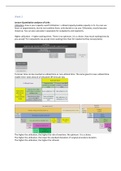
- You can divide your staff into four different groups, based on uniqueness and strategic value
- Q1: doctors and nurses (core employees) ® commitment-based HR
- Q2: social workers and dietitians (job-based employees) ® productivity-based HR
- Q3: cleaners (transactional) ® compliance-based HR
- Q4: consultancy and accountancy (transactional) ® collaborative-based HR
This makes a differentiation on how HR strategy could be implemented. It is not like one size fits all.
Not only for the organisation, but also for the employee.
The optimal relationship would be HRM related to patient related performance. Like patient
mortality. Statement: HRM diminishes patient death in hospitals.
HRM - performance relationship
The correlation between HRM and performance was there, but nobody knew why HRM lead to
4
Objectives course:
- Students can explain and discuss how HRM contributes to the performance of health care professionals and to
patient care.
- Students can analyse individual and collective behaviour of health care professionals within a case, based on
concepts discussed in the course such as HRM, leadership and teamwork.
- Students can analyse the consequences of developments in health care for the individual and collective behaviour
of health care professionals and for patients.
- Students can explain how concepts such as leadership, teamwork, and HRM can affect working in healthcare and
analyse how trends in health care affect this relationship.
- Students can present dilemmas and tensions on concepts such as leadership, performance, professionalism, and
teamwork within health care organisations and to reflect on it.
- Students can identify, analyse, and reach solutions to problems on individual and collective behaviour, presented
in a case.
- Students can discuss paper(s) in a workgroup by presenting the strengths and weaknesses and by relating papers
to each other.
Lecture 1: Introduction to organisational behaviour and human resource
management (M. Buljac)
Good work environments have an advantage compared to the competitors, because people are less
likely to switch their jobs. All those challenges leading to behaviour in the organisation and leading to
effectiveness of organisations, is organisational behaviour. We try to understand how it is that some
organisations are more effective than others and what leads employees to behave a certain way that
will lead to more or less success.
Organisational behaviour: “A field of study that investigates the impact that individuals, groups, and
structure have on behaviour within organisations, for the purpose of applying such knowledge
toward improving an organisation’s effectiveness.” ® We are looking at individual behaviour that is
influenced by different levels (individual level, group team level, organisational level). We are trying
to understand these relationships, to gain knowledge on how to improve the effectiveness of
organisations.
Human resource management (Boselie, 2002):
- Human: employment relationship employer and employee
- Resource: human capital; employees as resources to achieve organisational success through
knowledge, skills, and competencies
- Management: activities to let employees act in a desired way to achieve organisational
success
The management of work and people towards desired ends (Boxall et al., 2007).
HRM involves management decisions related to policies and practices that together shape the
employment relationship and are aimed at achieving individual, organisational, and societal goals
(Boselie, 2010).
Example of Google: HRM-director says that she gives talented people freedom, facilitates them to be creative (no
registration of sickness or vacation-days). She trusts her employees; no rules about working times.
Example of Buurtzorg: vision that when you recruit highly educated people, they’re well- capably of making own decisions
and that’s why you do not need managers. Supporting should be requested by the team itself.
Heaving a strong HR that is related to the strategy of the organisation will lead to advantage
compared to your competitors ® strategic HRM. Incorporating your HRM in your strategy. We have
strong evidence that strategic HRM will lead to better performance.
1
, Organisational Behaviour 2021 | Joyce Rommens
Strategic HRM: “strategic human resource management is defined as the pattern of planned human
resource deployments and activities intended to enable an organisation to achieve its goals.
It involves all of the activities that are implemented by an organisation to affect the behaviour of
individuals to implement the strategic needs of a business.” (Wright & McMahan, 1992)
Evolution of HRM:
HRM is more focused on the long term, is business-oriented and focusses more on commitment
instead of control. Now, there is an important role for the line-managers.
Major developments in HRM:
- Managing talent ® continuing lifelong learning
- Managing work-life balance
- Managing change and cultural transformation ® topic shift from control (technical, rewards,
appraisal, selection) to more commitment (how do we get committed employees that are
willing to take an extra step, that are happy)
- Becoming a learning organisation
- Improving leadership development
® More focus on well-being, and less on control/rules and productivity.
HRM approaches
Hard HRM: focus on added values (humans as a resource). ® Employees are one of the resources
that you have. Focussing on managing those resources to create and add economic value. It is more
the input versus the output.
Soft HRM: focus on moral values (humans as a goal on their own). ® Humans as a means to an end,
but they are also the most important resource. Your employees are a goal on its own. The
relationships they have among each other and with the organisation, is an important one. They are
not only an employee, but they are also persons that fit into multiple groups (family life, sport). They
have their own norms and values. Soft HRM is also about fairness, equity, not only the economic
rationality.
Michigan model (Fombrun et al., 1984):
- Narrow
- Hard HRM
- McGregor: theory X
(control)
- Incentives for employees to
perform
- Organisational strategy and
mission are central
2
, Organisational Behaviour 2021 | Joyce Rommens
® Model focussed more on the organisational strategy. It is about performance, rewards, appraisal,
training, more on the control based HRM.
Harvard model (Beer et al., 1984):
- Broad
- Soft HRM
- McGregor: theory Y
(participation)
- HRM facilitates
- Employees are central
- Multiple performance
measures
- People as assets, not costs
® Not only organisational effectiveness
as performance, but also e.g., work life
balance, commitment.
In search for synthesis:
- You want both sides: HRM is combining them
- Combining the ‘added value’ with the ‘moral value’ you create a unique approach
- Results in sustainable competitive advantages for every organisation
Individual practices versus a bundle of practices (High Performance Working Systems, HPWS) ®
activities that increase organisational performance.
The idea behind HR bundles is that you select and cluster
different HR strategies, aiming to affect and increase one
certain characteristic and that will lead to synergy. This also
has the assumption that you don’t have deadly
combinations. A deadly combination is not having self-
managing teams, but the goal setting is on individual level
and not on team level. There are three different topics you
can bundle your HR practices around:
3
, Organisational Behaviour 2021 | Joyce Rommens
AMO-model (ability, motivation, opportunity) gives a theoretical insight in how you can increase the
effective discretionary effort:
- Three types of HRM-bundles can be linked to the AMO model
- Takes the extra step without somebody expects it from you leads to better performance ®
organisational citizenship behaviour
® Opportunities are the same as empowerment enhancing bundles. The idea behind those bundles
is that they will increase the extra step you will take for the organisation, that will lead to
performance. A HR system should focus on all three topics.
Core versus peripheral workers:
- Not all employees are the same: one size does not fit all
- HR differentiation
- Tendency: focus on core workers
- HR architecture (Lepak & Snell, 2002)
- Based on uniqueness and strategic value
- Different employees, different HR treatment
- High strategic value: you want those employees to be internal
- Low strategic value: you need their services, but you want them externally
- You can divide your staff into four different groups, based on uniqueness and strategic value
- Q1: doctors and nurses (core employees) ® commitment-based HR
- Q2: social workers and dietitians (job-based employees) ® productivity-based HR
- Q3: cleaners (transactional) ® compliance-based HR
- Q4: consultancy and accountancy (transactional) ® collaborative-based HR
This makes a differentiation on how HR strategy could be implemented. It is not like one size fits all.
Not only for the organisation, but also for the employee.
The optimal relationship would be HRM related to patient related performance. Like patient
mortality. Statement: HRM diminishes patient death in hospitals.
HRM - performance relationship
The correlation between HRM and performance was there, but nobody knew why HRM lead to
4